
On October 14, 2026, the European Commission published the results of the Flash Eurobarometer on Artificial Intelligence and Algorithmic Management in European SMEs and mid-caps, the most complete official survey to date on how the continent's small and medium-sized businesses actually use AI. Fieldwork ran from March to April 2026: 12,826 phone interviews with decision-makers at companies with 1 to 749 employees across all 27 EU countries.
Here are the three headlines that matter to any business owner:
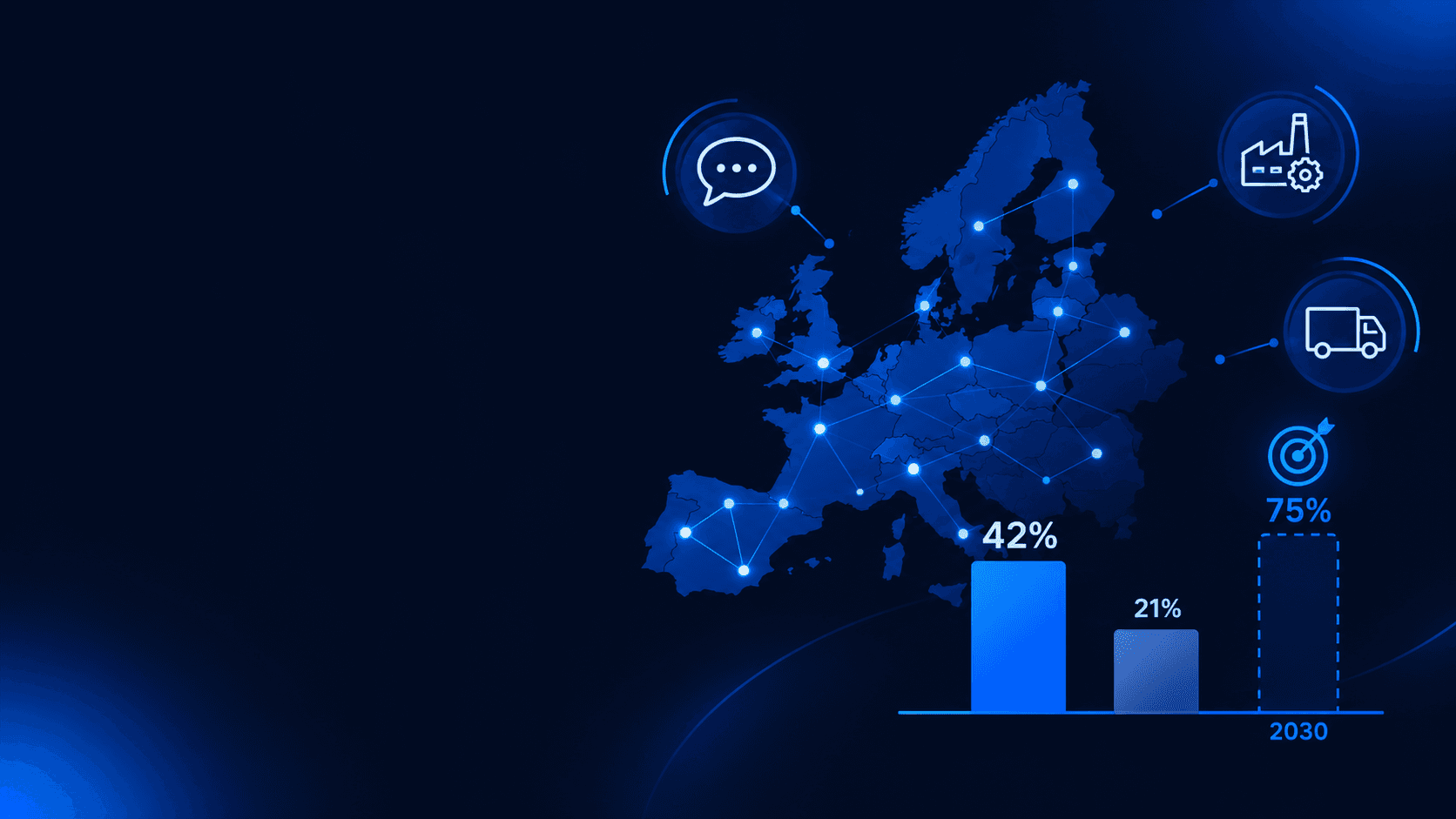
- 42% of European SMEs and mid-caps already use AI and automated systems, mostly in a limited, experimental way.
- Another 21% plan to adopt them in the future. In total, 63% of Europe's business fabric is moving in the same direction.
- Among companies already using AI, 61% say it helps them make better decisions.
If your company hasn't made the move yet, this article breaks the data down: what the SMEs ahead of the curve actually do, why half of them distrust AI for people management, which three barriers hold the rest back, and a 90-day plan to move from experimentation to profit.
1. The three uses where AI already pays off in European SMEs
The survey asks about concrete areas of application. The result revolves around phones, spreadsheets, and shift schedules.
Customer service and client relations (47%)
The dominant use case by a wide margin. In practice, for an SME: assistants that answer emails and WhatsApp messages outside business hours, chatbots that qualify an inquiry before passing it to a sales rep, and quote and proposal generators that cut response time from hours to minutes.
The reason for its popularity is economic and measurable: every inquiry answered the same day instead of three days later multiplies the odds of closing, and AI delivers that without hiring on-call staff. For a 10-person company, a customer service assistant works like an employee who covers nights, weekends, and peak seasons for a fraction of a salary.
Performance and productivity monitoring (36%)
The second area is internal: systems that cross-reference sales, production, or task data and show where time is being lost. Typical examples in a small industrial or service company:
- Spotting which stage of the process concentrates the delays (quotes that take too long to go out, parts waiting on the shop floor, tickets nobody closes).
- Alerting when a metric drifts: margin below target, backlog above threshold, overtime spiking.
- Generating the weekly reports that used to be assembled by hand in a spreadsheet.
Logistics, planning, and staff scheduling (30%)
The third area hits operating cost directly: delivery route optimization, demand forecasting to adjust purchasing, and shift assignment based on real workload. In companies with a fleet or shift-based staffing, this use typically pays back within months because it removes empty kilometers and overtime hours.
All three uses share the same pattern: AI enters where there is a repetitive, measurable process with direct cost, and it never replaces the person responsible for the decision.
2. The uncomfortable finding: 49% distrust AI for decisions about people
Nearly half of European companies (49%) say they do not trust artificial intelligence or automated systems to make decisions related to staff. The human-control figures confirm it:
- 90% of companies state that people make the final decisions.
- Only 2% of decisions are fully automated.
- At the same time, 75% believe AI and algorithmic management will improve job quality.
European business owners trust AI to answer customers and plan shifts, and distrust it when the decision touches a contract, a dismissal, or a promotion. That distrust is reasonable, and it matches the European legal framework (the AI Act already classifies AI used for worker selection and evaluation as high risk).
For your company, the practical consequence is clear: start with the processes where trust is not the blocker (customer service, documentation, logistics) and keep people signing off on decisions about people, with AI as an information support. That is exactly what the 90% of European companies already using AI do.
3. The three barriers cited by those left out
The Eurobarometer also asks companies why they are not adopting (or not adopting more) AI. The three most cited answers, in order:
| Reported barrier | % of companies | How to address it in practice |
|---|---|---|
| High investment cost | 50% | Start with a pilot of measurable ROI on usage-based software (monthly SaaS), not a six-figure custom project. The three dominant use cases of the 42% run on tools that cost tens of euros per month. |
| Legal uncertainty | 49% | The framework already exists: the AI Act, the GDPR. Most common SME use cases (marketing, customer service, documentation) carry reduced requirements. Regulatory focus concentrates on AI making decisions about people, where 90% of companies already keep a human in charge. |
| Lack of expertise | 48% | You don't need a data team: you need a well-defined process and a provider who understands it. The usual SME setup is basic internal team training plus a technology partner for deployment. |
All three barriers are execution problems: cost is managed with pilots, legality is handled by the existing framework, and expertise is bought or trained. None of them justifies waiting another year.
4. Where does your company stand against the European average?
The survey adds one detail that defines the real competitive map: most of the 42% that already use AI do so "in a limited, experimental way."
- The 37% that use nothing: still citing the three barriers from the previous section.
- Most of the 42%: running pilot tests (a chatbot, a loose automation) with no measurable impact on the bottom line.
- A minority of the 42%: has turned two or three processes into AI-powered workflows, measures the savings, and scales.
What separates the second group from the third is the existence of a defined process, an internal owner, and a metric; the AI model each one uses has little to do with it. If your company tried a tool, it "went well," and nobody measured it again, you are in the second group, like the majority.
5. The 90-day plan: from experimentation to profit
With the map of uses and barriers the Eurobarometer draws, here is the roadmap we recommend for an SME with 10 to 50 employees:
Days 1–30: diagnosis and process selection
- Inventory of repetitive processes with measurable cost: customer service hours, templated emails, quotes, routes, shifts.
- Selection of a single starting process, following the pattern of the European 47%: customer service or documentation.
- Definition of the metric before buying anything: hours recovered per week, response time, cost per order.
Days 31–60: pilot with an owner and a metric
- Deployment on the chosen process using usage-based software.
- One internal owner by name, with 2–3 dedicated hours per week.
- Weekly comparison of the metric against the baseline from before the pilot.
Days 61–90: scale decision backed by numbers
- If the pilot returns measurable hours or margin, extend to the second process (usually performance monitoring, the European 36% use case).
- Documentation of the final workflow so the knowledge doesn't depend on one person.
- Basic compliance review: what data the tool processes, legal basis, retention.
The goal at 90 days is to have one process with proven return and a second one underway, which is what separates the productive minority of the 42% from the experimental majority.
6. The European framework: what's coming for algorithmic people management
The publication coincides with the European AI Innovation Month, and the Commission announces two regulatory pieces that directly affect algorithmic management:
- The AI Act and the GDPR: already in force. They set safety, fundamental rights, and transparency requirements, with risk-based classification.
- The Quality Jobs Act (in preparation): will increase clarity for companies and better protect workers' rights in relation to algorithmic management (tasks, schedules, performance, staffing).
The official EU target framing all of this comes from the Digital Decade: at least 75% of EU businesses using AI, cloud, or big data by 2030. With today's 42%, the gap is 33 points, and public funding and support programs will aim to close it. For SMEs, grants and support schemes are already available, so the window to secure public funding for a well-designed project is open.
Conclusion: only 2% of decisions end up in the hands of an algorithm
The survey's three figures leave a clear lesson for SMEs: 42% of companies already use AI daily, but only 2% of decisions are fully automated. European companies are using AI to answer faster, plan better, and decide with data, with people signing off on the decisions.
That is the model to copy, and the three barriers the rest cite (cost, legality, expertise) are solved with measurable-ROI pilots, the current regulatory framework, and a provider who knows your sector. The 21% planning to adopt AI in the coming years will compete with the 42% already using it: the difference in response times and margins compounds every month.
Book your free AI audit here and we will show you, with your company's data on the table, which process gives you the fastest return and how to close the gap with the European average.
Frequently asked questions
What exactly is the "algorithmic management" the Eurobarometer measures?
It covers digital systems that help organize the workforce or support decisions about tasks, schedules, performance, or staffing. They may use AI or not. The key finding: in 90% of companies, a person makes the final call, and only 2% of decisions are fully automated.
Which companies were surveyed, exactly?
The Flash Eurobarometer ran between March and April 2026 in all 27 EU countries, with 12,826 phone interviews with decision-makers at private SMEs and mid-caps of 1 to 749 employees. 500 interviews took place in larger EU countries and 250 in smaller ones.
Is it too late to start if my company is in the 37% that uses no AI?
No. The 42% adoption figure is mostly experimental, according to the survey itself, and the barriers the rest cite (cost, legal uncertainty, lack of expertise) are solved with small, measurable pilots. Starting today with customer service or documentation puts you within a few months in the group that measures results.
Which AI use cases carry the least legal risk for an SME?
Use cases aimed at customers and internal documentation (customer service, content generation, email triage, logistics planning) carry reduced requirements under the AI Act. Regulatory focus concentrates on AI applied to decisions about people: hiring, evaluation, and dismissals, where 49% of European companies already report distrust and 90% keep the final decision with humans.
What is the EU target for 2030?
At least 75% of European businesses using AI, cloud, or big data, per the Digital Decade targets. With today's 42% of SMEs and mid-caps using AI and algorithmic management, plus another 21% planning to, the EU is directing funding and support programs toward closing that gap.