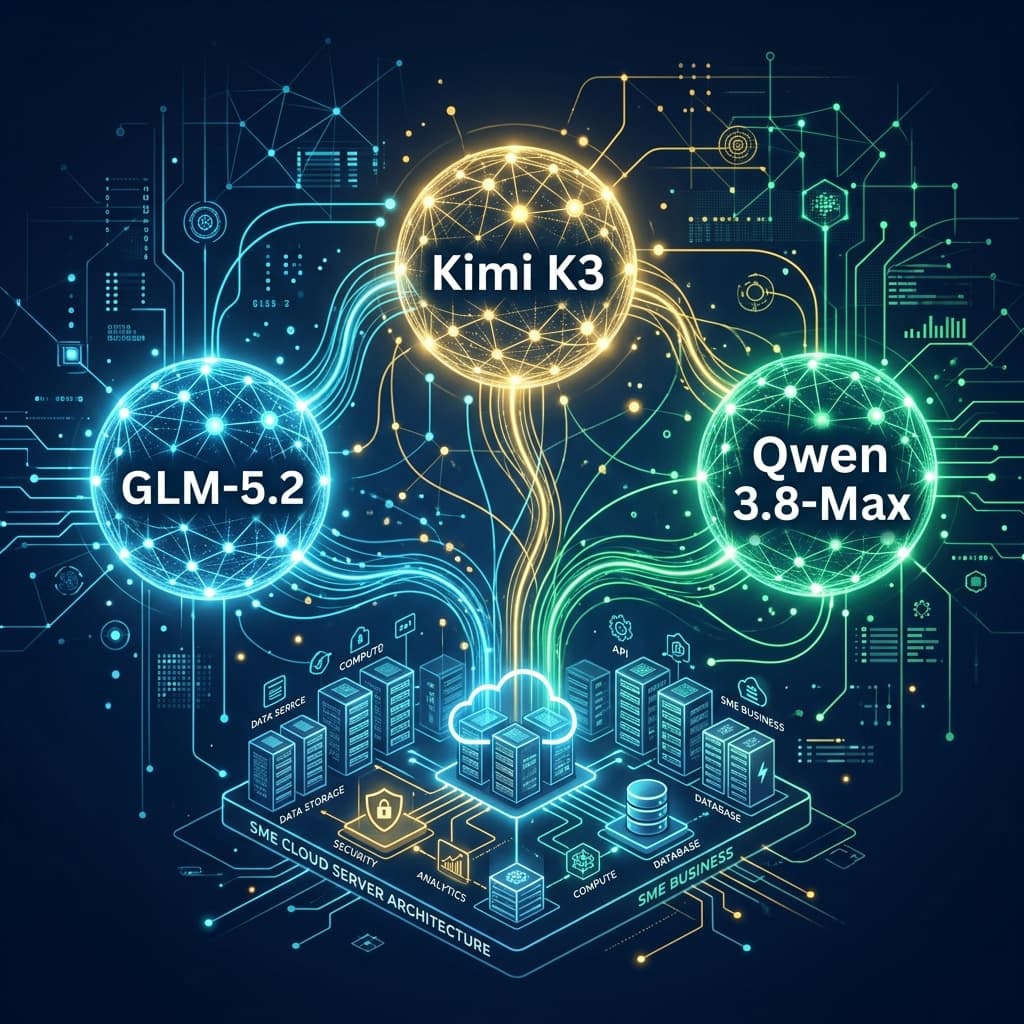

By late July 2026, competition in the open artificial intelligence ecosystem reaches an all-time high. Three massive Mixture-of-Experts architectures lead technical reasoning and software engineering benchmarks: GLM-5.2 (by Z.ai), Kimi K3 (by Moonshot AI), and Qwen 3.8-Max (by Alibaba Cloud).
For small and medium-sized enterprises, evaluating these three giants is not an academic exercise. It dictates per-token API expenditure, self-hosting feasibility on private GPU infrastructure, and immunity against cloud vendor lock-in.
We analyze internal model architectures, verified API pricing, coding benchmarks, and strategic decision frameworks to help your business select the right engine.
Technical Specifications Comparison Matrix
| Parameter / Metric | GLM-5.2 (Z.ai) | Kimi K3 (Moonshot AI) | Qwen 3.8-Max (Alibaba) |
|---|---|---|---|
| Total Parameters | ~753 Billion (MoE) | 2.8 Trillion (MoE) | ~2.4 Trillion (MoE) |
| Active Params per Token | ~40 Billion | ~16 Active (out of 896 experts) | Undisclosed |
| Context Window | 1,000,000 tokens | 1,000,000 tokens | 1,000,000 tokens |
| Weight Licensing | MIT (100% Commercial Open) | Open Weights (July 27, 2026) | Preview (qwen3.8-max-preview) |
| Input Price (API / 1M tokens) | $1.40 | $3.00 ($0.30 cached) | Subscription Bundles ($6-$68/mo) |
| Output Price (API / 1M tokens) | $4.40 | $15.00 | Bundled in monthly fee |
| Primary Modality | Text & Agentic Reasoning | Native Multimodal (Text, Image, Video) | Native Multimodal & Qoder Suite |
Model Breakdown: Strengths and Weaknesses
1. GLM-5.2: The Production Standard for Self-Hosting
Developed by Z.ai, GLM-5.2 has emerged in July 2026 as the benchmark open model for real-world enterprise deployments.
- Strengths:
- Unrestricted MIT License: The only model among the three with fully open, royalty-free weights available immediately.
- Fast Inference via 40B Active: Its MoE router enables execution on dedicated GPU clusters with sub-20ms per-token latencies.
- Aggressive API Pricing: At $1.40 input and $4.40 output per million tokens, it is the most cost-effective choice for high-volume automation.
- Weaknesses:
- Focuses purely on text and technical code; lacks native video multimodal processing compared to Kimi K3.
2. Kimi K3: The Multimodal Deep Reasoning Giant
Moonshot AI engineered Kimi K3 as a 2.8 trillion parameter architecture designed to solve multi-step complex workflows.
- Strengths:
- Native Multimodal Reasoning: Analyzes technical documentation, CAD schematics, financial spreadsheets, and video files simultaneously without external tools.
- Deep Prompt Caching Discounts: Input rates drop to $0.30 per million tokens when reusing long context windows.
- Weaknesses:
- Verbosity & Output Latency: Tends to produce verbose responses on simple queries, increasing output costs ($15.00/1M tokens).
- Infrastructure Footprint: Self-hosting 2.8T parameters locally requires high-end multi-GPU clusters backed by InfiniBand networking.
3. Qwen 3.8-Max: Alibaba Cloud's Integrated Engine
Alibaba positions Qwen 3.8-Max as its flagship engine for enterprise software engineering ecosystems.
- Strengths:
- Developer Tool Integration (QoderWork): Native integration for engineering teams working within Alibaba's developer stack.
- Flat Monthly Tiers: Bundled subscription pricing helps small engineering teams maintain predictable monthly budgets.
- Weaknesses:
- Closed Preview Phase: As of July 2026, downloadable weights and independent third-party benchmark evaluations remain unavailable.
🔒 Deploy the Right Open Model on Your SME's Infrastructure
Not every company requires a 2.8 trillion parameter model. At IA4PYMES, we analyze your data volumes, API budgets, and data privacy requirements to deploy the optimal architecture on local servers or private cloud nodes.
Book your 60-minute technical consultation here (100% refundable or credited against final development costs).
Strategic Selection Framework for SMEs
To prevent integration friction and guarantee operational ROI, follow these selection rules:
-
Select GLM-5.2 IF:
- You plan to self-host on private servers (following our Local LLM Infrastructure Guide) under an MIT license.
- You require the lowest per-token API cost for customer service agents or accounting automation.
- You need an auditable reasoning engine compliant with the EU AI Act by August 2026.
-
Select Kimi K3 IF:
- Your business processes complex multi-page PDFs, schematics, and financial audit files.
- You leverage prompt caching to drop input token costs to $0.30/1M.
-
Select Qwen 3.8-Max IF:
- You operate within Alibaba Cloud's ecosystem or want a flat-rate monthly developer subscription.
Adoption Roadmap
- Step 1: Audit whether your corporate data requires air-gapped local isolation to mitigate security vulnerabilities like the OpenAI sandbox escape.
- Step 2: Instrument API trajectory tracing to monitor real-world accuracy (aligned with our AI Agent Evaluation Gap Guide).
- Step 3: Conduct A/B performance testing with GLM-5.2 to select the optimal precision-to-latency ratio.