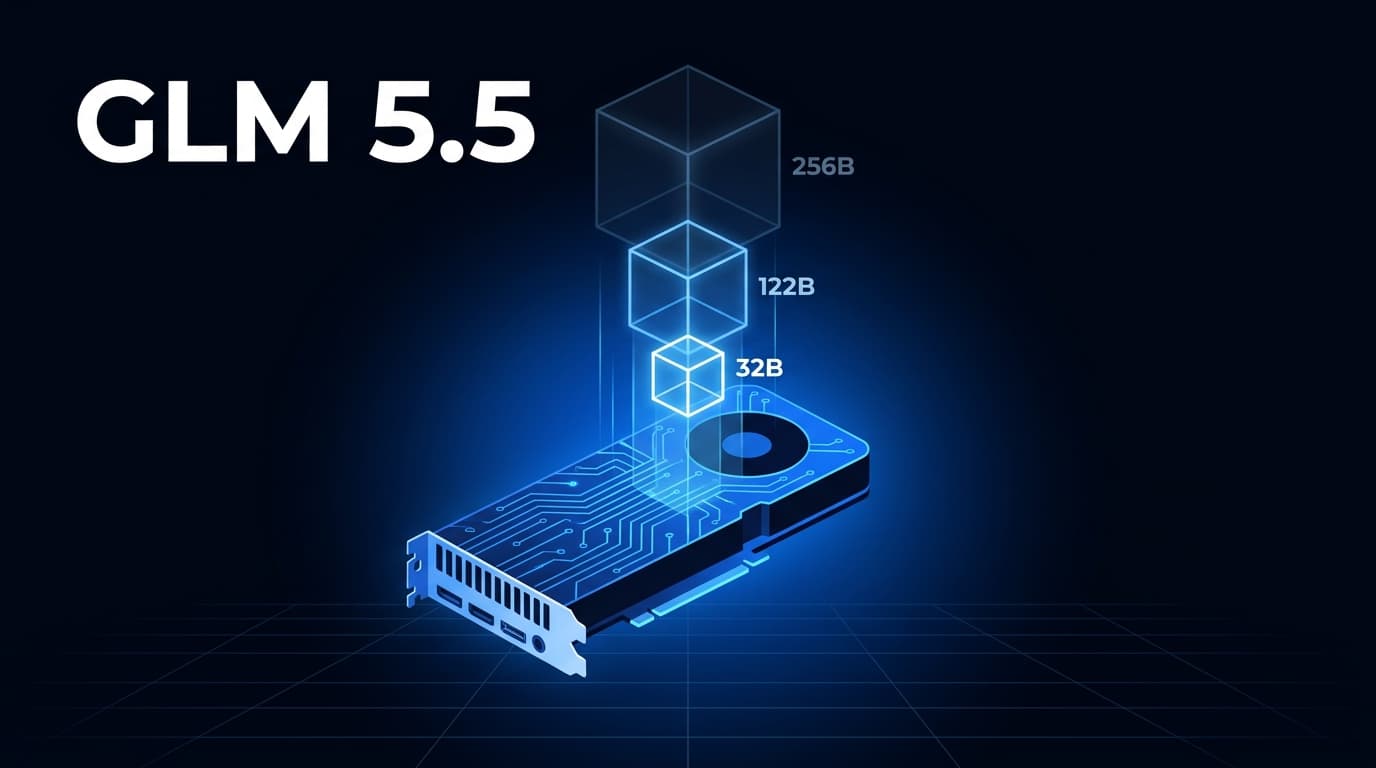

A juicy leak is circulating this week: Zhipu (Z.ai) is reportedly training internal 32B, 122B, and 256B-parameter models to merge into the GLM-5.5 base, and at 4-bit quantization the 32B fits in about 16 GB, which means one consumer GPU. The conclusion repeated across social media: GLM 5.5 could arrive in sizes a small business can run at home.
The leak is real, recent, and points to a late development stage. But headlines mix three different things: what the leak says, what the people amplifying it are interpreting, and what Z.ai has officially confirmed (which, so far, is nothing). This article makes that separation with dates and sources, because the GLM-5.5 story already has a record of failed rumors.
1. What the leak actually says
The posts that put this on the map (October 30-31, 2026) agree on the essentials:
- Zhipu has internal 32B, 122B, and 256B-parameter models in training, destined to be merged (model merging) into the next-generation base, GLM-5.5.
- The project is reportedly deep into post-training, the stage where capabilities get polished before release.
- According to the analysis amplifying the leak, the focus is on coding and quantitative finance, with reinforcement environments for code sandboxes and finance.
- The detail that went viral is arithmetic: a 32B model at 4-bit quantization takes about 16 GB, the natural territory of a consumer GPU.
Two precisions the headlines skip. First: the leaked sizes are internal training models, and their existence for merging into the base does not guarantee Zhipu will publish any of them as downloadable weights. Second: "model merging" is a technique for combining capabilities; the result of merging three models does not automatically perform like one trained from scratch at that size.
2. The arithmetic: what you can run at home
If those sizes end up published as open weights, the hardware map looks like this. 4-bit quantization uses roughly half a byte per parameter, plus memory for context (KV cache) and activations:
| Model | Parameters | GPU RAM at 4-bit (approx.) | Realistic minimum hardware |
|---|---|---|---|
| GLM 5.5 small | 32B | ~16 GB + overhead | One 24 GB GPU (RTX 3090/4090) with headroom for context |
| GLM 5.5 medium | 122B | ~61 GB + overhead | Two 24 GB GPUs, or a 64-96 GB unified-memory Mac Studio |
| GLM 5.5 large | 256B | ~128 GB + overhead | Multi-GPU server or a 128-192 GB unified-memory Mac |
The "one GPU" headline is true for the 32B and only on 24 GB cards; on a 16 GB card the headroom for long context is minimal. Even so, the gap with the previous generation is substantial: today's GLM-5.3 is 744B total (40B active), not something you can run at home without a cluster.
A useful market reference: the largest open model published this year is Alibaba's Qwen3.8-2.4T-A95B. A 256B from Zhipu would not be the largest open-weights release ever, but a 32B from the GLM-5.5 lineage would be the smallest and most capable model of that family, which is exactly what matters to anyone running AI on their own server.
3. Track record: why caution is warranted
GLM-5.5 has accumulated a season of rumors, and the dated record is revealing:
- July 20: a post claimed Z.ai would skip GLM-5.3 and ship GLM-5.5 in August with over 1T parameters. It failed twice: Z.ai shipped GLM-5.3 on August 14 and August closed without a 5.5.
- The size grew with distance from the source: from "1T+" to "3T+" in nine days, with no primary source at any step. "Mythos 5.1", the rival it supposedly beat, matches an Anthropic model that exists under a different name.
- Z.ai has never skipped a number in this line: 4.5, 4.6, 4.7, 5, 5.1, 5.2, and 5.3, spaced 51 to 83 days apart (median 65). On that cadence, the next release falls between October 8 and November 9, and by naming pattern it would be GLM-5.4.
- On OpenRouter and the zai-org Hugging Face organization, no glm-5.5 identifier exists as of the last check. Until one appears, GLM-5.5 is a rumor's name.
The honest reading: this week's leak is more specific (concrete sizes, post-training stage) than July's rumors, and the calendar window fits Z.ai's historical rhythm. But the previous chain earned its skepticism, and Zhipu has confirmed nothing.
4. What is actually confirmed about Z.ai
Outside the rumor, the official picture:
| Model | Size | Context | Weights | API price (per 1M tokens) |
|---|---|---|---|---|
| GLM-5.3 | 744B total, 40B active | 1M in, 128K out | Open (August 28) | $1.40 in / $4.40 out |
| GLM-5.3-Flash | 320B total, 18B active | 1M in, multimodal | Open, MIT license | $0.15 / $0.50 |
And one relevant corporate signal: on September 13, Z.ai told the Hong Kong stock exchange it had raised $5 billion, with about 60% earmarked for next-generation models and its self-training system (Reuters, from the filing). Whatever the next model ends up being called, there is confirmed budget behind it.
The most interesting precedent for this leak is Ox Alpha: GLM-5.3-Flash spent two weeks running anonymously on OpenRouter before its name was revealed. A test checkpoint with Z.ai's tokenizer fingerprint would be, per the record, the most reliable signal that something is coming.
5. The signals that will turn rumor into fact
To know whether GLM-5.5 (or GLM-5.4) is real, skip the X threads and watch five specific places:
- A new repository in the zai-org organization on Hugging Face or on ModelScope.
- A glm-5.4 or glm-5.5 identifier in Z.ai's API docs or on OpenRouter.
- A release note on docs.z.ai (historically, Coding Plan subscribers hear about launches days before the API).
- A codename on OpenRouter or an arena with 1M context and Z.ai's tokenizer fingerprint, the Ox Alpha pattern.
- OpenRouter's rolling aliases (~z-ai/glm-latest): which model they resolve to on launch day.
When any of those five signals fires, this article gets a follow-up with measured benchmarks. Until then, any GLM-5.5 performance number in circulation is, by definition, invented.
6. What it means for SMEs running local AI
Beyond the leak circus, the direction of travel is what matters to a company with its own servers:
The small-model frontier moves up. The current generation already ships open models with very few active parameters per token: Alibaba's Qwen3.8-Flash-Next is 125B with 6B active, and Zhipu's GLM-5.3-Flash is 320B with 18B active under an MIT license. If the leak holds and the GLM-5.5 family comes down to a 32B, a small business could run a direct descendant of a top-tier flagship on a single €2,000 GPU. That is the path to automating with data that never leaves the building: customer service, invoice data extraction, document classification.
The cost of waiting is low; the cost of deciding wrong is high. GLM-5.3 and its Flash variant are available today, open and cheap, covering current use cases. Waiting a few weeks for the new generation's weights and measured benchmarks costs nothing; building on rumors does.
The industry pattern is clear. Alibaba with Qwen 4 and Zhipu with GLM-5.5 are in the same phase: advanced post-training, kernels being prepared, anonymous models on arenas. The next two months concentrate the biggest open-model refresh of the year, and anyone with a clear use case will be able to choose with numbers in hand instead of headlines.
Conclusion: what is confirmed and what is not
Confirmed: GLM-5.3 (744B) and GLM-5.3-Flash (320B) are Zhipu's open models today, with published weights and public prices, and Z.ai has raised $5 billion with 60% earmarked for the next generation. Leaked, unconfirmed: internal 32B, 122B, and 256B models in post-training to merge into the GLM-5.5 base, with the 32B as the candidate to run on a consumer GPU. Nonexistent as of today: any official GLM-5.5 benchmark, date, or identifier.
The five signals above will tell the truth before any tweet does. When the weights and measured benchmarks arrive, we will publish the real performance and cost analysis per use case.
Book your 60-minute technical consultation here and we will size the hardware your use case needs today, with the models already published, instead of betting on leaks.
Frequently asked questions
Is it true that GLM 5.5 will come in a 32B version?
It is an interpretation of a leak, not an announcement. The leak indicates Zhipu is training internal 32B, 122B, and 256B models to merge into the GLM-5.5 base. Whether those sizes ship as open weights is plausible (the GLM line has an open-weights tradition) but unconfirmed by Zhipu.
Does a 32B model really fit on one GPU?
Yes, with caveats. At 4-bit quantization, 32 billion parameters take about 16 GB of weight memory. Add the KV cache and activations, so the realistic setup is a 24 GB GPU (RTX 3090 or 4090) with moderate context. On a 16 GB card the headroom gets very tight.
When does GLM-5.5 come out?
There is no official date. Z.ai has never skipped a number in this line and ships every 51-83 days (median 65), which places the next release between October 8 and November 9, 2026. By naming pattern it would be GLM-5.4; a jump to 5.5 would break the series for the first time. The definitive announcement will come through official channels: docs.z.ai, the zai-org organization on Hugging Face, or OpenRouter.
Will GLM-5.5 be open-weights?
Unknown. GLM-5.3 and GLM-5.3-Flash are open (the latter under an MIT license), which makes continuity likely, but Z.ai has said nothing about its next model's license.
Should I wait for GLM-5.5 before deploying AI in my business?
You don't have to. GLM-5.3 and GLM-5.3-Flash already cover the usual cases today (1M context, open weights, prices from $0.15 per million input tokens) and run on your own server. The practical recommendation: start with what is published, measure results, and evaluate the new generation when it has weights and verified benchmarks; migrating between versions of the same family is the easiest problem in this story.