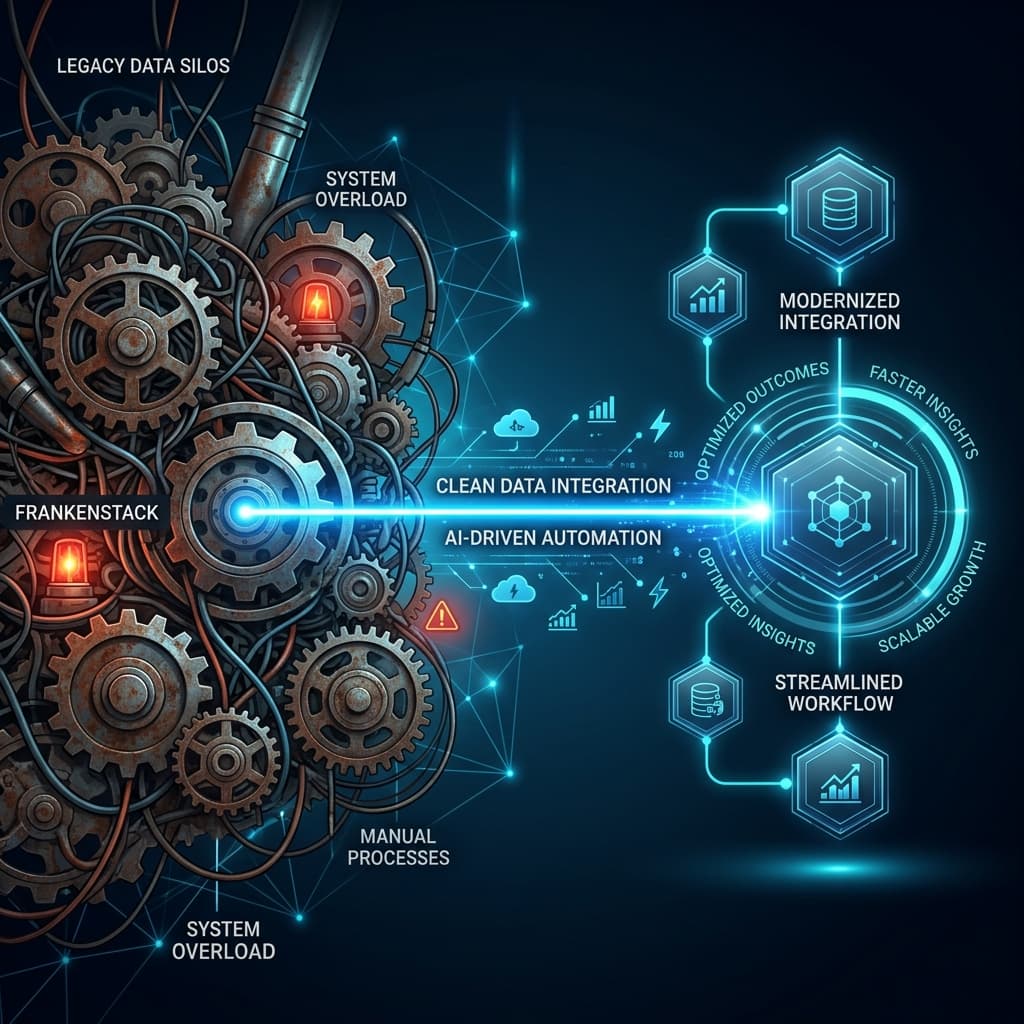

The deployment of artificial intelligence in corporate environments has officially entered its maturity phase. Following a period of massive experimentation dominated by technical demos and simple pilots, businesses today face the harsh reality of production deployments. In this landscape, an invisible yet financially devastating barrier has emerged for small and medium-sized enterprises: the "Integration Tax".
This concept, recently analyzed by analysts and business publications such as Forbes, defines the hidden costs — in engineering hours, custom middleware development, and accumulated technical debt — that organizations incur when attempting to connect AI tools to their existing systems of record (such as CRMs, ERPs, databases, or document managers).
For an SME, understanding the nature of this "tax," calculating its impact, and implementing architectures that neutralize it is the difference between achieving a real return on investment (ROI) or drowning the technology budget in constant maintenance.
1. The Reality of the "Data Plumber" (20% Intelligence, 80% Plumbing)
One of the most common mistakes when budgeting an AI project is assuming that the primary cost lies in model consumption (the price per token of APIs like OpenAI, Anthropic, or dedicated hosting clouds). The operational reality is radically different:
A successful AI project is approximately 20% intelligence (the model) and 80% data engineering (the integration).
The true complexity is not asking a large language model a question, but ensuring that the model's response is accurate, secure, and useful for the business. This requires connecting the model to internal systems:
- Extracting customer records from a CRM like Salesforce or Zoho.
- Querying real-time inventory in an ERP like Holded or SAP.
- Validating current tax rules before generating an invoice.
When development teams approach these connections in an ad-hoc manner — creating bespoke, fragmented connectors for every small task — they build what is known in the industry as a "Frankenstack": an unstable web of software patches that generates a permanent dependence on technical maintenance.
2. Symptoms That Your Business Is Paying the "Integration Tax"
If you have launched AI projects in your business and detect any of the following scenarios, you are paying a hidden premium on your technology budget:
Latency and Outdated Decisions
Your AI assistants take several seconds to respond or consult data that is hours out of date because the connection to your systems is not synchronous, forcing you to sync data periodically.
Fragility to API Changes
Every time your invoicing software or CRM updates its conditions or changes its field structure, your AI-driven automation workflows stop working, requiring emergency patches from your developers.
Multiplying Middleware and Hidden Costs
To prevent the AI from giving incorrect answers (hallucinations), you are forced to deploy additional validation layers, vector databases, and custom code patches that drive up monthly infrastructure costs until they become unsustainable.
🔒 Looking to deploy AI in your SME without paying the costly "Integration Tax"?
Real AI profitability doesn't depend on the model you choose, but on the architecture that connects your systems. At IA4PYMES, we design clean, unified data infrastructures, eliminating patches and guaranteeing a +360% ROI.
Book your 60-minute technical consultation here (100% refundable if we don't validate project feasibility in the first 15 minutes, or fully credited against final development costs on hire).
3. Roadmap to Neutralize the Integration Tax
To build a scalable AI architecture that minimizes maintenance costs and maximizes ROI, companies must adopt three strategic pillars:
1. Migrate Toward Unified Data Architectures
Instead of dispersing your company's information across multiple external databases that the AI must query via bespoke APIs, consolidate your critical business data into a unified, AI-friendly data engine (such as modern relational databases with native vector support). Fewer data hops translate to lower latency and reduced development costs.
2. Adopt Open Standards (Model Context Protocol)
The tech sector is pivoting toward standardizing AI connections. Open protocols like the Model Context Protocol (MCP) allow any AI model to connect to any data source (SQL databases, Markdown files, Git repositories) via a standardized, secure interface. Using open standards eliminates the need to write custom code for every new connection.
3. Reduce Point Solutions and Consolidate the Stack
Avoid hiring dozens of independent SaaS AI tools for hyper-specific tasks. Prioritize the development of consolidated platforms that centralize the logic of your AI agents, allowing you to reuse the same data connections across multiple departments (sales, support, finance).
Conclusion
Enterprise AI has evolved from a technical novelty into a matter of financial efficiency. SMEs cannot afford to fund an unstable "Frankenstack" that requires constant attention. By approaching AI development through clean data architecture and standardized integrations, companies can bypass the "Integration Tax," ensuring a robust, sovereign, and truly profitable technology infrastructure over the long term.