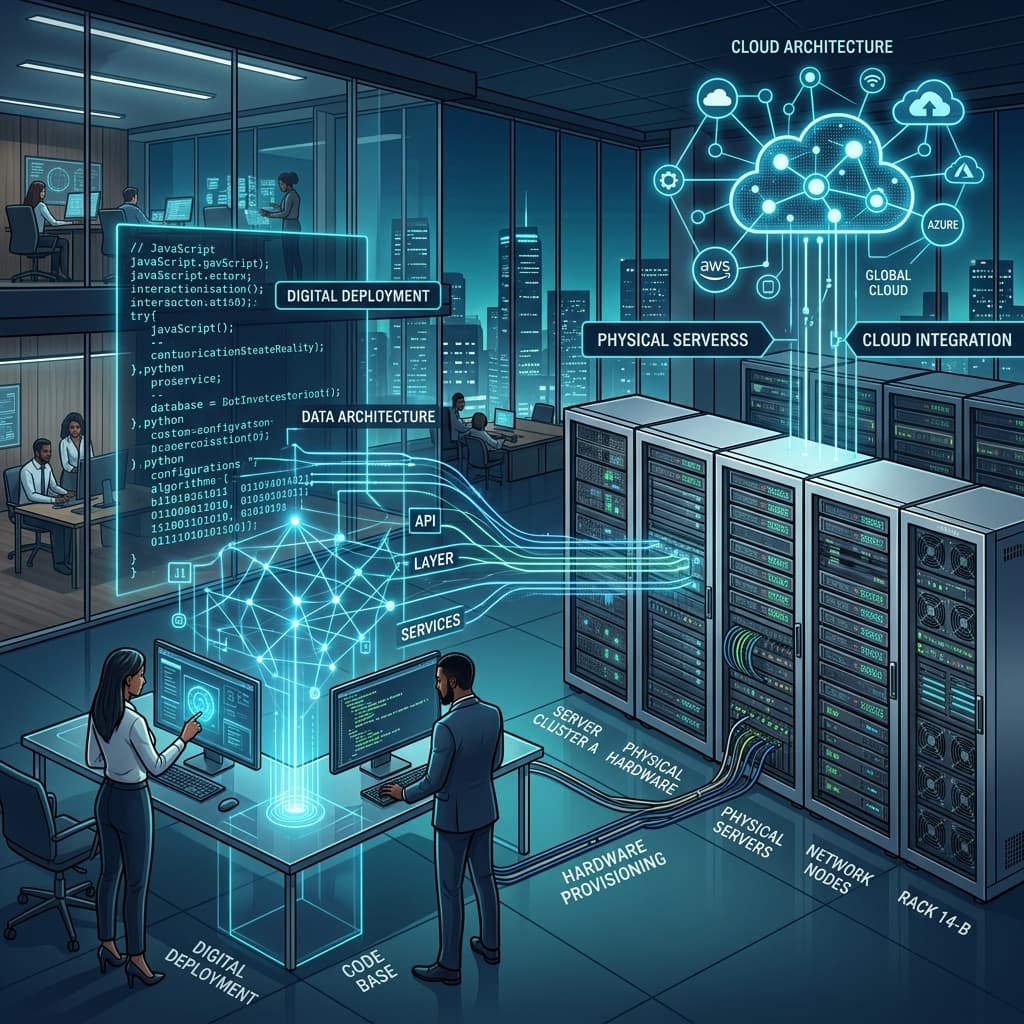

The launch of Microsoft Frontier Company, a new enterprise division backed by $2.5 billion and 6,000 engineering and industry experts, marks the end of an era. The phase of "playing" with artificial intelligence, running quick pilots with ChatGPT, and marveling at basic chatbot demos is officially over.
Microsoft has recognized that the industry's major bottleneck is not the lack of powerful foundation models, but rather the immense complexity of moving these models into real production environments. Automating critical business workflows (such as billing, inventory management, technical support, and risk analysis) requires rigorous systems engineering, not just a Copilot subscription.
We analyze the paradigm shift represented by this move, the technical factors causing AI projects to fail in the experimental phase, and how SMEs can deploy advanced solutions without the astronomical budgets of global corporations.
1. The AI Project "Valley of Death"
Until now, most companies have approached AI through Proof of Concept (PoC) models—simple implementations that perform well in controlled lab environments. However, industry estimates indicate that over 80% of these projects never reach production.
Why does AI fail when leaving the laboratory? Systems engineers face four main operational roadblocks:
API Cost Scaling
A prototype tested by ten employees costs only a few dollars in API usage per month. However, when that same agent is deployed to handle thousands of concurrent users in real time or process massive daily transactional batches, black-box cloud API bills (OpenAI, Anthropic) scale exponentially, destroying the estimated return on investment (ROI).
Latency and Real-Time Performance
For critical automations (such as voice-based customer agents or real-time financial transaction verification), a response delay of 5 or 6 seconds is unacceptable. Commercial APIs suffer from performance throttling during peak traffic hours, requiring complex fallback systems and custom cache orchestration.
GDPR Compliance and Data Sovereignty
European companies face strict legal barriers when processing sensitive assets (medical records, financial histories, or customer databases) on cloud servers located outside the EU. Current regulations demand that data flows remain within EU borders, which is difficult to guarantee when relying solely on closed US cloud infrastructures.
🔒 Is your AI project still stuck in the experimental phase?
The launch of Microsoft Frontier Company confirms that useful business AI requires custom integration engineering. At IA4PYMES, we act as your external development team: auditing your workflows, optimizing API costs, and deploying hybrid or on-premise architectures that are 100% GDPR-compliant.
Book your 60-minute technical consultation here (100% refundable if we don't validate project feasibility in the first 15 minutes, or fully credited against final development costs on hire).
2. Microsoft's Strategy: Why Human Engineers and Not Just Software?
By creating Frontier Company, Microsoft has implicitly acknowledged a core reality of the sector: AI is not an out-of-the-box product.
Selling software licenses is no longer enough. The success of AI in real-world business relies on the ability to integrate models with existing data systems (legacy ERPs, decades-old CRMs, and relational databases). This requires engineers who can sit down with clients, understand their specific business rules, clean their data repositories, and build robust agentic pipelines.
3. The SME Roadmap: Production-Grade AI Without a Fortune 500 Budget
Small and medium-sized businesses do not have multi-million dollar budgets to hire Microsoft Frontier Company consulting teams. However, they can implement the same production-grade strategies using cost-efficient architectures:
Adopt Regional and Open-Source Models
Using open-source models like Llama 3 or Qwen 3.6 running on local servers or private clouds allows SMEs to control 100% of their inference costs. Expenses are no longer tied to external API call volumes, but to the amortization of their own computing hardware.
Implement Semantic Cache (Prompt Caching)
Caching repetitive context blocks (such as technical manuals or client database structures) reduces processing costs by up to 90% and cuts latency to under a second on repetitive tasks, enabling near-instantaneous support response times.
Design Pipelines with Intermediate Validators (Safety Classifiers)
In a production environment, AI agents cannot be allowed to hallucinate or deliver incorrect data to a client. It is critical to implement automated validation layers (guardrails) that verify the logical consistency of responses before they leave your servers.
Conclusion
Microsoft's launch of Frontier Company marks the maturity of the artificial intelligence industry. Rapid experimentation has served its educational purpose, but business growth will now depend on the ability to deploy robust, secure, and financially viable production systems. SMEs that begin structuring their data engineering and designing hybrid or local architectures today will be prepared to compete in a market where AI is no longer a toy, but a core operational engine.