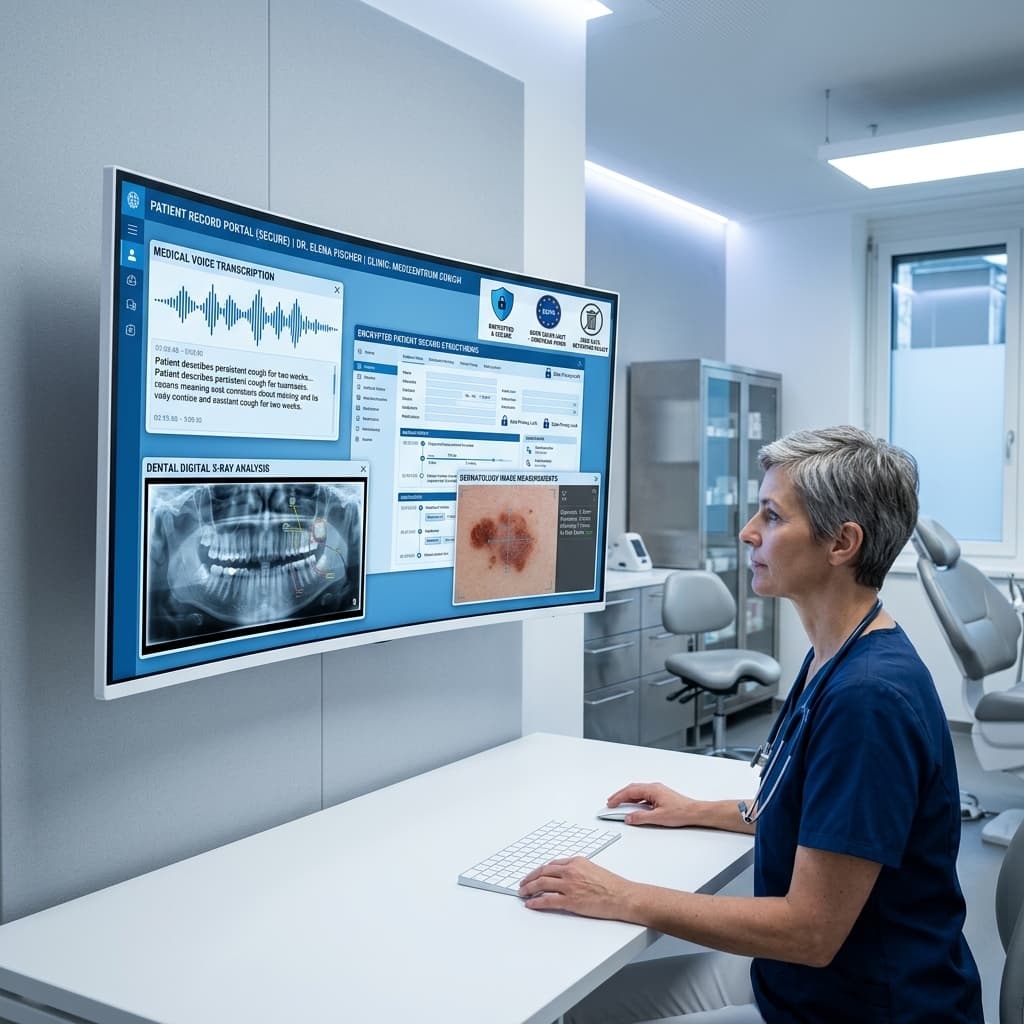

Daily operations in medical practices, dental clinics, and dermatology centers face a persistent operational bottleneck: administrative paperwork accompanying clinical care. Dictating consultation notes, updating Electronic Health Records (EHR), transcribing diagnostic test results, and organizing external documents consume between 30% and 40% of a physician's daily schedule.
Rather than locking clinics into monthly per-seat SaaS subscriptions or installing generic front-desk chatbots, a more efficient technical architecture has emerged: on-demand AI microservices.
These specialized agentic tools trigger exclusively when requested by medical staff to execute specific micro-tasks, processing data in milliseconds and delivering formatted results directly into the clinic's local or cloud EHR system.
1. Why On-Demand Inference Beats Rigid SaaS Subscriptions
Traditional medical software vendor models lock clinics into recurring monthly per-user licensing fees while offering limited integration with existing local databases.
On-demand AI microservices operate via event-driven API endpoints. Clinics pay strictly for processed volume (fractions of a cent per dictation or image analysis), maintaining full architectural control.
Core Operational Benefits:
- Zero User Lock-In or Fixed Monthly Fees: Infrastructure costs scale linearly with actual patient consultation volume.
- Native EHR System Integration: Extracted data injects directly into clinical software (Gesden, DriCloud, Clinic Cloud, Nubimed, Infomed, or custom EHR platforms).
- Complete Data Privacy: Inferences execute on sovereign European servers or private local hardware (On-Premise).
2. Microservice 1: Medical Voice-to-Text Dictation & Anamnesis Structuring
Conventional voice dictation tools require continuous manual editing due to a lack of specialized medical vocabulary and an inability to format raw speech into syntactically structured EHR fields.
By pairing specialized medical-grade speech-to-text models with small language models (SLM), clinicians dictate naturally during patient consultations. The system processes the audio stream and instantly generates a structured HL7 FHIR JSON payload.
{
  "clinical_episode": {
    "date": "2026-08-05",
    "chief_complaint": "Malar erythema with burning sensation following solar exposure.",
    "physical_examination": "Well-demarcated erythematous plaques, no active scaling or secondary infection.",
    "clinical_impression": "Photosensitivity dermatitis.",
    "treatment_plan": {
      "prescription": "Low-potency topical corticosteroids q12h for 5 days.",
      "recommendations": "Strict SPF 50+ photoprotection and avoidance of direct sunlight."
    }
  }
}
Physicians avoid typing while interacting with patients. Upon consultation closure, clinical notes populate the EHR following a quick visual review.
3. Microservice 2: Computer Vision for Clinical Image Analysis
Automated computer vision serves as a clinical decision-support tool, accelerating image review without overriding physician expertise.
Practice-Specific Applications:
- Dermatology: Vision models parse dermoscopy images, computing lesion asymmetry, border irregularity, color variation, and diameter (ABCD metrics). The microservice tracks longitudinal progression by comparing current images with historical visits.
- Dentistry & Maxillofacial: DICOM file ingestion for periapical and panoramic dental X-rays. Computer vision models detect bone resorption patterns, verify aligner fit, and highlight calculus placement for dentist review.
- General Medicine & Diagnostic Imaging: Automated data extraction from scanned paper or PDF lab reports, converting raw laboratory values into longitudinal trend charts in patient records.
4. Microservice 3: Automated EHR Data Entry & Document Parsing
Clinics receive disparate external documentation daily: specialist referrals, blood panels, signed patient consent forms, and insurance claims.
The document parsing microservice ingests incoming files via scanner watch folders or shared directories, semantic-analyzing content to execute three automated actions:
- Patient Matching: Binds incoming files to the correct patient chart using ID number or full name matching.
- Document Tagging: Classifies documents into standardized categories (e.g., Hematology / Lab Results).
- Metric Extraction: Reads out-of-range metrics (such as HbA1c or LDL cholesterol) and flags high-priority alerts directly on the patient's EHR dashboard.
To learn how to integrate these workflows into your enterprise architecture, explore our guide on connecting CRM and ERP systems before deploying AI.
5. Privacy Architecture: Strict Compliance with GDPR & the EU AI Act
Protected Health Information (PHI) constitutes special category data under Article 9 of the EU General Data Protection Regulation (GDPR). Routing patient records through public cloud AI chats or APIs that log data for model training constitutes a severe compliance violation.
Our clinic microservices are engineered under strict Privacy by Design principles:
[ Audio / Image / Document ]
              │
              ▼ (TLS 1.3 Encrypted Pipeline)
┌──────────────────────────────────────────┐
│  Sovereign EU Inference Node (RAM Only)  │  ◄── Header X-Zero-Data-Retention: true
└─────────────┬────────────────────────────┘
              │ (Zero disk persistence / Ephemeral RAM storage)
              ▼
┌──────────────────────────────────────────┐
│  Direct JSON Injection to Clinic EHR     │  ◄── Data persists solely in local EHR
└──────────────────────────────────────────┘
Technical Compliance Guarantees:
- Zero Data Retention (ZDR): Inference calls execute exclusively in server RAM and are wiped immediately after returning JSON payloads. No data is stored on disk or used for model training.
- Sovereign European Hosting: Compute nodes reside in EU datacenters (Germany, France, or Spain) or on private On-Premise GPU servers within the clinic's local network, following our Guide to deploying local LLMs on private SME infrastructure.
- Human-in-the-Loop Governance: In accordance with the EU AI Act, AI microservices act strictly as clinical decision-support tools. Diagnostic and treatment liability remains exclusively with the licensed medical practitioner.
Ready to optimize your medical clinic with sovereign AI microservices?
At IA4PYMES, we design and integrate speech, vision, and document processing pipelines tailored to your clinical software, ensuring 100% GDPR compliance.
6. Step-by-Step Implementation Strategy for Medical Practices
Deploying AI microservices occurs iteratively without disrupting daily patient care:
- Workflow Audit: Pinpoint high-friction administrative tasks (voice notes, lab entry, or image review).
- Inference Environment Selection: Choose between private On-Premise GPU hardware or sovereign EU cloud endpoints certified under European security standards.
- EHR API Integration: Configure API endpoints so structured JSON outputs populate corresponding database tables in your clinical software.
- Sandbox Validation: Run test batches using anonymized records to fine-tune medical vocabulary accuracy prior to production release.