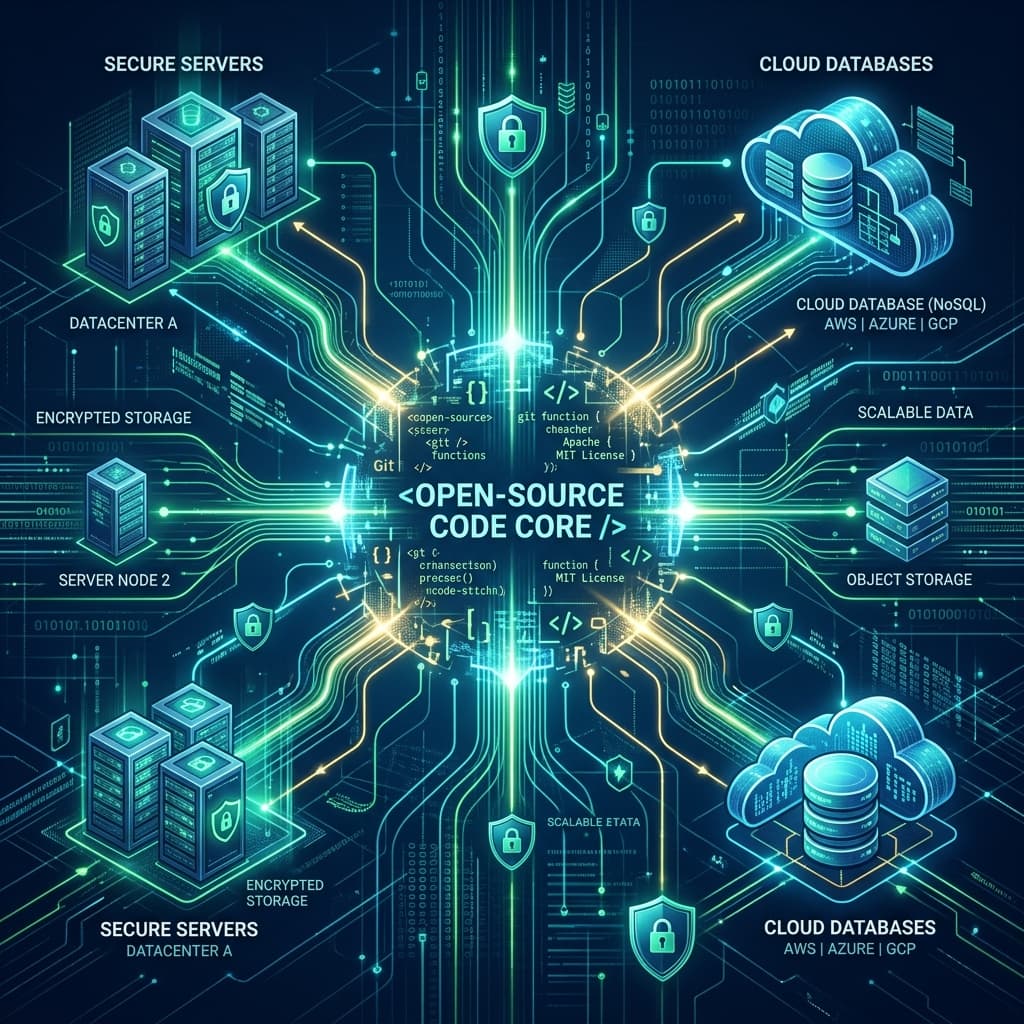

The closing of Together AI’s $800 million Series C funding round, valuing the company at $8.3 billion, represents a major milestone for the consolidation of enterprise artificial intelligence. That this investment was backed by industry giants like Nvidia, Salesforce Ventures, and Aramco Ventures is no coincidence: it is official confirmation that the future of business AI belongs to open-source and open-weight models.
For years, closed-source APIs with pay-per-token pricing (such as OpenAI and Anthropic) have dominated the experimental AI market. However, as enterprises demand better cost control, guaranteed privacy, and custom tailoring capabilities, dedicated computing clouds for open-source models have become the only viable option at scale.
We analyze the details of this funding milestone, the technical factors driving open-source AI adoption in enterprise environments, and how SMEs can leverage this infrastructure.
1. Why Nvidia and Salesforce Are Backing Together AI
Together AI has established itself as the leading cloud infrastructure provider for running, fine-tuning, and training open-weight models (such as Llama 3, Qwen, and Mistral). The investment from Nvidia and Salesforce addresses distinct strategic needs in their respective business models:
Nvidia: Securing the Compute Ecosystem
Nvidia must ensure that its specialized hardware (H100, B200 GPUs) remains accessible to developers and businesses through flexible, specialized clouds, preventing the compute market from being monopolized by the three major public clouds (AWS, Azure, GCP). Backing specialized AI clouds like Together AI ensures a competitive and dynamic market for its silicon.
Salesforce: The Engine for Autonomous Agents
With the rollout of autonomous agents across Slack and its CRM ecosystem, Salesforce requires an inference infrastructure that offers minimal latency and predictable costs. Relying exclusively on closed third-party APIs presents a significant operational risk; running optimized open-source models on Together AI’s cloud allows them to control the entire execution stack.
2. The Three Pillars of Enterprise Open-Source AI
For small and medium-sized enterprises, migrating from closed commercial models to open-source architectures provides three immediate competitive advantages:
Predictable Costs and Scalability
With traditional closed APIs, companies pay per token processed. If your application analyzes massive datasets or handles thousands of customer support queries, monthly costs can become unsustainable and volatile. Hosting open-weight models on Together AI or dedicated private GPU servers allows you to pay for dedicated GPU compute time, keeping costs predictable, stable, and up to 85% cheaper at scale.
Absolute Data Sovereignty and Privacy
Under European GDPR rules, sensitive customer data cannot be used to train public third-party models. Running open-weight models on dedicated Together AI server nodes ensures that your corporate data remains isolated within your private environment, eliminating the risk of data leaks.
Customization Through Fine-Tuning
General-purpose AI models lack knowledge of your company's internal rules, specific product catalogs, or local tax laws. Open-source models allow you to perform fine-tuning using your own historical datasets, creating a highly specialized AI that performs with the same precision as a frontier model but at a fraction of the size and cost.
🔒 Looking to break free from costly foreign API fees?
Together AI's $800M funding round proves that open-source AI is the new standard for businesses seeking real ROI and legal compliance. At IA4PYMES, we help you migrate your workflows to dedicated open-source infrastructures, guaranteeing control over your data and costs.
Book your 60-minute technical consultation here (100% refundable if we don't validate project feasibility in the first 15 minutes, or fully credited against final development costs on hire).
3. Technical Roadmap: Adopting Open-Source AI Today
SMEs looking to build a robust, independent AI infrastructure should follow these steps:
Evaluate Specialized Mid-Sized Models
Mid-sized open-source models (such as Llama 3 8B or Qwen 3.6 14B) now deliver performance levels comparable to closed frontier models from a year ago for text processing, data extraction, and coding tasks, while requiring significantly fewer computing resources.
Utilize Serverless GPU Inference
For early-stage projects with variable traffic, utilize Together AI’s serverless APIs. They allow you to run popular open-source models while paying only for the exact GPU processing time used, avoiding the cost of renting a dedicated server 24/7.
Build on OpenAI-Compatible APIs
The primary advantage of modern open-source platforms is that their APIs are fully compatible with OpenAI’s standard structures. This means you can switch your backend provider from a closed API to a local open-source model by changing just a few lines of code in your connection endpoints.
Conclusion
The $800 million injection into Together AI is clear evidence that open-source has won the enterprise infrastructure battle. SMEs that remain tied to exclusive closed-API contracts will see their operating costs scale without control, limiting their capacity for growth. Adopting open-weight architectures, combined with high-performance dedicated clouds, is the only viable path to building secure, sovereign, and financially sustainable business AI systems.