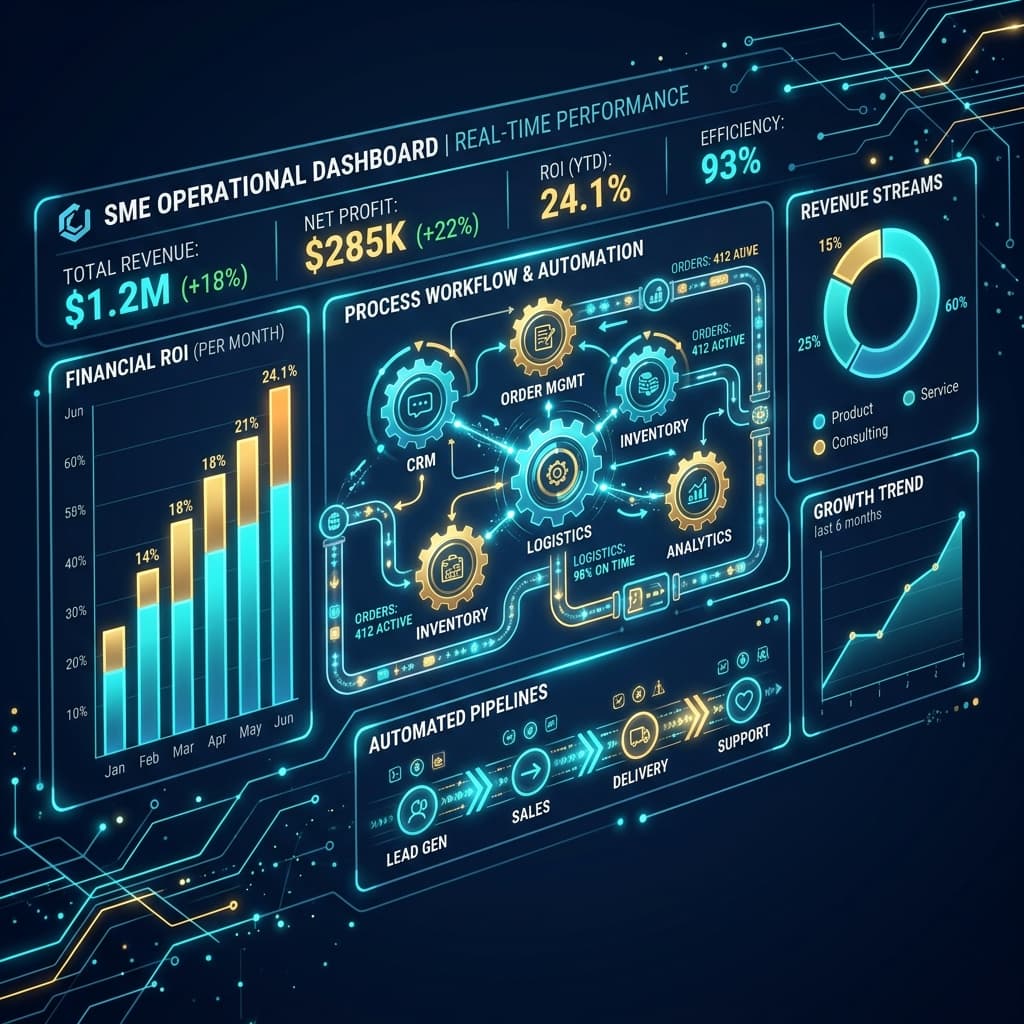

By mid-2026, 41% of small and medium-sized enterprises in Spain use Artificial Intelligence in at least one daily operational process, according to data from IONOS industry surveys and INE statistics. This figure doubles 2025 benchmarks and establishes a clear boundary between businesses expanding their profit margins and those absorbing rising operational overhead.
For an SME owner, AI is no longer an abstract laboratory concept. It is executable software that completes repetitive tasks, reduces human error, and restores capacity to existing staff without inflating headcount.
We analyze real impact metrics, specific operational processes to automate, and the implementation roadmap to deploy solutions without risking business operations or capital.
Real Impact Metrics: Saved Hours and Operating Margin
The main barrier when evaluating AI is uncertainty around technical complexity or unclear financial return. However, empirical studies across European SMEs over the past year show direct metrics:
- Operational time savings: Companies automating administrative tasks (invoicing, payment reconciliation, email management) save an average of 83 hours monthly (over 1,000 hours annually per business).
- Productivity gains: Reports from Cotec and ISEAK place the average productivity increase at 27% for SMEs adopting agentic automation.
- Error reduction: 39.1% of SMEs report a direct drop in transcription errors, accounting mismatches, and order processing mistakes.
- Payback period (ROI): Integrations targeting specific operational bottlenecks recover initial investments within 3 to 6 months.
📊 Operational Impact Pipeline in SMEs:
Repetitive Manual Tasks ➔ AI Agent Integration ➔ 83h/month Saved ➔ 39% Error Reduction ➔ ROI < 6 Months
🔒 Transform Your SME Operations with Custom AI Architecture
Avoid unnecessary SaaS subscriptions and isolated chatbots. At IA4PYMES, we audit your operational workflows and deploy technical integrations with guaranteed ROI metrics.
Book your 60-minute technical consultation here (100% refundable or credited against final project costs).
4 Processes Delivering Immediate SME Profitability
Integrating AI does not require replacing your core software stack overnight. High-performing SMEs start by automating a single, well-defined bottleneck:
1. Quote & Commercial Email Management
Reviewing incoming requests, extracting client requirements, and drafting PDF proposals takes 15 to 30 minutes per quote. An automated pipeline reduces that process to 5 seconds (as detailed in our email quote automation guide).
2. Phone Support & Incident Handling
Missing sales calls after hours or swamping reception with repetitive questions costs revenue. An AI voice agent answers 24/7 at a fraction of traditional call center costs (see our Voice AI vs Call Center ROI Analysis).
3. Invoice & Document Processing
Extracting line items from PDF invoices, verifying tax IDs, and pushing data into accounting software is manual labor. AI parses heterogenous documents with over 98% accuracy and posts structured data straight to your ERP API.
4. Internal Corporate Knowledge Search
Employees spend an average of 4 hours per week searching for SOPs, vendor price lists, old contracts, or internal policies. Indexing documentation into a private knowledge base lets your team query any data in natural language within 2 seconds.
Addressing Common Concerns
"Does my team need coding skills?"
No. Production-grade solutions run as background agents integrated directly into the tools your team already uses (WhatsApp, email, CRM, or accounting software). Staff interact via plain natural language.
"What about data security?"
Businesses should never upload proprietary client databases to public cloud chats. The proper architecture uses private APIs with zero data retention or deploys local models on private servers, following our Local LLM Infrastructure Guide. This also ensures compliance with the EU AI Act by August 2026.
Steps to Start Without Financial Risk
- Audit team hours: Identify which administrative task consumes over 10 hours weekly.
- Calculate hourly cost: Multiply those hours by the loaded salary cost of the employees executing them.
- Deploy a scoped pilot: Implement an automated solution for that single task for 30 days and measure time saved.
- Scale on results: Reinvest generated savings to automate the next operational bottleneck.