
The construction industry faces a historic operational contradiction: while demand for residential, commercial, and civil infrastructure remains strong, the average net margins of small and mid-sized contractors remain dangerously compressed between 2.5% and 5%.
Volatile building material costs (steel, ready-mix concrete, fuel), structural skilled labor shortages, and growing administrative compliance mean that any unexpected delay or site variance immediately wipes out project profitability.
In this environment, the term artificial intelligence often triggers skepticism across construction executive suites. Many general contractors view it as Silicon Valley hype, an unnecessary expense reserved for multibillion-dollar engineering giants, or an unrealistic threat claiming to replace seasoned site supervisors.
The operational reality is entirely different: AI is not meant to lay bricks or operate tower cranes; it is engineered to resolve the administrative gridlock, manual estimating errors, and delayed job-site cost tracking that erode construction margins.
According to global engineering and construction data from late 2025 and 2026, 91% of construction firms are actively increasing investment in practical AI management tools. This guide explains why construction companies should embrace AI, how to deploy it on active job sites without technical friction, and where direct bottom-line savings are generated.
1. Dismantling the 3 Common Fears in the Construction Sector
Before reviewing software, business owners must address the three most frequent objections in the industry:
Fear 1: "My site superintendents are on the muddy job site all day; they won't use complicated software"
This concern was valid a decade ago when digitization meant entering rows of spreadsheets in a trailer with poor connectivity.
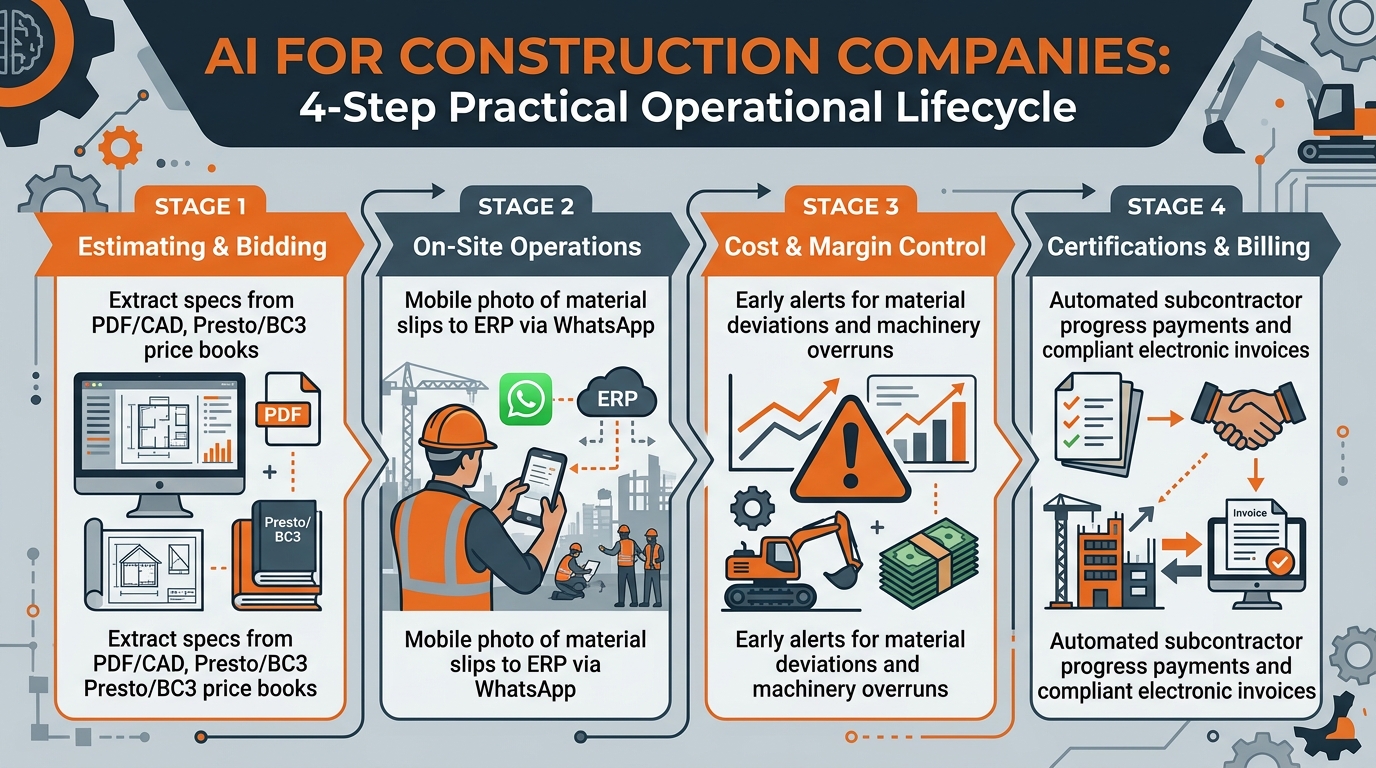
Today, the primary AI interface is the smartphone already in the supervisor's pocket: taking a photo of a material delivery slip via WhatsApp or dictating a 15-second voice memo for the daily site log. The AI model automatically transcribes the audio, extracts concrete volumes and supplier rates, and logs the cost code into the ERP without requiring the superintendent to sit in front of a computer.
Fear 2: "AI makes mistakes, and structural errors in construction can be catastrophic"
Artificial intelligence must never make structural engineering decisions or stamp blueprints. Its role is not to replace structural calculations or professional engineering judgment, but to eliminate blind administrative work: cross-checking 400 pages of technical specifications, verifying that subcontractor pricing matches project cost codes, and flagging material cost increases before a tender is submitted.
Human experts retain final authority on all deliverables; AI acts as a tireless technical auditor reviewing 100% of line items in seconds.
Fear 3: "It is an exorbitant investment only affordable for multinational conglomerates"
Modern implementations do not require multimillion-dollar on-premise hardware or hiring in-house machine learning engineers. They integrate seamlessly with software contractors already use (AutoCAD, Revit, Navision, SAP, Excel, or standard email) via secure cloud services or compact, private local servers like the Apple Mac Studio M5.
2. The 4 Operational Areas Where AI Protects Construction Margins
Project profitability is not won solely on the scaffolding; it is defended in the precision of the initial estimate and daily field cost tracking. These four processes deliver immediate commercial impact:
Process 1: Rapid Estimating, Quantity Takeoffs, and Tender Bidding
- The Manual Bottleneck: Preparing a competitive bid requires weeks of manual review across 400-page specification books, measuring CAD drawings line by line, and assembling Unit Price Analyses (UPAs). Under tight tender deadlines, teams rush calculations, add arbitrary contingency cushions that lose the bid, or miss costly scope items that result in execution losses.
- How AI Solves It: The system ingests architectural PDFs and CAD/BIM models, extracts quantities automatically (drywall square meters, rebar tonnage, earthwork volumes), and cross-references them against your company's historical cost database.
- Result: Tender studies that previously required 12 working days are finalized in 48 hours, enabling the contractor to bid on three times more projects without expanding technical office headcount.
Process 2: Real-Time Field Cost Tracking and Automated Material Slips
- The Manual Bottleneck: Every day, delivery trucks bring concrete, structural steel, aggregates, and piping to the site. Paper delivery tickets accumulate in truck dashboards or site office trays. By the time they reach accounting at month-end, budget overruns have already occurred.
- How AI Solves It: The field foreman photographs delivery tickets with a smartphone. The AI model extracts the vendor, delivered quantity, unit price, and maps it directly to the designated project cost code in your ERP.
- Early Overrun Warnings: If the "Foundation Concrete" budget allocated 120 m³ and accumulated slips reach 115 m³ with foundation work only 80% complete, the system alerts project management immediately, allowing adjustments before concrete pours conclude.
Process 3: Progress Billing, Subcontractor Certifications, and Invoicing
- The Manual Bottleneck: Month-end brings disputes between general contractors, project owners, and trade subcontractors over completed work percentages, retainage calculations, and delayed invoice approvals.
- How AI Solves It: The platform cross-references daily verified site progress against scheduled quantities, generates itemized monthly progress billing drafts, and prepares compliant electronic invoices aligned with digital regulations like VeriFactu.
- Benefit: Faster payment cycles and elimination of billing disputes through complete, auditable documentation.
Process 4: Job-Site Safety (OSHA/HSE) and Compliance Management
- The Manual Bottleneck: Health and safety regulations require extensive documentation: subcontractor worker qualifications, equipment inspection certifications, and safety orientation records. A single expired document can halt site operations during an official inspection.
- How AI Solves It: Automated portals audit subcontractor compliance files before granting site entry permissions, flagging expired insurance or safety certifications. In addition, vision AI connected to site perimeter cameras can monitor compliance with Personal Protective Equipment (hard hats, harnesses, high-vis vests) in high-risk zones.
3. Real-World Return on Investment (ROI) for a Mid-Sized Contractor
Let us review the financial metrics of a mid-sized general contractor generating €4 million in annual revenue, with 25 employees and 4 to 6 active projects:
| Operational Area | Previous Manual Expense / Leak | With Practical AI Automation | Annual Financial Impact |
|---|---|---|---|
| Untracked material variance & slip losses | ~1.5% unnoticed cost leakage | Real-time 100% material capture | +€42,000 / year |
| Technical office manual estimating hours | 600 hours/year manual data entry | 75% reduction in repetitive takeoff work | +€18,000 / year |
| Project delay penalties & supply lapses | Unplanned material shortages | Predictive supply delivery alerts | +€25,000 / year |
| AI software & secure integration cost | €0 | Turnkey maintenance and connectors | -€6,000 / year |
| TOTAL NET RECOVERED ANNUAL PROFIT | — | — | +€79,000 / year |
Recovering nearly €80,000 in net profit annually for a company of this scale equates to expanding operating margin by nearly two percentage points, without taking on riskier projects or underbidding competitors.
4. How to Get Started: A Practical Implementation Roadmap
To ensure high adoption and immediate ROI, rollout should be phased:
- Step 1: Operational Process Audit: Pinpoint your contractor's primary bottleneck (are you losing bids due to slow estimating, or losing margin due to untracked field expenses?).
- Step 2: Connect to Existing Systems: Never replace your existing ERP or takeoff software. AI functions as an intelligent connective layer linked to your project folders, email inboxes, and accounting databases using gateways like Executor.sh / MCP.
- Step 3: Field-First Training: Train site superintendents and office staff on automated workflows in under one hour using tools they already know.
At IA4PYMES, we help construction, civil engineering, and remodeling firms implement pragmatic, high-ROI AI systems tailored to real-world job sites.
Request an Operational Process AI Audit for Your Construction Business → We analyze your estimating and job-site cost tracking workflows to deliver a clear implementation plan targeting your highest-margin improvements for the upcoming year.
5. Frequently Asked Questions
Do we need BIM models on every project to benefit from AI?
No. While AI integrates seamlessly with BIM and IFC files, the vast majority of contractors capture significant financial ROI working directly with standard 2D PDF drawings, Excel sheets, and industry cost databases (BC3 / Presto format).
What happens if a job site has poor mobile connectivity?
Mobile applications for capturing delivery slips and daily logs operate offline. The superintendent captures the photo or voice memo, and data automatically syncs and processes once the device reconnects to 4G/5G or site office Wi-Fi.
Can cost analyses be calibrated with our company's proprietary historical labor rates?
Yes. Unlike generic public AI tools, a private enterprise implementation is calibrated using your company's own historical records (your specific labor crew outputs, preferred subcontractors, and negotiated supplier discounts).