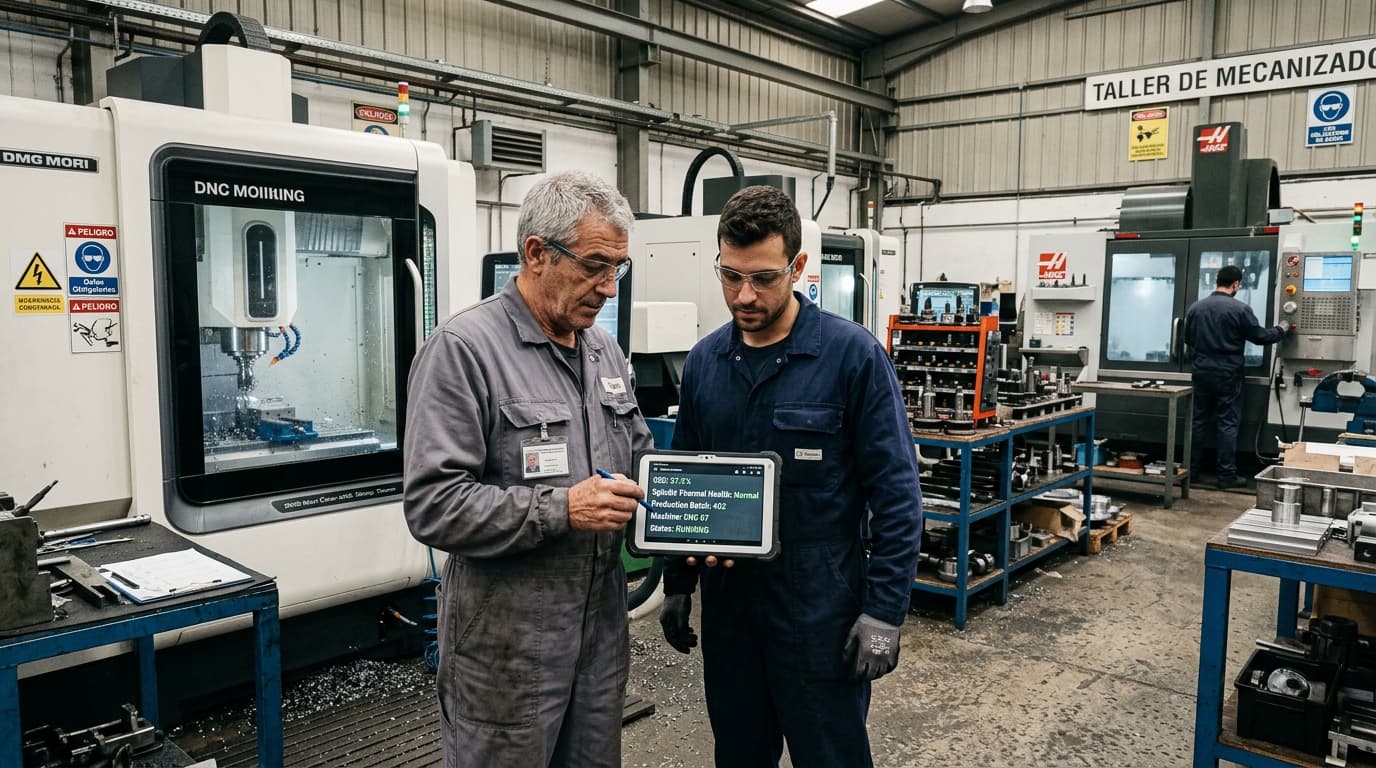

Across industrial manufacturing corridors—from CNC precision workshops to plastic injection molding, metal stamping, and food processing facilities—plant managers fight an ongoing battle to protect per-part margins.
Executive directors and factory managers of small and medium plants (10 to 50 employees) face three chronic operational pain points:
- Unplanned Machine Downtime: When a primary CNC milling center, stamping press, or packaging line breaks down unexpectedly, the entire shop floor grinds to a halt. Every hour of lost production costs between €300 and €1,200 in delayed customer orders, expedited freight penalties, and overtime wages.
- Material Scrap and Defect Rates: Expensive raw materials (structural steel, aluminum billets, technical polymers) too often end up in the scrap recycling bin. Thermal drift or cutting tool wear is frequently discovered only after hundreds of defective components have already been produced.
- Shortage of Skilled Maintenance and Machinists: Qualified machinists, toolmakers, and electromechanical technicians are increasingly difficult to recruit. Seasoned plant personnel are retiring, risking the loss of unwritten machine-tuning knowledge.
In this context, mentioning artificial intelligence frequently provokes skepticism in manufacturing boardrooms. Many factory owners view AI as corporate technology meant solely for massive automotive conglomerates or aerospace hangars, imagining that adoption requires replacing existing machinery or spending hundreds of thousands of euros on humanoid robots.
The operational reality is far more practical: modern industrial AI is not designed to replace machinery or skilled operators; it connects non-invasively to critical shop-floor assets to alert teams before machines fail and prevent material waste.
According to industry data from 2025 and 2026, small manufacturing plants deploying data-driven machine monitoring already achieve a 15% reduction in unplanned downtime and up to a 30% reduction in corrective maintenance costs.
1. Dismantling the 3 Common Myths Among Industrial SMEs
Before considering technology investments, business owners should address three common misconceptions:
Myth 1: "Our machines are older and lack network connectivity"
You do not need to replace existing CNC machines with multimillion-euro units or rewrite legacy Programmable Logic Controllers (PLCs).
Modern monitoring uses non-invasive external sensors: compact vibration, temperature, and current clamp devices that mount magnetically to critical spindle bearings or drive motors in five minutes. The sensor reads operational telemetry and transmits data wirelessly to an isolated, secure industrial gateway without modifying the machine's electrical cabinet.
Myth 2: "Implementation requires shutting down production for weeks"
A properly designed deployment requires zero downtime. Technicians select a single bottleneck asset (such as the primary 5-axis mill or central extruder), install two wireless sensors during a scheduled shift changeover, and allow the system to establish baseline operating data while production continues at full speed.
Myth 3: "Our veteran shop-floor operators will reject complex software"
The operator interface is not a complicated dashboard with obscure telemetry charts. It translates into an unambiguous visual signal (green/amber/red indicator) or a direct automated alert to the plant manager's phone: "Spindle front bearing anomaly detected; estimated 48 operating hours to failure; schedule maintenance during the next scheduled changeover".
2. The 4 High-Impact Areas Where Industrial AI Protects Margins
Artificial intelligence on the factory floor is justified only when it improves net profit per manufactured part:
Application 1: Predictive Maintenance on Bottleneck Machines
- The Routine Bottleneck: Corrective maintenance (running components until catastrophic failure) halts production and damages customer delivery commitments. Classic scheduled maintenance (replacing bearings every 6 months) discards components with hundreds of hours of usable life remaining.
- The AI Solution: Machine learning algorithms that detect subtle harmonic vibration shifts and thermal elevation weeks before mechanical failure occurs.
- Outcome: Mechanical overhauls are scheduled during off-peak hours, eliminating emergency shutdowns and maximizing tooling lifespan.
Application 2: Computer Vision Quality Inspection and Scrap Reduction
- The Routine Bottleneck: In laser cutting, stamping, or injection molding, surface burrs, porosity, or micro-cracks are often identified only during end-of-batch manual sampling—after pallets of defective parts have already been produced.
- The AI Solution: An industrial camera positioned along the output conveyor connected to a lightweight computer vision model trained to identify non-conforming parts.
- Outcome: 100% real-time part inspection within milliseconds, automated rejection of defective units, and instant alerts when batch defect rates exceed 2%.
Application 3: Paperless Work Orders and Raw Material Receiving
- The Routine Bottleneck: Shop supervisors spend hours sorting through grease-stained paper job tickets to enter machine cycle times and material consumption into accounting software manually.
- The AI Solution: Digital tracking via rugged tablets at machine stations and QR code verification. Incoming raw material deliveries (steel coils, plastic resin) are logged by capturing smartphone photos of vendor delivery slips, automatically cross-referencing invoice details with purchase orders and electronic compliance standards like VeriFactu.
Application 4: Industrial Energy Consumption Optimization
- The Routine Bottleneck: Unmonitored peak power draws and heavy electrical loads (annealing furnaces, high-pressure compressors) initiated simultaneously during peak utility tariff periods drive up monthly plant utility bills.
- The AI Solution: Line-level energy telemetry that orchestrates power sequencing, shifting high-load processes to off-peak tariff hours without delaying customer deadlines.
3. Financial Analysis: Annual Bottom-Line Impact for a 20-Person Plant
Consider the operational financial metrics of a precision machining or fabrication plant employing 20 machine operators and generating €3 million in annual revenue:
| Manufacturing Domain | Prior Manual Status | With Practical AI Deployment | Estimated Annual Savings |
|---|---|---|---|
| Unplanned production downtime | 45 hours/year lost (€600/hr) | 20% reduction in downtime | +€5,400 / year |
| Catastrophic machine repairs | 1 major spindle/press failure annually | Early intervention (bearing replacement only) | +€12,000 / year |
| Material scrap and waste | 3.5% raw material loss | Reduced to 2.6% via vision quality control | +€18,500 / year |
| Shop floor admin and data entry | 10 hrs/week manual office entry | Vision OCR and automated work orders | +€8,400 / year |
| IoT hardware & telemetry infrastructure | €0 | Non-invasive sensors and gateways | -€4,800 / year |
| NET ANNUAL RECOVERED PROFIT | — | — | +€39,500 / year |
Recovering nearly €40,000 in net profit annually allows a factory of this scale to finance tooling upgrades and qualify for tier-1 automotive or industrial contracts without balance sheet stress.
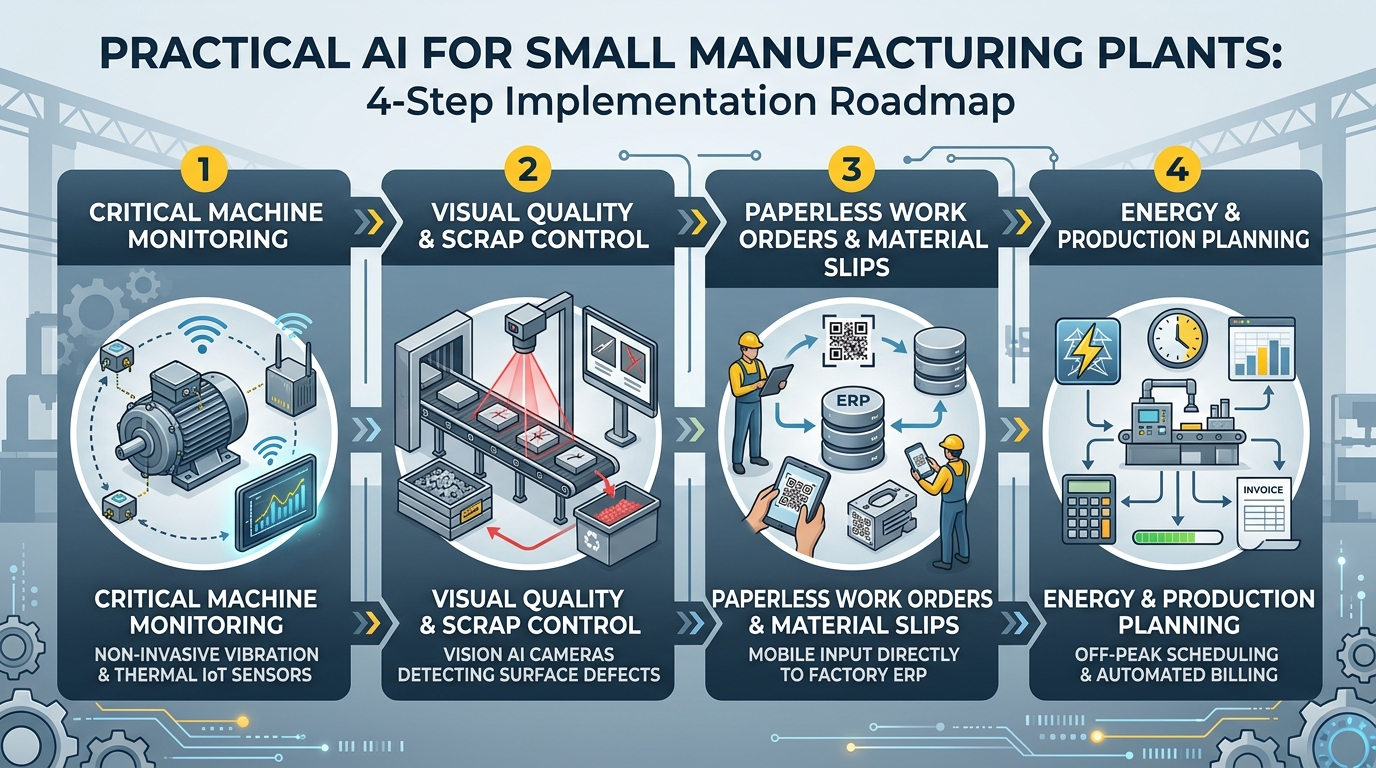
4. The Gradual Implementation Roadmap
To secure immediate operational adoption, rollout should follow a phased approach:
- Step 1: Bottleneck Assessment: Identify the single machine or production stage that accounts for the highest downtime or scrap percentage.
- Step 2: 30-Day Pilot Project: Install non-invasive sensors on that critical machine to calibrate predictive anomaly models. If the system does not demonstrate clear value within 30 days, hardware is removed without operational disruption.
- Step 3: ERP Integration: Connect production data and billing to existing software via secure gateways like Executor.sh / MCP, avoiding costly ERP migrations.
- Step 4: Facility Expansion: Extend monitoring across secondary lines once operators and supervisors experience the practical value firsthand.
At IA4PYMES, we help small and medium manufacturing facilities modernize their production floors pragmatically, leveraging disciplined engineering practices like gentle-pi and secure local servers like the Apple Mac Studio M5 to ensure proprietary CAD designs and manufacturing formulas remain strictly on-premise.
Request an Operational Process AI Audit for Your Manufacturing Plant → We evaluate your bottleneck machinery, scrap rates, and shop-floor data flows to deliver a concrete implementation plan targeting your highest-margin improvements.
5. Frequently Asked Questions
Is it secure to connect industrial production data to AI systems?
Yes. Sensor readings and machine telemetry can be processed entirely on local on-premise servers (edge computing), ensuring proprietary machine parameters and CAD specifications never leave your physical facility.
How accurate is computer vision for factory quality inspection?
Using standard industrial cameras and controlled lighting, surface inspection vision models consistently achieve defect detection rates exceeding 98.5% for surface abrasions, micro-cracks, and dimensional irregularities.
What is the expected payback period for an initial pilot?
For plants experiencing recurring machine downtime, avoiding a single major spindle failure or catching one defective batch early typically recovers the entire pilot investment within three to six months.