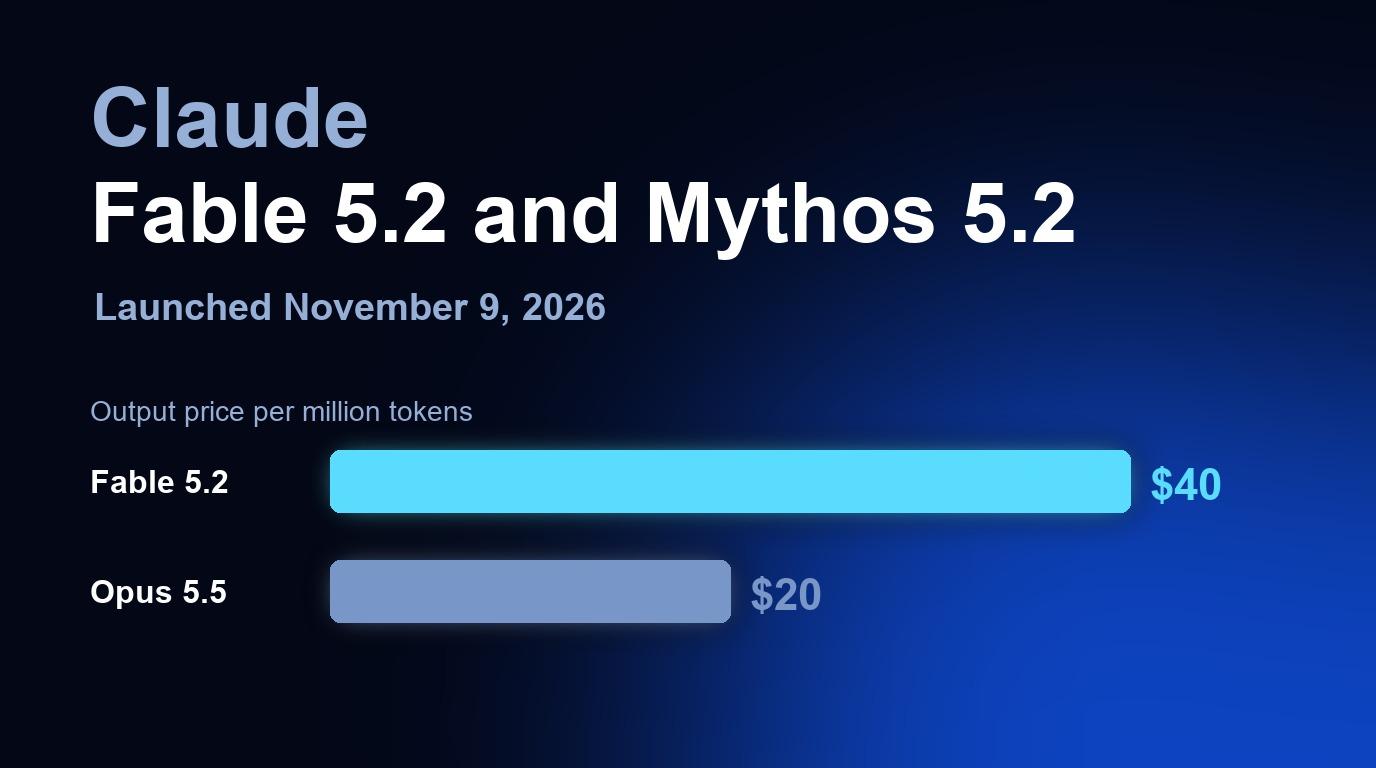

Anthropic launched Claude Fable 5.2 and Claude Mythos 5.2 on November 9, 2026. They are the same model with different safeguards: Fable is available to all users and Mythos only to verified organizations. Fable 5.2 costs $8 per million input tokens and $40 per million output tokens, and Anthropic says it generates up to 30% faster than Fable 5.1.
For an SME, the most useful data point comes from Anthropic itself: it recommends starting with Claude Opus 5.5 for most coding and knowledge tasks and reserving Fable for more demanding work. This article covers what the launch includes, which figures come from the company and which from third parties, and what is worth testing this week. A note on a name that circulates by mistake: there is no Opus 5.2 in Anthropic's documentation. The current Opus is 5.5.
1. What did Anthropic launch?
According to Anthropic's announcement and its model documentation:
| Model | Who it is for | Access |
|---|---|---|
| Claude Fable 5.2 | All users | Available since November 9 on Amazon Web Services, Google Cloud, and Microsoft Azure. API ID: claude-fable-5-2 |
| Claude Mythos 5.2 | Verified organizations in cybersecurity and life sciences | Through verification programs. Anthropic does not publish its API ID or a separate price |
| Claude Opus 5.5 | Daily use | The model Anthropic recommends as a starting point |
Anthropic describes Mythos 5.2 as the same model as Fable 5.2 without certain cybersecurity and biology safeguards. Enterprise customers can use Claude Security, which includes Mythos 5.2, even if they are not in the cyber verification program.
2. Price, speed, and context
| Fable 5.2 | Fable 5.2 fast mode | Opus 5.5 | |
|---|---|---|---|
| Input (per million tokens) | $8 | $16 | $4 |
| Output (per million tokens) | $40 | $80 | $20 |
- Context and output: 1M tokens of context and up to 128K of output in the synchronous API. Adaptive thinking is always on and the reliable knowledge cutoff is June 2026.
- Speed: Anthropic states that both models generate "up to 30% faster" than Fable 5.1 and Mythos 5.1. The comparison is only against those versions. Fast mode speeds up generation by up to 2.5 times.
- Price cut: the press (TechCrunch and Yahoo Finance) puts Fable 5.1's previous price at $10 and $50. Anthropic does not cite those numbers on its pages.
- Discounts: according to its documentation, batch requests get a 50% discount and prompt cache reads cost 2.5% of the base input price.
At the published rates, Fable 5.2 costs twice as much per token as Opus 5.5. A task with 100,000 input tokens and 10,000 output tokens costs $1.20 on Fable 5.2 and $0.60 on Opus 5.5, without caching or batching. That calculation is ours, using the announced rates.
3. What do the benchmarks say?
These are the figures from the table Anthropic publishes. All scores use each model's highest available effort unless noted otherwise:
| Test | Fable 5.2 | Fable 5.1 | Opus 5.5 | GPT-6 Astra | Gemini 4 Carbon |
|---|---|---|---|---|---|
| FrontierCode 2.0 (agentic coding) | 49.1% | 32.4% | 45.5% | 42.8% | 41.1% |
| FrontierSWE v2 | 69.9% | 56.3% | 62.3% | 65.5% | 61.2% |
| AutomationBench | 51.4% | 31.4% | 42.5% | 41.4% | 53.9% |
| OSWorld 2.1 (computer use, partial set) | 89.3% | 83.5% | 87.2% | 79.5% | 81.5% |
| Remote Labor Index | 41.3% | 17.9% | 21.3% | 20.8% | no data |
| Humanity's Last Exam (with tools) | 74.2% | 65.6% | 67.7% | 57.2% | no data |
Four caveats before using these numbers:
- They are Anthropic's data. The page does not say who ran the tests for the competing models.
- On FrontierCode, the 49.1% corresponds to Xhigh effort. At High effort, Anthropic says Fable 5.2 lands at the level of Opus 5.5's best result (45.3% vs. 45.5%).
- On AutomationBench, the test closest to office tasks, Gemini 4 Carbon (53.9%) beats Fable 5.2 (51.4%).
- A benchmark measures a set of tasks. Your invoices, your emails, and your ERP are a different set.
4. Safeguards, Mythos, and safety
Fable 5.2 uses classifiers that block high-risk cyber activity (penetration testing, exploit generation) and most biology research. When a query is blocked, Opus 4.8 responds for cybersecurity and Opus 5 for biology. Anthropic estimates Fable 5.2 produces 55% fewer blocks than Fable 5.1 (60% fewer in cybersecurity and 40% fewer in biology) based on early testing across claude.ai, Claude Code, and Cowork.
In an adversarial test with more than 1,800 scenarios, Mythos 5.2 used credentials or files placed outside its sandbox in 3.1% of cases. Opus 5.5 did so in 3.3% and Sonnet 5.5 in 5.1%. Earlier versions of Mythos (5 and 5.1) scored 39% and 21%. Anthropic attributes these results to the system card and expects Fable 5.2 to behave similarly. We could not read that system card, so we cite the announcement.
The same announcement states that more than 90% of the changes merged into Anthropic's core codebase are now written by Claude, with human guidance. The page does not explain how that was measured.
5. What METR says
METR, an external evaluator, published an assessment on November 5 of the acceleration of AI R&D at Anthropic. Its main result is that the capabilities of Anthropic's models on well-specified tasks have been advancing 1.9 times faster since October 2025 (95% confidence interval: 1.5 to 2.8 times), measured with AECI, Anthropic's own version of the Epoch Capabilities Index.
METR adds limits. It would not be surprised if the true figure were between 1.3 and 3 times. The figure could be explained by overfitting to the benchmark distribution or be an artifact of the methodology. And Anthropic redacted most of the evidence METR found most informative, so the public has to rely on METR's judgment more than would be ideal.
For an SME, what matters in this report is the pace: if capabilities improve this fast, a model decision made today expires soon. We cover that in our guide to deciding with numbers.
6. What it means for an SME
What follows is our reading, not an Anthropic conclusion.
Start with the cheaper model. Anthropic recommends Opus 5.5 as its "strongest daily driver" for most tasks, and Fable 5.2 costs twice as much per token. An invoice, an email, or a quote rarely needs the most expensive model. Fable 5.2 makes sense for long, complex tasks, such as an agent that works for several hours.
Competitors' numbers are not a verdict. On AutomationBench, the test most similar to administrative work, Gemini 4 Carbon comes out ahead. The reliable way to choose is to test with your own documents. We explain it in our articles on Claude Opus 5 and Claude Sonnet 5.
Check your data before sending it. Anthropic states that, for customers without zero data retention, it keeps 30-day retention for safety monitoring. Zero data retention with Fable 5.2 goes through Enterprise Frontier Safeguards, which is in private beta with customers such as Bridgewater, Salesforce, and Stripe. Neither the announcement nor the support page addresses EU data residency or Spain-specific availability. Before sending personal data of customers or employees, ask in writing.
Access to Anthropic models shifts with geopolitics. It already happened with Fable 5. We covered it in the US ban on Fable 5 and in the return of Fable 5 with an Opus 4.8 fallback. It pays to have an alternative tested.
7. Plans, limits, and dates
Anthropic's support page details the launch terms:
- Pro and standard Team seats: Fable models are included for up to 50% of weekly limits, for one week, from November 9 to 16, 2026 (until 11:59 pm Pacific), plus one limit reset. After that week, Fable runs on usage credits.
- Max, Ultra, and premium Team seats: one to three limit resets depending on tenure: under six months, one; six to twelve, two; over twelve, three. They expire on March 8, 2027.
- Excluded: the free plan and standard seats on legacy seat-based Enterprise plans.
- Fine print: a reset does not raise your limits, and Fable models use up limits faster than other Claude models.
What to do this week
Pick five to ten real cases from your company: invoices, customer emails, quotes, or reports. Run them through Opus 5.5 and Fable 5.2 and note three things for each: whether the result is correct, how long it takes, and what it costs. If you have a Pro or Team plan, do it before November 16 to use the included week. If Opus 5.5 gets the same results, keep the cheaper one. If personal data is involved, review the retention terms first.
Book your 60-minute technical consultation here and we will help you choose the model, hardware, and architecture for your case, with a test on your own data.
Frequently asked questions
What is Claude Fable 5.2?
It is the Anthropic model launched on November 9, 2026 for all users. It costs $8 per million input tokens and $40 per million output tokens, has 1M tokens of context, and is available on AWS, Google Cloud, and Azure. Anthropic says it generates up to 30% faster than Fable 5.1.
What is the difference between Fable 5.2 and Mythos 5.2?
According to Anthropic they are the same model. Mythos 5.2 does not include certain cybersecurity and biology safeguards and is only available to verified organizations, through the cyber and life sciences verification programs.
Is there a Claude Opus 5.2?
It does not appear in Anthropic's documentation. The current Opus is Claude Opus 5.5, announced on September 22, 2026. The name Opus 5.2 circulated as a rumor on secondary websites.
Is Fable 5.2 worth paying for compared with Opus 5.5?
It depends on the task. Fable 5.2 costs twice as much per token ($8 and $40 versus $4 and $20), and Anthropic recommends Opus 5.5 as the starting point for most tasks. Fable 5.2 makes more sense for long, complex work. The way to decide is to compare both on your own cases.
Is Fable 5.2 available in Spain and the EU?
Anthropic says it is available on all platforms, including AWS, Google Cloud, and Azure, but neither the announcement nor its documentation details availability by region or EU data residency. Ask your provider before sending personal data.