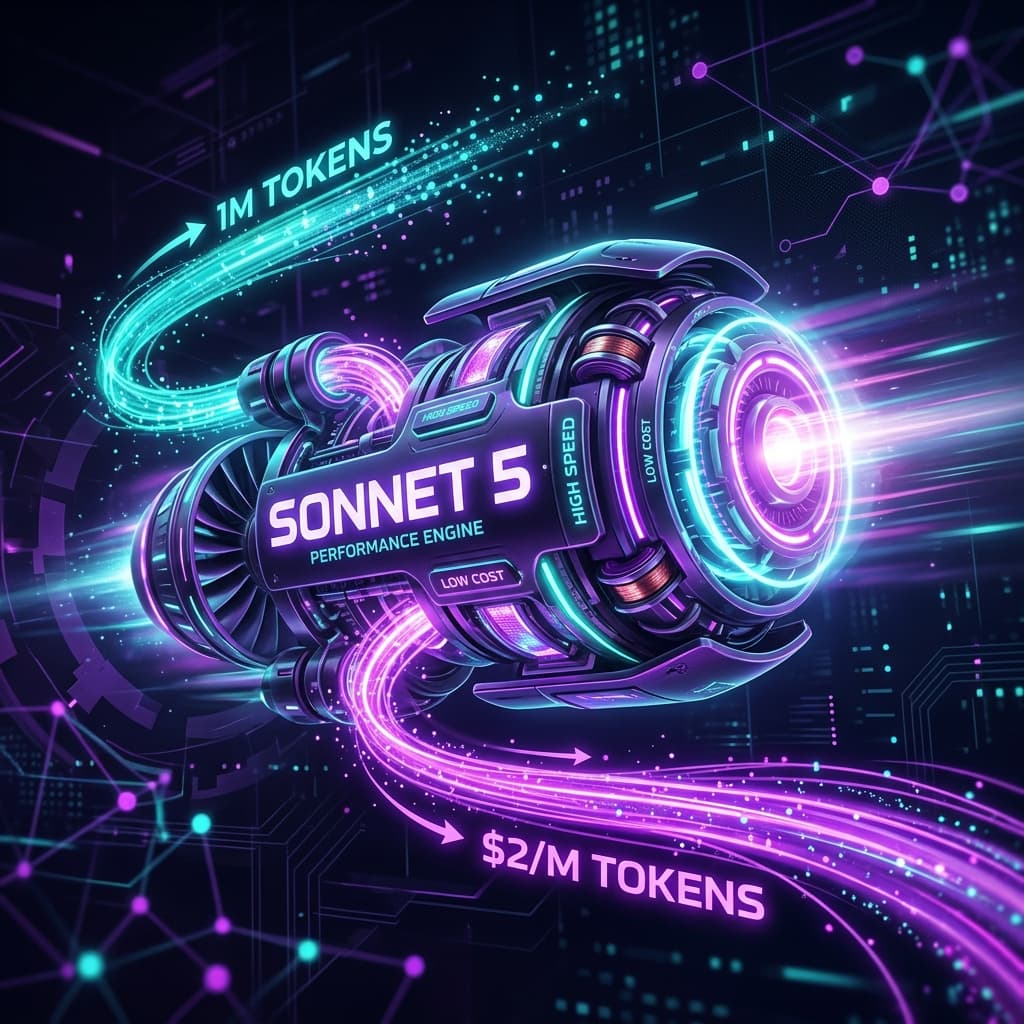

On June 30, 2026, Anthropic significantly altered the artificial intelligence landscape with the launch of Claude Sonnet 5. Designed specifically to serve as the new default daily driver for software development and autonomous agentic workflows, this model arrives with an incredibly aggressive technical and pricing proposition.
Featuring a 1-million-token context window, a 128,000-token output limit, and advanced agentic capabilities that rival premium flagship models at a fraction of their cost, Sonnet 5 redefines the Return on Investment (ROI) for tech-driven SMEs.
We analyze its technical features, performance benchmarks, introductory promotional pricing, and strategic positioning as the definitive cost-effective workhorse of 2026.
1. Technical Innovations: Adaptive Thinking and Optimized Context
Under the hood, Claude Sonnet 5 is not just an incremental improvement over Sonnet 4.6. Anthropic has redesigned the way the model manages reasoning and tools through three major upgrades:
Adaptive Thinking
Enabled by default via the API, this mechanism allows the model to dynamically allocate its "thinking budget" based on task complexity. For simple formatting tasks, the model responds instantly. When faced with debugging or large refactoring tasks, Sonnet 5 generates an internal, abstract reasoning block to draft a plan before producing the final output code.
High-Efficiency Tokenizer
An updated tokenizer packs approximately 30% more plain-text information per token compared to Sonnet 4.6. For SMEs sending entire code repositories or vectors to the context window (RAG), this translates directly into a 30% reduction in API bills for the exact same volume of raw source code or data.
128K Output Window
This massive expansion is ideal for generating complete software modules, extensive technical documentation, or handling complex database migrations. Developers no longer have to handle chunking logics or premature outputs mid-refactoring, streamlining client-side integration logic.
2. Benchmarks: Flagship Capabilities at Mid-Tier Pricing
Anthropic's internal evaluations and early developer benchmarks position Sonnet 5 as a strong daily alternative to the flagship Claude Opus 4.8:
- Agentic Coding (SWE-bench): Sonnet 5 scores 63.2% on agentic coding benchmarks, significantly outperforming Sonnet 4.6 (58.1%) and approaching Opus 4.8 (69.2%). This allows it to resolve repository issues and coordinate console tools autonomously.
- Tool Calling Precision: Its function-calling accuracy reaches 94%, greatly reducing syntax or interface errors that commonly stall automated pipelines in production.
- Enterprise-Grade Safety: Built with the latest corporate cybersecurity guardrails. While it doesn't support the raw permissiveness of the specialized Mythos class (such as Claude Fable 5), its guardrails guarantee a secure runtime environment for B2B applications.
🚀 Ready to optimize your AI infrastructure costs by migrating to Claude Sonnet 5?
The launch of Sonnet 5 offers a unique opportunity to reduce your API bills by up to 60% without sacrificing agentic quality. At IA4PYMES, we help your engineering team implement advanced semantic routers, configure Adaptive Thinking, and redesign your custom agents to maximize your technical ROI.
Book your 60-minute technical consultation here (100% refundable if we don't validate feasibility in 15 minutes, or fully credited against final development costs on hire).
3. Cost Structure: Anthropic's API Pricing Strategy
To drive massive adoption, Anthropic has launched an introductory promotional pricing structure for the summer of 2026:
| Period | Input Cost (per 1M tokens) | Output Cost (per 1M tokens) |
|---|---|---|
| Introductory (Through August 31, 2026) | $2.00 | $10.00 |
| Standard (Starting September 1, 2026) | $3.00 | $15.00 |
This pricing sets a new benchmark:
- It is up to 60% cheaper than Opus 4.8 ($5/$25) during the promotional period while offering comparable execution quality.
- Utilizing Prompt Caching can drop recurrent input costs by up to 90% ($0.20 per million tokens for cache hits).
4. Strategic Positioning: The Workhorse for Tech SMEs
For software-developing SMEs, the arrival of Claude Sonnet 5 completely changes model selection strategies:
Replacing Opus 4.8 for Everyday Tasks
Opus 4.8 is now reserved for extreme conceptual challenges, massive security audits, or highly complex reasoning loops. Sonnet 5 easily handles 90% of daily engineering operations: unit testing, routine refactoring, API integrations, and tier-2 customer support.
Commercial Viability of AI Agents at Scale
The high cost of running terminal-based agents has historically prevented their widespread commercial deployment. With Sonnet 5's $2/$10 pricing and a 30% denser tokenizer, the business case for automating customer service workflows and back-office syncs is now fully viable for SMEs.
Conclusion
Claude Sonnet 5 represents the maturity of mid-tier large language models. By pairing advanced agentic coding with Adaptive Thinking and a highly competitive promotional pricing scheme, Anthropic has delivered a powerful tool for software teams to automate operations at a highly controllable cost. Continuing to rely on older, high-end APIs for routine work is no longer financially justifiable.