
The truck unloads at eight in the morning, someone signs the delivery note on the hood and the paper ends up in the glovebox. Three weeks later the supplier's invoice reaches the office, and the person recording it does not know whether the material arrived complete, which site it went to or whether the price matches what was agreed. By then the payment period is already running.
This article covers what Spanish law says about the delivery notes and invoices a construction company receives, what changes with mandatory e-invoicing and Verifactu, and which part of the work an AI system can do. We read the cited rules in the Official State Gazette (BOE), consulted on November 26, 2026. The Verifactu calendar changed on November 25, so many guides published before that date show old deadlines. This is not tax or legal advice: have your advisor validate how it applies to your company.
1. The payment period starts at delivery
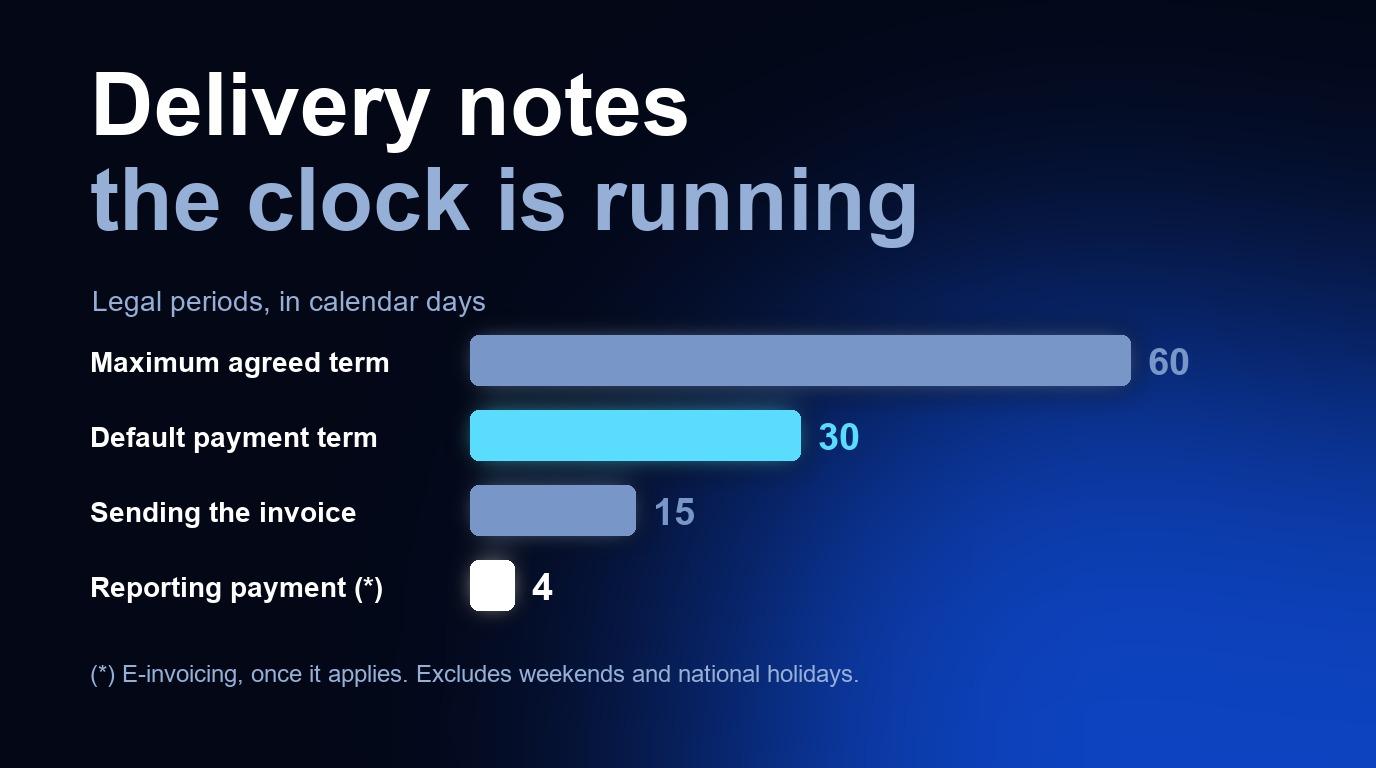
Article 4 of Law 3/2004, on late payment in commercial transactions, applies to payments between businesses, including those from main contractors to suppliers and subcontractors. If the contract sets no term, payment is due 30 calendar days after receiving the goods or the service, even if the invoice arrived earlier.
The same article sets the remaining rules:
| Rule | What Article 4 says |
|---|---|
| Maximum that can be agreed | The parties may extend the term, never beyond 60 calendar days |
| Sending the invoice | The supplier must get it to the customer within 15 calendar days of receipt of the goods or service |
| Acceptance checks | If the law or the contract provides an acceptance procedure, it cannot exceed 30 calendar days from receipt, and payment is due 30 days after acceptance |
| E-invoice with an agreed term | Electronic receipt starts the clock if the signer's identity and authenticity, the invoice's integrity and its receipt are guaranteed |
| Grouped invoices | Periods of up to 15 days can be grouped; the term counts from the middle of the period and cannot exceed 60 days from that date |
The date on the delivery note therefore has financial consequences. When the clock starts at delivery, a delivery note that takes three weeks to reach the office leaves nine days to record, check and pay it within a 30-day term.
2. The legal difference between a delivery note and an invoice
To deduct the VAT you pay, you need the invoice. Article 97 of the Spanish VAT Law lists the documents that support the right to deduct. For an ordinary domestic purchase, that is the original invoice issued by the supplier or on their behalf, and a document that fails to meet all the requirements does not support the deduction until it is corrected. The delivery note is not on that list.
The delivery note helps elsewhere, although the article that follows does not name it. Article 8 of the Invoicing Regulation (Royal Decree 1619/2012) allows a company to guarantee the authenticity of origin and the integrity of an invoice through its usual business controls. Those controls must create a reliable audit trail linking the invoice to the delivery of goods or the provision of services. A chain made of purchase order, signed delivery note and invoice is the common way to show that link.
The same regulation explains why construction companies often receive many delivery notes and few invoices:
- When the customer is a business, the supplier must issue the invoice before the 16th of the month after the VAT becomes chargeable (Article 11).
- The supplier can gather the transactions of one calendar month for the same customer into a single summary invoice, also before the 16th of the following month (Article 13).
One invoice from a building materials warehouse can summarize dozens of deliveries to different sites. Whoever reviews it has to check line by line that each delivery happened, with those quantities and prices, and decide which site each one belongs to. Your cost control per project reflects reality only if that allocation is right.
3. How long to keep them and in what format
Article 30 of the Spanish Commercial Code requires businesses to keep their books, correspondence, documentation and supporting records for six years from the last entry in the books. On the tax side, Article 19 of the Invoicing Regulation requires companies to keep received invoices for the period set in the General Tax Law, whose Article 66 sets a general four-year limitation period. Some cases extend these periods, so ask your advisor before deleting anything.
Records can be kept electronically if the system guarantees authenticity of origin, integrity, legibility and access for the Tax Agency without delay (Articles 20 and 21). A phone photo is fine for working with the data, but it does not let you throw away a paper invoice. To dispense with the original, Order EHA/962/2007 regulates certified digitization: a faithful and complete image, an electronic signature and software approved by the Tax Agency, which publishes information on that approval. If your system does not meet those requirements, keep the originals.
4. Mandatory e-invoicing: what changes for the buyer
Royal Decree 238/2026 develops mandatory electronic invoicing between businesses and professionals. Its deadlines started running with Order HAC/1028/2026, which regulates the Tax Agency's public invoicing platform, was published on October 5, 2026 and took effect the next day.
| Who | When it applies |
|---|---|
| Businesses and professionals whose turnover exceeded 8 million euros the previous year | 12 months after the order took effect: October 2027 |
| Everyone else | 24 months after: October 2028 |
For a small construction company, the effect can arrive before its own duty to issue. Suppliers above 8 million euros will start e-invoicing their business customers in 2027. During the first 12 months of that phase they must attach a readable PDF, unless the recipient expressly agrees to receive only the original format. Ask your large suppliers how they will send it to you.
The royal decree also gives tasks to whoever receives the invoice:
- Tell the issuer about commercial acceptance or rejection and about full payment, with their dates (Article 10).
- Report rejection or full payment of the invoice to the public platform (Article 12).
- Do both within four calendar days, excluding Saturdays, Sundays and national holidays.
The calendar for these reports depends on your situation. Individuals and pass-through entities under income tax rules that do not exceed 8 million euros get 12 extra months beyond the general phase to report the invoice statuses covered by the third transitional provision. Ask your advisor which date applies to you. Either way, reporting a payment on time means knowing which invoices you accepted and when you paid them.
5. Verifactu: a new deadline since November 25, 2026
The Verifactu Regulation (Royal Decree 1007/2023) governs the software a company uses to issue its invoices. Recording the delivery notes and invoices you receive from suppliers is a different task, even if the same management program does both.
The 2027 dates still shown in many guides are no longer the ones in the BOE. Royal Decree-law 43/2026, of November 24 and published on the 25th, changed the deadline: taxpayers who use the software must have it adapted when the 24-month e-invoicing period expires, which is October 2028.
Congress must vote to validate or repeal a royal decree-law within 30 days of its enactment (Article 86 of the Constitution). As of November 26, 2026, that vote is pending. Before postponing a project because of the new date, check what Congress decided. The deadline for software makers did not move: it remains tied to the nine months following the Verifactu ministerial order.
6. Where the manual process loses money
Look for these failures in your own process:
- The delivery note stays in the van or on the foreman's phone.
- The summary invoice is approved by its total, without matching each line to a delivery.
- The invoiced price is not compared with the purchase order or the agreed rate.
- You pay for material that arrived incomplete or was returned, because the problem was handwritten on a delivery note nobody looked at again.
- The cost reaches the project weeks late or lands on the wrong site.
- The same invoice is entered twice, once on paper and once from email.
To measure your exposure, take last month's material invoices and count how many lines you can support with a signed delivery note and an agreed price.
7. What AI can do and what stays with you
A document reading system can take the photo of a delivery note from the site or the email with the invoice, extract supplier, date, references, quantities and amounts, and suggest the project. After that, matching purchase order, delivery note and invoice runs on explicit rules: ordered against delivered quantity, delivered against invoiced, and agreed price against invoiced price.
| Task | Who does it |
|---|---|
| Read the document and extract the data | AI |
| Suggest supplier, project and cost line | AI, reviewed by a person |
| Match lines and detect differences or duplicates | Programmed rules |
| Warn about due dates based on delivery date and agreed term | Programmed rules |
| Approve or reject the invoice and order payment | A person at your company |
| Decide the tax treatment | Your advisor |
Automated reading makes mistakes. A crumpled delivery note, a quantity corrected in pen, a stamp over the amount or difficult handwriting can produce wrong data that looks right. So the system should show the original image next to each value, flag what it could not read with confidence and check what can be checked: that lines add up to the total, that the taxable base and VAT agree and that the invoice number is not repeated. No invoice should be paid without a person approving it. Before buying, ask for a test with your own delivery notes, including the worst ones, and count the errors.
Delivery notes and invoices can contain personal data, such as names, signatures, phone numbers or the details of a self-employed supplier. Ask where documents are processed, who acts as data processor, how long they are kept and whether they are used to train models.
The solution we offer construction companies at IA4PYMES follows that split: you take a photo or forward the email, the system reads supplier, amounts and project, and your team reviews and approves. If you also work with subcontractors, controlling their paperwork is a separate process, covered in our subcontractor documentation guide.
8. How to start this week
- Gather last month's material delivery notes and invoices for a single project.
- Match each invoiced line to its delivery note and flag the ones with no support or a different price.
- Write down how many days each delivery note took to reach the office.
- Check in your contracts and purchase terms which payment period you agreed and when it starts counting.
- Ask your main suppliers when they will start sending you e-invoices and through which channel.
- Set a site rule: the delivery note is photographed at the moment of delivery, with problems written down before signing.
- With that information, decide what to automate first.
Steps 1 to 6 need no new software, and they will tell you how many lines lack support.
Frequently asked questions
Can I deduct VAT with only the delivery note?
No. Article 97 of the VAT Law requires the supporting document, which for an ordinary domestic purchase is the original invoice meeting the regulatory requirements. The delivery note helps prove the delivery happened.
How many days does a construction company have to pay a supplier in Spain?
With no agreed term, 30 calendar days from receipt of the goods or service. The parties can extend it by agreement, up to a maximum of 60 calendar days. If there is an acceptance procedure or invoices are grouped, the count follows the specific rules in Article 4 of Law 3/2004.
Can I throw away paper delivery notes and invoices after photographing them?
An ordinary photo is not enough to dispense with an original paper invoice. Order EHA/962/2007 requires certified digitization with approved software. For delivery notes and other supporting records, ask your advisor before destroying anything.
Does Verifactu affect the invoices I receive from suppliers?
The regulation governs the systems used to issue invoices. If your software also records purchases, check with its maker which part falls under the regulation.
When is e-invoicing mandatory for a small construction company in Spain?
If turnover does not exceed 8 million euros, the 24-month phase counts from the day Order HAC/1028/2026 took effect, October 6, 2026, and falls in October 2028. Before that, the company may receive e-invoices from large suppliers, who start in October 2027.
How many of this month's invoices can you support line by line?
If answering means searching gloveboxes, inboxes and folders, we can review with you how your delivery notes travel from the site to accounting today.
Book the free 30-minute diagnostic for your construction company here and we will tell you which part of recording and checking your delivery notes and invoices can be automated.