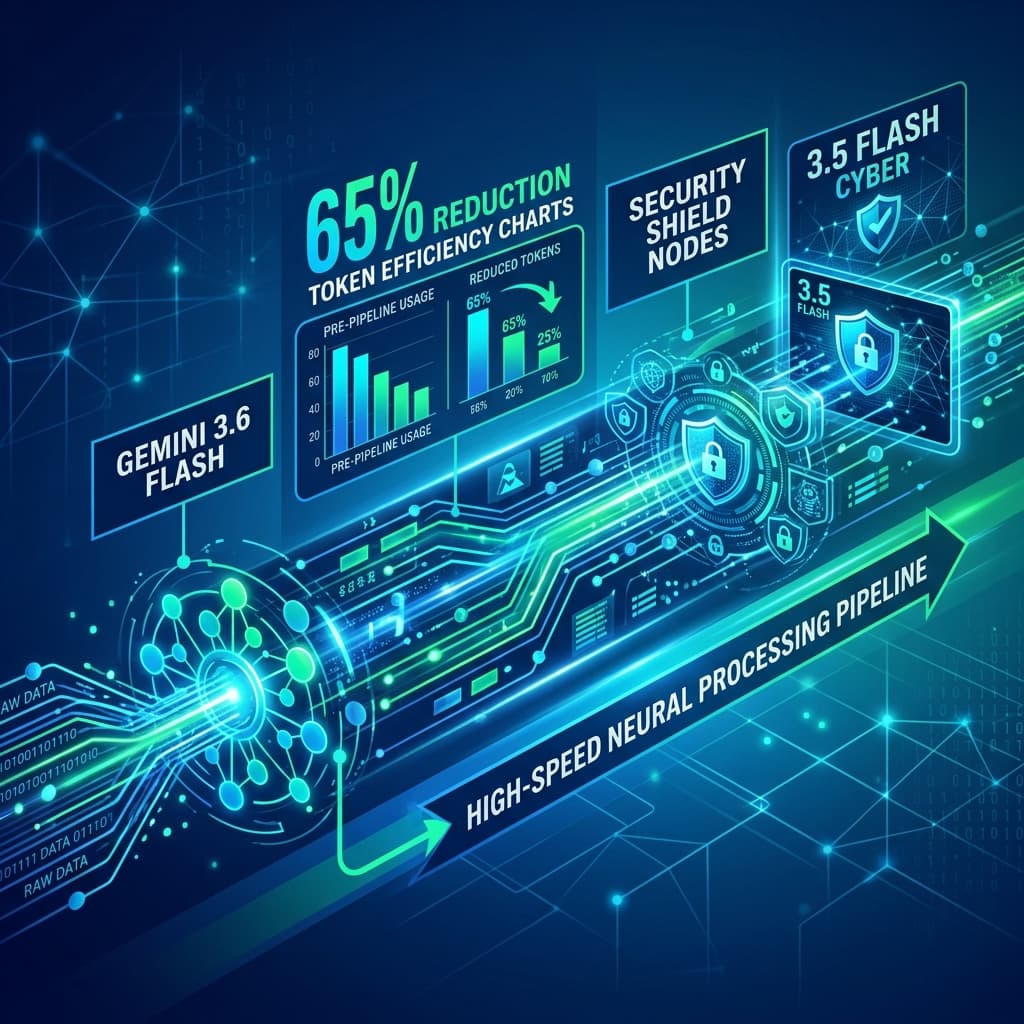

On July 21, 2026, Google DeepMind officially unveiled the latest update to its high-speed model family: Gemini 3.6 Flash, Gemini 3.5 Flash-Lite, and the specialized Gemini 3.5 Flash Cyber model.
This release addresses the single largest financial bottleneck facing enterprises deploying autonomous agents to production: excessive token consumption generated during multi-step execution loops.
We evaluate verified technical specifications, API pricing tables, cybersecurity capabilities, and architectural implications for enterprise SMEs.
65% Reduction in Agentic Token Consumption
When an autonomous agent performs a complex workflow (such as reconciling invoices against an ERP or analyzing server logs), it triggers consecutive internal function calls (tool calling). Previous model generations produced verbose output responses that rapidly inflated API invoices.
Gemini 3.6 Flash introduces alignment fine-tuning engineered specifically for output efficiency:
- Average token savings: Generates 17% fewer output tokens on standard coding benchmarks compared to Gemini 3.5 Flash.
- Agentic loop savings: Achieves up to a 65% reduction in output token consumption during multi-turn agent execution without accuracy loss.
- Engineering benchmarks: Scores 49% on DeepSWE and 63.9% on MLE Bench.
Technical Specifications and API Pricing
Google established a pricing tier designed for high-frequency enterprise integration:
| Model | Context Window | Output Cap | Input Price (1M tokens) | Output Price (1M tokens) | Primary Use Case |
|---|---|---|---|---|---|
| Gemini 3.6 Flash | 1,000,000 tokens | 64,000 tokens | $1.50 | $7.50 | Coding agents, mass RAG, and multimodal reasoning |
| Gemini 3.5 Flash-Lite | 1,000,000 tokens | 8,192 tokens | $0.30 | $2.50 | Instant classification (350 tokens/sec) |
| Gemini 3.5 Flash Cyber | 1,000,000 tokens | 32,000 tokens | Enterprise Pilot | Enterprise Pilot | Cybersecurity auditing and automated patching |
📊 Multi-Step Agent Execution Cost Benchmark (10,000 runs/month):
- Previous Flash Model: ~15,000,000 output tokens ➔ High API expense ➔ Accumulated latency
- Gemini 3.6 Flash: ~5,250,000 output tokens (65% savings) ➔ Sub-second latency ➔ High ROI
🔒 Optimize API Token Expenses and Agent Runtime Security
Deploying agents without token controls or API schema validation can expose enterprise systems to unexpected billing spikes and security vulnerabilities. At IA4PYMES, we help engineering teams implement intelligent model routing and tailored security audits.
Book your 60-minute technical consultation here (100% refundable or credited against final development costs).
Gemini 3.5 Flash Cyber and API Runtime Security
A key highlight of the release is Gemini 3.5 Flash Cyber, a specialized model fine-tuned on operational threat intelligence alongside Google's CodeMender framework.
As autonomous agents gain authorization to execute database mutations (Odoo, SAP, Stripe, HubSpot), the primary cyber threat vector in 2026 has shifted from textual prompt injection to exploiting the API tool endpoints executed by agents.
Gemini 3.5 Flash Cyber empowers enterprise security teams to:
- Audit API payload requests in real-time: Flag anomalous parameters or code injection attempts before they reach internal ERP databases.
- Automated patch generation: Identify security vulnerabilities across internal codebases and propose verified patches without halting production.
SME Architectural Action Plan
- Step 1: Evaluate transitioning high-frequency RAG and extraction agents to Gemini 3.6 Flash to immediately cut output token billing.
- Step 2: Combine fast commercial endpoints with private self-hosted open models (GLM-5.2 or Ling-3.0-flash) to comply with the EU AI Act by August 2026.
- Step 3: Connect design-to-code pipelines via Model Context Protocol following our Figma-Context-MCP Tutorial.
- Step 4: Ensure full observability across agent execution trajectories as detailed in our AI Agent Evaluation Gap Guide.