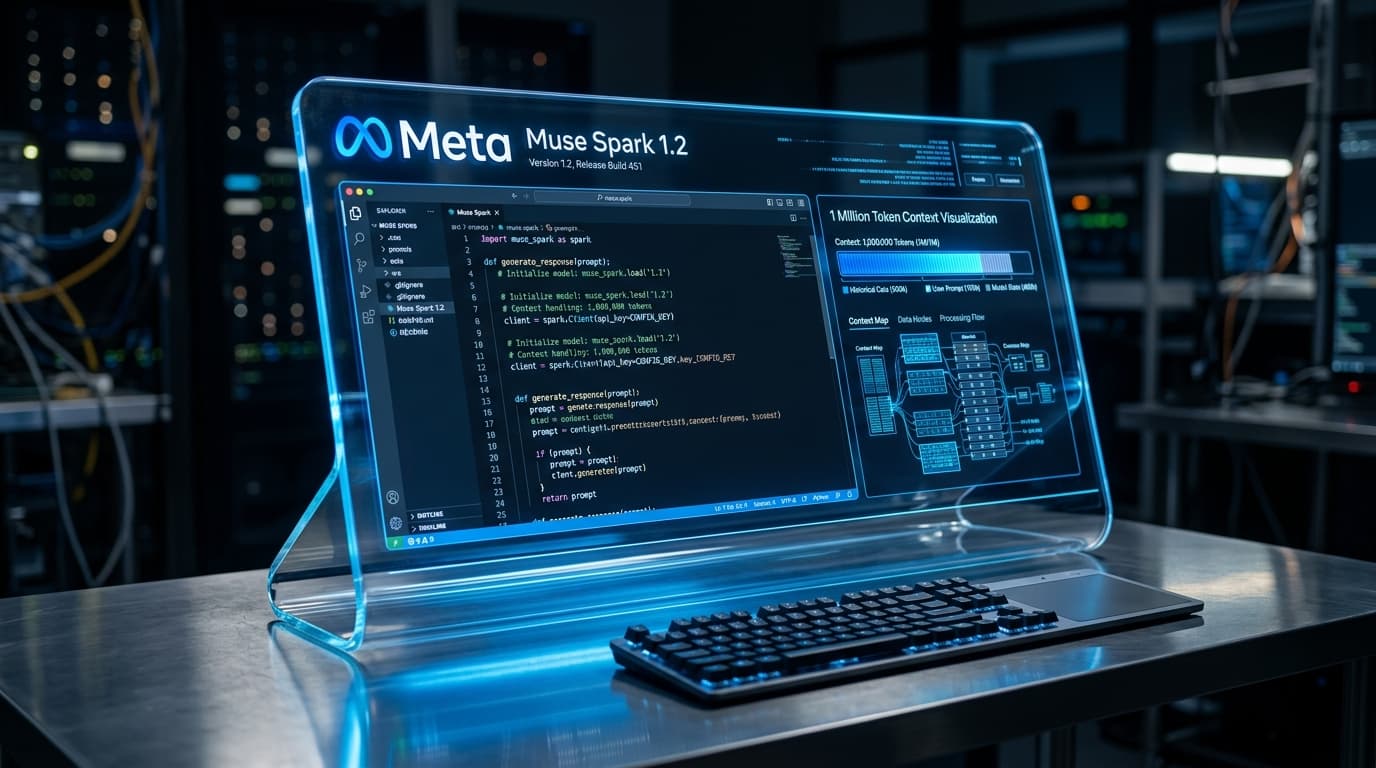

Meta has re-entered the frontier AI race for software engineering with the official release of Muse Spark 1.2 and its accompanying terminal agent, Muse Code.
Launched on August 5, 2026, via the Meta Model API (developer.meta.ai), Muse Spark 1.2 is a reasoning model engineered for real-world programming workflows: whole-repository code generation, multi-file debugging, and reliable tool calling.
The model combines a native 1-million-token context window with a disruptive tiered pricing scheme that lowers compute costs for startups and software engineering departments.
1. What Makes Meta Muse Spark 1.2 Different
Until now, software engineering LLMs faced two primary limitations: low First-Try Pass Rates on complex logic and erratic tool calling when projects scaled beyond 100,000 tokens.
Muse Spark 1.2 resolves these bottlenecks through three architecture optimizations:
- High First-Attempt Accuracy: Fine-tuned on production enterprise repositories to minimize syntax fix loops.
- Deterministic Tool Calling: Strict argument formatting for linters, compilers, and test runners without parameter hallucination.
- 1,000,000 Token Context Window: Ingests entire codebases, database migration histories, and documentation in a single inference session.
2. The Terminal Agent: Muse Code
Alongside the model, Meta launched Muse Code, a command-line interface (CLI) coding agent co-trained with Muse Spark 1.2.
Available for macOS and Linux, Muse Code installs via terminal:
curl -fsSL https://dev.meta.ai/install.sh | bash
Muse Code Core Capabilities:
- Persistent Background Execution: Autonomously plans, edits multiple files, runs build checks, and verifies unit test outputs.
- Native Repository Awareness: Parses project structures in real time, maps cross-module dependencies, and writes structured Git commits.
- Autonomous Task Resolution: Ingests complex prompts such as "Migrate the Stripe billing module to the new API version and run verification suites" and operates independently until complete.
3. Tiered Pricing Model: Standard vs. Contributor Plan
The most notable feature of Meta's launch is its tiered pricing structure, offering options for different privacy requirements:
| Plan / Tier | Input Price (/M) | Output Price (/M) | Cached Input (/M) | Data Privacy & Training |
|---|---|---|---|---|
Standard Tier (muse-spark-1.2) | $1.25 / M tokens | $4.25 / M tokens | N/A | Zero Data Retention (100% Private) |
Contributor Tier (muse-spark-1.2-contributor) | $0.10 / M tokens | $0.20 / M tokens | $0.002 / M tokens | Meta uses data for model training |
Financial & Strategic Impact:
- The Contributor Tier provides over a 90% cost reduction, suited for open-source projects, rapid prototyping, and non-sensitive internal tools.
- The Standard Tier guarantees GDPR compliance and complete intellectual property protection, ensuring Meta does not log or train on customer code.
4. August 2026 Software Engineering Benchmarks
Muse Spark 1.2 competes directly with frontier coding models:
| Model / Feature | Native Context Window | Output Price ($/M) | Tool-Calling Reliability | Official CLI Agent |
|---|---|---|---|---|
| Meta Muse Spark 1.2 | 1,000,000 tokens | $0.20 - $4.25 | High (Deterministic) | Muse Code |
| Claude Opus 5 | 200,000 tokens | ~$15.00 | Very High | Claude Code |
| OpenAI GPT-5.6 Sol | 128,000 tokens | ~$10.00 | High | Codex CLI |
| GLM-5.2 Open Weights | 128.000 tokens | Local / Self-Hosted | Medium-High | Prime Agent |
To understand how this compares with self-improving RLM agent frameworks, explore our analysis of Prime Agent by Prime Intellect.
5. Practical Use Cases for Engineering Teams & SMEs
A. Legacy Monolith Refactoring
With a 1M token context window, Muse Spark 1.2 ingests whole monolithic repositories, allowing teams to upgrade outdated dependencies without losing module context.
B. High-Volume Unit Testing & CI/CD Cost Reduction
Development teams can leverage the Contributor Tier to generate unit tests and technical documentation for fractions of a cent, reserving the Standard Tier for proprietary source code.
C. End-to-End Design to Code Workflows
Combining Muse Code with design context tools streamlines prototype-to-code pipelines. To learn more, read our Figma Context MCP tutorial for AI agents.
To evaluate how autonomous agents align with business goals, review our guide on why SMEs must integrate AI into operational processes.
Ready to integrate Meta Muse Spark 1.2 and coding agents into your development workflows?
At IA4PYMES, we help software engineering departments design AI-assisted coding architectures, set up secure environments, and optimize API costs.
6. Implementation Roadmap
- Meta Model API Setup: Register developer credentials at
developer.meta.aiand generate API keys. - Privacy Plan Selection: Configure
muse-spark-1.2for private corporate code ormuse-spark-1.2-contributorfor public tasks. - Muse Code Installation: Deploy the terminal agent across developer workstations using the official installer.
- Pilot Project Evaluation: Execute trial refactoring sprints to measure delivery acceleration and API token cost efficiency.