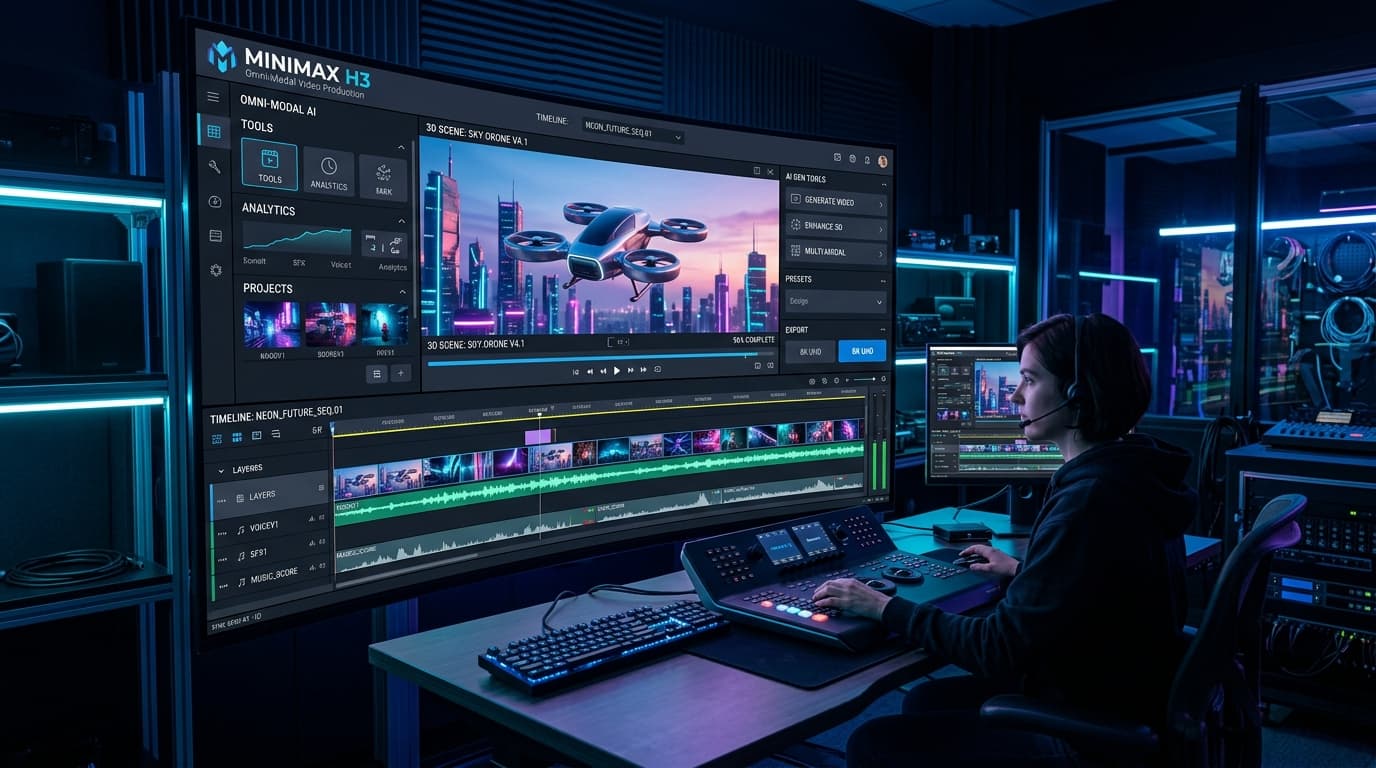

Traditional video generation models decouple visual synthesis from audio design. A model outputs a silent clip, requiring external audio software to layer sound effects, room tone, or voiceovers during post-production.
MiniMax Hailuo H3 (officially released on July 31, 2026) replaces this fragmented workflow with a unified omni-modal transformer architecture. The model processes text tokens, image inputs, camera trajectory vectors, and stereo audio signals in a single inference pass. When a prompt specifies dialogue or physical impact (such as a bottle sliding across a table or a vehicle braking), H3 synthesizes 2K resolution (2560x1440) video clips at 24 FPS with perfectly synchronized stereo room tone, speech, and sound effects generated from millisecond zero.
1. From Hailuo 02 to Hailuo H3: Unified Omni-Modal Architecture
In earlier Hailuo releases (01 and 02), video generation relied on diffusion pipelines where audio had to be coupled post-hoc via separate vocoders. H3 unifies vision, audio, and spatial dynamics inside a shared latent space.
Core Architectural Breakthroughs:
- Single-Pass Video & Audio Synthesis: Eliminates separate audio post-production tools to sync voiceovers or ambient room noise.
- Omni-Modal Latent Space: The model understands the physical relationship between visual motion and acoustic output (e.g., sound variations when walking on gravel vs. wet asphalt).
- Photorealistic Color & Temporal Stability: Native 24 FPS output at up to 2K resolution without temporal flickering between frames.
2. Technical Specifications & Multi-Asset Ingestion
A primary bottleneck in AI video generation has been scene-to-scene inconsistency: actor faces morph, lighting shifts, and brand logos distort.
MiniMax H3 enforces visual and narrative consistency through multi-asset ingestion:
- Up to 9 Reference Images: Enables locking actor facial features, clothing, product geometry, corporate logos, and color palettes.
- 3 Motion Guidance Video Clips: Extracts camera trajectories or human actions to apply across selected visual assets.
- 3 Reference Audio Tracks: Preserves speaker voice identity or brand acoustic signatures.
- Instruction-Guided Editing: Modifies specific scene elements (such as changing lighting from day to night or replacing backgrounds) without re-rendering the entire clip.
- Clip Duration: Generates continuous 4-to-15 second clips with native support for First-and-Last-Frame Interpolation.
3. Benchmarks & Cost Efficiency vs. Proprietary Alternatives
In August 2026 independent video evaluation leaderboards, MiniMax H3 ranks near the top across generation and editing benchmarks:
| Metric / Feature | MiniMax Hailuo H3 | Closed Proprietary Model A | Closed Proprietary Model B |
|---|---|---|---|
| Max Native Resolution | 2K (2560x1440) | 1080p (1920x1080) | 1080p (1920x1080) |
| Native Audio Generation | 1-Pass Stereo Sync | No (Post-processing required) | No (Silent output) |
| Reference Asset Support | Up to 9 images | 1 to 2 images | 1 image |
| Relative Cost per Second (API) | < €0.03 / sec | ~€0.11 / sec | ~€0.09 / sec |
| Commercial License for SMEs | MiniMax Community (<$20M) | Per-user closed subscription | Per-user closed subscription |
H3 reduces compute costs to under one-third of competing closed-source alternatives, allowing production teams and marketing agencies to run dozens of creative iterations at low cost.
4. Practical Applications for Marketing, Advertising & E-Commerce SMEs
A. High-Volume A/B Hook Testing for Social Campaigns
Performance marketing agencies require dozens of visual variants to test ad performance on TikTok, Reels, and Shorts. Using H3, creative teams upload product photography and generate 20 vertical (9:16) video ad hooks complete with voiceovers and sound effects in minutes.
B. E-Commerce Product Showcases
Capturing physical product motion (such as textile drapes, liquid pours, or vehicle dynamics) requires expensive camera rigs and studio rentals. H3 simulates fluid physics and textile motion directly from static product shots.
C. Commercial Continuity & High-Definition Storyboarding
For traditional advertising agencies, H3 serves as a photorealistic pre-visualization engine. With up to 9 reference images, agencies can pitch complete commercial concepts maintaining identical actor appearances and brand guidelines before filming on location.
To learn how to connect content generation with enterprise sales infrastructure, explore our guide on why SMEs must integrate AI into operational processes.
5. Open Licensing & ComfyUI Deployment
MiniMax distributes H3 under the MiniMax Community License, providing free commercial usage for enterprises generating under US$20 million in annual revenue.
In addition to API access, MiniMax is rolling out open weights on Hugging Face alongside official nodes for ComfyUI. This allows production teams to deploy H3 on local GPU hardware without uploading client assets to third-party cloud servers.
To explore converting design prototypes into executable code, review our Figma Context MCP tutorial for AI agents.
Ready to integrate AI video generation into your creative agency?
At IA4PYMES, we help advertising agencies, video producers, and e-commerce brands build automated multimodal video and audio pipelines integrated into internal tools.
6. Agency Implementation Roadmap
- Asset Library Audit: Organize a high-resolution reference library containing key products, brand characters, and vector logos.
- Environment Setup: Determine whether to execute via low-latency cloud APIs or local ComfyUI nodes for confidential client campaigns.
- Multi-Format Automation: Configure API workflows to output horizontal (16:9) and vertical (9:16) aspect ratios simultaneously.
- Visual Quality Sandbox: Conduct pilot runs on small ad budgets before replacing traditional video production workflows.