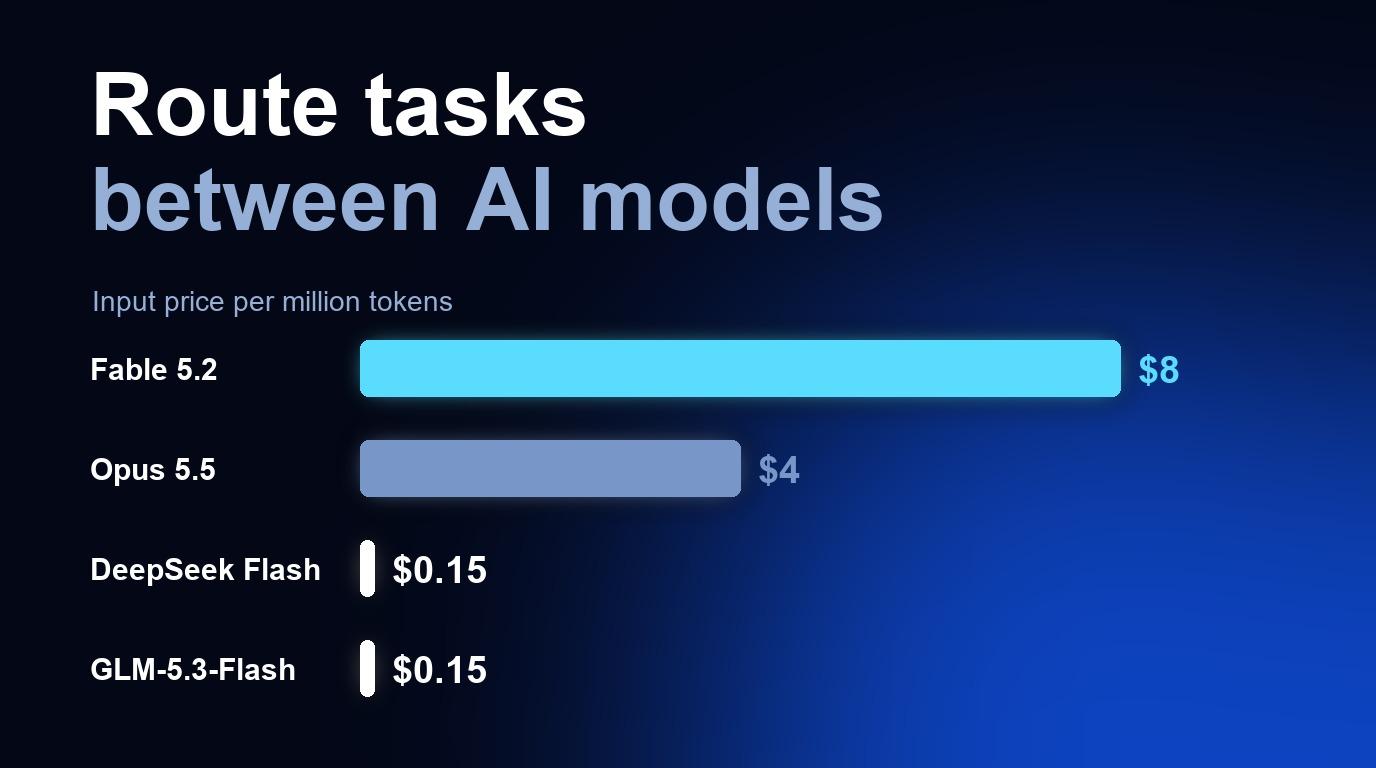

Claude Fable 5.2 costs $8 per million input tokens and $40 per million output tokens. DeepSeek Flash costs $0.15 and $0.60 off-peak, and GLM-5.3-Flash costs $0.15 and $0.50. Per input token, Fable 5.2 is about 53 times more expensive than either, and per output token, between 67 and 80 times.
That gap does not mean a cheap model is enough for everything. It means that always paying for the most expensive model, on every task, is a decision worth measuring. The alternative is called model routing: each task goes first to a cheap model and moves up to an expensive one only when needed. This article covers official prices, what research says about routing, a bill example, and a method to apply it. Near the end we mention a flat-rate service with an IA4PYMES referral link, and we flag it where it appears.
1. How much does each model cost?
Prices per million tokens, taken from each provider's official pages:
| Model | Input | Output | Source |
|---|---|---|---|
| Claude Fable 5.2 | $8 | $40 | Anthropic |
| Claude Opus 5.5 | $4 | $20 | Anthropic documentation |
| DeepSeek Flash, off-peak | $0.15 | $0.60 | DeepSeek |
| DeepSeek Flash, peak | $0.30 | $1.20 | DeepSeek |
| GLM-5.3-Flash | $0.15 | $0.50 | Z.ai |
Three details that change the math:
- DeepSeek charges double at peak hours. According to its documentation, peak hours are 01:00 to 04:00 and 06:00 to 10:00 UTC, Monday through Friday, excluding Chinese public holidays. In Spanish mainland winter time that is 02:00 to 05:00 and 07:00 to 11:00. Batch jobs that run at night or on weekends get the off-peak price. We analyzed the pricing change in our article on the DeepSeek V4-Pro price hike.
- DeepSeek's model name varies. DeepSeek's documentation uses the identifier deepseek-flash and lists the version DeepSeek-V4.1-Flash-1017. The older names, such as deepseek-v4-flash, are still accepted, but DeepSeek states that the corresponding models have been retired. Context is 1M tokens with up to 384K of output.
- GLM-5.3-Flash has 320 billion parameters, 18 billion active, 1M of context, and up to 128K of output, according to Z.ai's documentation. On Hugging Face it is listed under the MIT license. Before redistributing it or using it in a product, read the license file in the repository.
These are list prices for each provider's API. They do not include caching or batch discounts, which several of them offer.
2. What does the data say about quality?
The honest answer is that there is no clean, independent comparison of these models on office tasks. What exists are figures from each provider:
- Z.ai reports that GLM-5.3-Flash scores 63.4 on DeepSWE v1.1 (versus 46.2 for GLM-5.2) and 48.8 on AutomationBench (versus 26.2 for GLM-5.2).
- Anthropic's table lists on AutomationBench 51.4% for Fable 5.2, 42.5% for Opus 5.5, and 53.9% for Gemini 4 Carbon.
Taken together, those figures suggest a Flash model can land close to a frontier model on that test. Two caveats limit that reading: each number is published by a different provider, and we cannot confirm they use the same version or configuration of AutomationBench. We do not include figures for DeepSeek Flash because we have not checked any against an official source.
The practical conclusion is the same as always: the only comparison that counts is the one you run on your own documents.
3. What research says about routing
Two academic papers measure how much is saved when a gateway decides which model to use for each query:
- RouteLLM (LMSYS, 2024) routes between GPT-4 Turbo as the strong model and Mixtral 8x7B as the weak model. According to its blog, it achieves cost reductions of over 85% on MT Bench, 45% on MMLU, and 35% on GSM8K versus using only GPT-4, while keeping 95% of its performance. Against another baseline, a random router, the best router reaches 95% of the performance by calling GPT-4 in 26% of cases, at a cost about 48% lower.
- FrugalGPT (2023) states in its abstract that it can match the performance of the best individual model with up to a 98% cost reduction, or improve GPT-4's accuracy by 4% at the same cost.
The caveats weigh as much as the figures. These are 2023 and 2024 studies with older models. In RouteLLM, routers trained only on Arena data performed near random on MMLU, and the data had to be augmented with golden labels. Cost is measured by the number of calls to the expensive model. And the 85% from MT Bench does not repeat on the other tests.
What they do show is the mechanism: when queries vary in difficulty, splitting them saves money. How much it saves in your case you only learn by measuring.
4. How to split the tasks
This table reflects our starting criteria, not a rule:
| Task type | Starting model | When to move up |
|---|---|---|
| Classifying emails, extracting invoice fields, formatting data | Flash | If field validation fails |
| Summarizing documents and meetings | Flash | If the document is long or ambiguous |
| Drafting customer replies | Flash, with human review | If tone or context is sensitive |
| Analyzing contracts or documents with nuance | Opus 5.5 | High-impact cases, with human review |
| Agents that work for hours, complex code | Opus 5.5 or Fable 5.2 | Anthropic recommends starting with Opus 5.5 |
The method has three steps:
- Label your tasks by difficulty and by the cost of an error. A misclassified email costs little, a misposted invoice quite a bit more.
- Test 20 to 50 real cases with a cheap model and an expensive one. Score whether the result is correct, how long it takes, and what it costs.
- Define the escalation rule. The cheap model answers first, and the task moves to the expensive one when an automatic validation fails (format, amounts, required fields), when the model reports low confidence, or when the task type demands it.
Automatic validations are the cheapest and most useful part of the system. An invoice whose total does not match the sum of its lines does not need a more expensive model to catch the error. It needs a rule.
5. A bill example
An illustrative calculation with our own assumptions: 20,000 documents per month, 3,000 input tokens and 500 output tokens each, which is 60 million input tokens and 10 million output tokens. No caching or batching.
| Strategy | Monthly cost |
|---|---|
| Everything on Fable 5.2 | $880 |
| Everything on Opus 5.5 | $440 |
| Everything on DeepSeek Flash (off-peak / peak) | $15 / $30 |
| Everything on GLM-5.3-Flash | $14 |
| Routed: 90% to DeepSeek Flash and 10% to Opus 5.5 | between $57.50 and $71 |
The routed setup in the example costs more than 80% less than sending everything to Opus 5.5 and more than 90% less than sending everything to Fable 5.2. The 90/10 split is an assumption, not data. If in your tests the cheap model solves 70% of cases, the bill goes up. The calculation also leaves out the time to build and maintain the routing, and the repeated calls when a task moves up a model. With those costs included, the savings still count, but less than the raw figure.
The same logic appears in our earlier article on the FOMO for the most expensive model. Here we add current prices and a splitting method.
6. The flat-rate alternative: NaN Builders
Paying per token gives a bill that varies with use. A flat rate fixes it in advance. NaN Builders is an open-model inference service with a monthly fee. According to its official page:
- Fixed monthly fee: the plan with inference included costs €70 per month, VAT included, and provides a personal OpenAI-compatible API key, so you only need to change the base URL in your tools.
- Open models: among others, DeepSeek V4.1 Flash and GLM-5.3-Flash, plus embedding, reranking, and voice models.
- Privacy: its privacy policy, updated on October 14, 2026, states that the cluster stores neither prompts nor responses, that processing happens in the European Union, and that your code trains no models. These are the company's own statements.
A flat rate pays off when volume is high or hard to predict and the plan's usage limits do not hold you back. To decide whether it pays off for you, run the test from section 4 against its API and compare the cost per task with pay-per-token pricing.
We want to be transparent: this is an IA4PYMES referral link. We have tested NaN Builders and highly recommend it for its quality. If you subscribe with this NaN Builders invitation link, you get €5 off your first month. Check the terms on their website before paying. We published a broader analysis of the service in our article on NaN Builders.
One privacy consideration applies to any option. Before sending personal data of customers or employees to a provider's API, check where it is processed and how long it is kept.
What to do this week
Pick three tasks you currently run on a frontier model: the one that uses the most tokens, the simplest one, and the most sensitive one. Run them with 20 real cases through a Flash model and through the model you use today, and score accuracy, time, and cost. If the cheap model gets the first two right, route those tasks and keep the expensive model for the third. And add an automatic validation before each step to catch errors without paying more.
Book your 60-minute technical consultation here and we will design the model split for your case, with a test on your own data.
Frequently asked questions
What is AI model routing?
It is a system that decides, for each task or query, which model processes it. The usual pattern is that a cheap model answers first and the task moves to a more expensive one when a validation fails, confidence is low, or the task type demands it. Studies such as RouteLLM and FrugalGPT measure the savings it delivers.
How much cheaper is DeepSeek Flash than Claude Fable 5.2?
At list prices, Fable 5.2 costs $8 for input and $40 for output per million tokens. DeepSeek Flash costs $0.15 and $0.60 off-peak and double at peak hours. Per input token, the gap is about 53 times off-peak and about 27 times at peak. A price gap does not measure a quality gap.
Is GLM-5.3-Flash open source?
On Hugging Face it is listed under the MIT license with downloadable weights, with 320 billion parameters and 18 billion active. Read the repository's license file before using it in a product. Z.ai's API costs $0.15 for input and $0.50 for output per million tokens.
Is a cheap model good enough for real business tasks?
For many bounded tasks, such as classifying, extracting fields, or summarizing, it is reasonable to test it first. There is no conclusive independent comparison for office tasks, so the decision is made with your own documents, a set of 20 to 50 cases, and an automatic validation of the result.
Is a flat-rate inference plan worth it?
It depends on your volume and how predictable it is. A fixed fee gives a known bill, but the plan has usage limits. Compare the cost per task from your tests with pay-per-token pricing before deciding.