

On September 21, 2026, the Spanish Government unveiled the Plan IA360 strategic roadmap—a national initiative featuring 14 key projects designed to accelerate artificial intelligence adoption across industries. The official goal is to lift AI adoption among Spanish companies from 21.1% to over 55% before 2030.
The flagship measure for small and mid-sized enterprises (SMEs) is the AI Voucher (Bono de Inteligencia Artificial), backed by a €600 million budget allocated to support projects across 25,000 SMEs and self-employed professionals.
However, the announcement has prompted two problematic market behaviors:
- Predatory grant middlemen: Commercial agencies marketing "voucher management services" even though no official regulatory terms or grant application windows currently exist. A pilot trial with 100 SMEs across two regions will not launch until the first half of 2027, followed by the nationwide call toward the end of 2027.
- The waiting trap: Business owners and executives pausing operational improvement projects to "wait for the subsidy" twelve months down the road.
Falling into this second trap exposes companies to failure during application reviews or wasted investments in superficial software. This analysis breaks down the technical differences between this initiative and older schemes like Kit Digital, the rigorous justification criteria involved, and why operational preparation must begin immediately.
1. The Core Difference: Why the AI Voucher Is Not Kit Digital 2.0
Spain's earlier Kit Digital program relied on a closed catalog of standardized solutions: lump-sum vouchers to purchase websites, social media packages, or standard CRM licenses. Many businesses acquired generic tools that remained unused because they failed to resolve underlying operational bottlenecks.
Plan IA360 and the upcoming AI Voucher enforce a completely different standard:
- Commercial software subscriptions are excluded: The AI Voucher will not fund standard commercial software licenses or SaaS subscriptions. Funding explicitly excludes monthly seats for ChatGPT, Microsoft Copilot, or generic office suites.
- Focus on custom implementation: Eligible expenses target bespoke technical development, internal data cleansing and formatting, integration with core systems (ERP, CRM), and operational workflow redesign.
- Measurable business outcomes: Projects must prove measurable improvements in task cycle times, error rates, or operating capacity compared against baseline figures.
Companies that delay process evaluations until the public window opens will struggle to build a credible technical project within tight submission deadlines.
2. Three Technical Prerequisites SMEs Must Address
To successfully secure technical integration grants—or to deploy automation profitably without public subsidies—companies must establish three operational foundations before writing code:
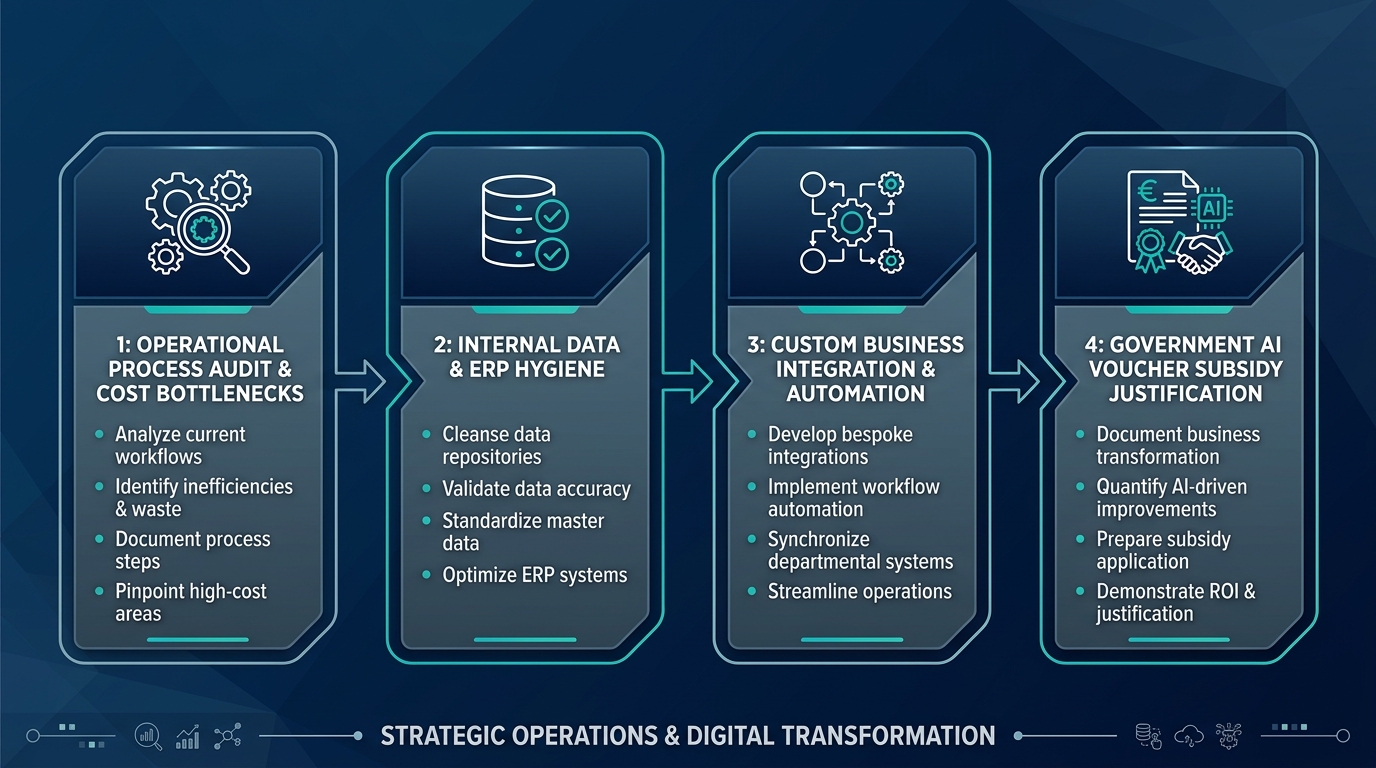
Prerequisite 1: Quantified Operational Workflows
Organizations cannot automate undocumented or unmeasured operations. To qualify for workflow integration funding, technical project briefs must provide concrete operational metrics:
- How many hours per month does accounting spend reconciling vendor invoices and delivery notes to comply with VeriFactu electronic invoicing rules?
- What is the hourly cost of senior engineering talent consumed by mechanical drawing tasks, as examined in our guide on AI in CAD design and mechanical engineering?
- What are the scrap rates and unplanned downtime costs experienced by shop-floor teams, as seen in small manufacturing plants?
Without precise data on task duration and loaded labor rates, establishing project scope and calculating return on investment becomes impossible.
Prerequisite 2: Clean and Standardized Internal Data
Artificial intelligence algorithms do not resolve messy records; they accelerate erroneous outputs.
If historical sales data, CRM lead histories, ERP inventory tables, and work orders remain fragmented across disparate spreadsheets with duplicate records and conflicting product names, automated connectors cannot deliver reliable results.
Cleaning data repositories, standardizing product master tables, and organizing internal documentation require dedicated lead time. Postponing this work forces grant funds to be burned on basic data cleanup rather than high-value workflow automation.
Prerequisite 3: Data Governance and Private Infrastructure
Plan IA360 places explicit weight on data sovereignty, cybersecurity, and adherence to the European Artificial Intelligence Act (EU AI Act).
Technical audits will scrutinize whether proprietary company records, customer contracts, and intellectual property are exposed to public third-party web services without strict privacy guarantees. Implementing on-premise appliances or dedicated private inference environments with auditable logging will be essential to pass formal regulatory reviews.
3. Waiting for Grants vs. Optimizing Today
The operational difference between postponing modernization and taking disciplined action today is clear:
| Factor | Companies Waiting for Grant Calls (Late 2027) | Companies Auditing and Upgrading Processes Today |
|---|---|---|
| Cost savings onset | Zero savings for 12 to 14 months | Immediate operational savings within the current quarter |
| Project quality | Hurried submission drafted to meet arbitrary filing deadlines | Tested technical solution aligned with real daily workflows |
| Grant dependency | If denied or if funds exhaust, operations stay uncompetitive | The project delivers self-sustaining ROI regardless of grants |
| Administrative filing | Obstacles documenting baseline operational metrics | Swift submission supported by audit reports and clean data |
| Operating margins | Carrying ongoing overhead throughout 2026 and 2027 | Elimination of repetitive bottlenecks and higher margins |
Waiting for government subsidies to address operational inefficiencies amounts to postponing business profitability by more than a year.
4. Action Plan for Managing Directors and Business Owners
For SME executives managing teams between 10 and 150 employees who intend to capitalize on the AI Voucher intelligently:
- Audit internal operations: Identify the three processes consuming the highest number of skilled employee hours without driving direct customer revenue (document processing, recurring order entry, procurement matching, or production scheduling).
- Quantify the cost of inefficiency: Calculate: (weekly hours spent) × (average loaded labor cost/hour) × 52 weeks. That total defines your baseline automation budget.
- Consolidate data architecture: Centralize scattered customer, vendor, and production data into secure, access-controlled repositories.
When the government publishes official AI Voucher guidelines in 2027, your business will possess clean records, documented bottlenecks, and a proven technical use case ready to file immediately.
Schedule an Operational Process Audit for Your Company → We analyze your operational bottlenecks, quantify the cost of repetitive tasks, and design the technical architecture required to automate workflows and gain an edge in official grant programs.
5. Frequently Asked Questions about Plan IA360
Can businesses apply for the AI Voucher right now?
No. As of October 2026, the plan is in its strategic roadmap phase. Official regulatory terms have not been published in the official state gazette (BOE). The 100-company pilot is slated for the first half of 2027, with the nationwide general rollout targeting late 2027.
Will the voucher cover commercial ChatGPT or Microsoft Copilot seats?
No. Government authorities have explicitly clarified that funds will subsidize custom technical integrations, process engineering, and data preparation, excluding off-the-shelf software subscriptions.
What is the NEURONA Network under Plan IA360?
It is a nationwide network of demonstration centers designed to help SMEs test and evaluate real-world AI use cases in controlled sandbox environments before committing capital to full production deployments.