
In mechanical engineering design studios and industrial product development departments, tight client deadlines and prototyping cost pressures define day-to-day operations. Any engineering team working with industrial-grade CAD tools such as Siemens NX, Autodesk Inventor, SolidWorks, or CATIA knows precisely where senior engineering hours are consumed:
- The 2D Drafting Bottleneck: After completing complex 3D parametric modeling of an assembly, engineering teams spend 35% to 45% of total project hours producing manufacturing drawings—placing orthographic projections, section cuts, surface roughness symbols, and Geometric Dimensioning and Tolerancing (GD&T).
- Late Design-for-Manufacturing (DFM) Errors: Modeling components that look pristine in CAD but prove impossible to mill with standard end mills or produce sink marks in plastic injection molding due to uneven wall thicknesses.
- Component Redundancy in PDM/PLM: Lacking 3D geometric shape search capabilities, design engineers repeatedly remodel brackets, shafts, or flanges that colleagues designed years ago under different part numbers.
In contrast to consumer "text-to-3D" generative toys (which produce non-parametric polygon meshes unsuitable for precision CNC machining or tooling), industrial AI in 2026 does not replace engineering creativity; it automates routine drafting, verification, and component retrieval so engineers focus on calculation and structural performance.
This technical guide reviews practical AI implementations across leading CAD ecosystems, their bottom-line impact on engineering margins, and how to integrate them smoothly without disrupting client deliverables.
1. The State of the Art: Industrial AI Applications in CAD
The deployment of native design copilots (such as Design Copilot in Autodesk Inventor or operation prediction engines in Siemens NX) has modernized four essential phases of mechanical engineering:
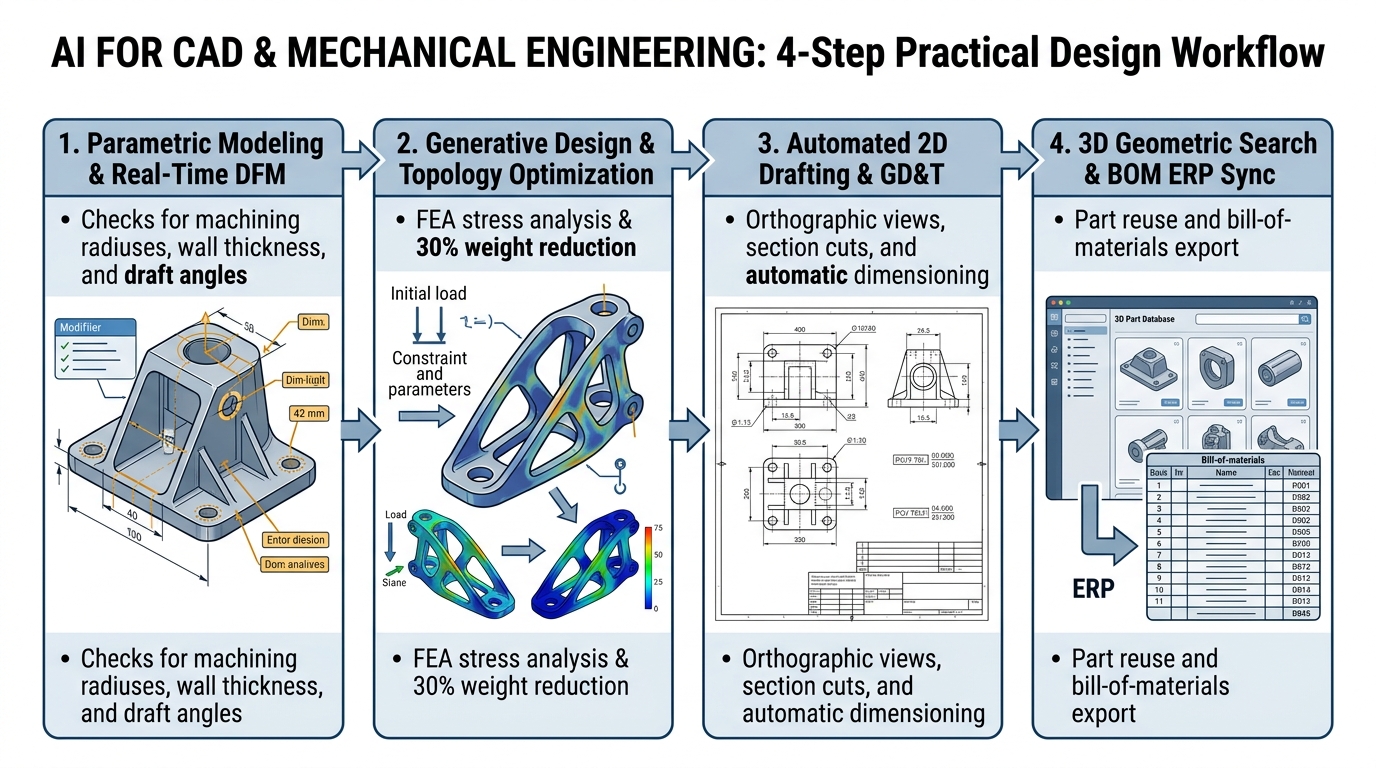
Application 1: Automated 2D Drafting and Smart Dimensioning
- The Engineering Challenge: Converting a 3D model into an error-free manufacturing drawing (DWG, DXF, or IDW) is tedious and prone to human omission. Missing an alignment tolerance or a press-fit H7/g6 callout leads to scrapped shop-floor parts and thousands of euros in wasted material.
- The AI Solution: Integrated drawing automation engines (such as DraftAid or native NX predictive drafting) inspect the B-Rep topology of the 3D solid, recognize machining datums, tapped holes, and bearing bores, and automatically lay out orthographic projections, detail sections, and 80% of functional dimensions according to company standards (ISO or ASME Y14.5).
- Impact: Drawing preparation that traditionally consumed 4 to 6 hours per complex assembly drawing is completed in under 20 minutes of engineer review and sign-off.
Application 2: Real-Time Predictive DFM and DFA Validation
- The Engineering Challenge: Discovering a machining clash when raw materials are already mounted on a milling machine multiplies rework expenses by an order of magnitude.
- The AI Solution: While the engineer models features in the Inventor or NX design tree, background validation algorithms evaluate geometric constraints in real time:
- CNC Machining: Flags internal corner radiuses requiring excessive tool overhang that induce chatter and tool deflection.
- Sheet Metal: Verifies minimum hole-to-bend relief distances to prevent stretching distortion.
- Injection Molding: Checks draft angle adequacy and highlights rapid wall thickness variations that trigger sink marks or warpage.
- Impact: A 70% decrease in engineering-to-shop revision loops with auxiliary machine shops like those highlighted in our guide on AI for small manufacturing plants.
Application 3: 3D Geometric Shape Search and PDM Component Reuse
- The Engineering Challenge: In databases containing 50,000 components, searching by filename ("bracket_rear_v2.ipt") is ineffective when a part was modeled five years ago as "flange_ang_40.prt". Remodeling a part costs 3 engineering hours plus documentation and ERP supplier setup overhead.
- The AI Solution: Geometric fingerprint algorithms index CAD databases by 3D topological shape. An engineer selects an existing solid or sketches a basic contour, and the search engine instantly returns identical or similar parts with mass and volume variance breakdowns.
- Impact: A 15% reduction in active duplicate part catalogs, consolidating fastener inventory and tooling purchases.
Application 4: Generative Design and Load-Driven Topology Optimization
- The Engineering Challenge: Traditional manual pocketing and lightweighting rely on designer intuition, often leaving unnecessary mass or creating stress concentrations in corners.
- The AI Solution: Given design envelopes, structural load cases, and manufacturing constraints (such as 3-axis CNC milling, metal casting, or additive manufacturing), generative algorithms synthesize organic, high-stiffness geometries through integrated Finite Element Analysis (FEA).
- Outcome: 25% to 40% component weight reductions while strictly preserving safety factors, cutting weeks of manual FEA iteration.
2. Financial Return on Investment (ROI) for a 10-Engineer Studio
Let us evaluate the financial impact on a mechanical engineering firm employing 10 design engineers delivering custom machinery, automotive subassemblies, or industrial tooling:
| Engineering Department Task | Traditional Manual Process | With Practical AI Automation | Annual Financial Value |
|---|---|---|---|
| Routine 2D drafting & dimensioning | 30 hrs/week manual drawing layout | 60% reduction in drafting time | +€31,500 / year |
| Shop-floor scrap due to drawing gaps | 12 machining errors per year | Real-time DFM feature audits | +€18,000 / year |
| Remodeling redundant legacy parts | ~150 duplicate parts remodeled yearly | 3D geometric shape search reuse | +€12,600 / year |
| Manual Bill-of-Materials (BOM) entry | 5 hrs/week manual spreadsheet entry | Direct assembly-to-ERP synchronization | +€5,200 / year |
| Specialized software & connector seats | €0 | CAD plugins and secure gateways | -€7,500 / year |
| NET RECOVERED ANNUAL VALUE | — | — | +€59,800 / year |
Capturing nearly €60,000 in recovered net value annually enables an engineering studio to handle up to 30% more project volume without outsourcing drafting or overworking design staff.
3. Implementation Roadmap for Engineering Studios
To guarantee smooth adoption without client friction:
- Step 1: Standardize Drafting Styles and GD&T Standards: Before automating drawings, define clear dimensioning rules, layering, and tolerance standards across your firm.
- Step 2: Connect CAD Assemblies Directly to Billing and ERP: Ensure 3D Bill of Materials (BOM) data transfers automatically into operational accounting software aligned with electronic standards like VeriFactu.
- Step 3: Safeguard Proprietary IP and Client Data: Sensitive client CAD models must never be transmitted to unvetted public AI platforms. At IA4PYMES, we implement private, dedicated automation gateways hosted on secure local workstations like the Apple Mac Studio M5 or private European clusters like NaN Builders.
Request an Operational Process AI Audit for Your Engineering Firm → We evaluate your CAD workflows, drafting bottlenecks, and project delivery timelines to deliver a high-ROI implementation plan tailored to your technical team.
4. Frequently Asked Questions
Does this workflow support neutral exchange formats like STEP and Parasolid?
Yes. Modern topological validation and DFM engines process native files (PRT, IPT, SLDPRT) as well as neutral industry formats (STEP AP214/AP242, Parasolid X_T, and IGES) without geometric fidelity degradation.
Can automated drafting apply Geometric Dimensioning and Tolerancing (GD&T)?
Yes. By recognizing functional relationships such as coaxial alignment, symmetry, and primary datum references (Datums A, B, C), automated drafting engines place geometric feature control frames (true position, perpendicularity, flatness) in accordance with ISO 1101 and ASME Y14.5 standards.
Does the engineer retain full parametric history in the design tree?
Yes. Unlike visual generative tools that output un-editable mesh blobs, professional CAD plugins for NX and Inventor construct native parametric features (extrusions, fillets, holes, and patterns) that engineers can adjust manually at any point.