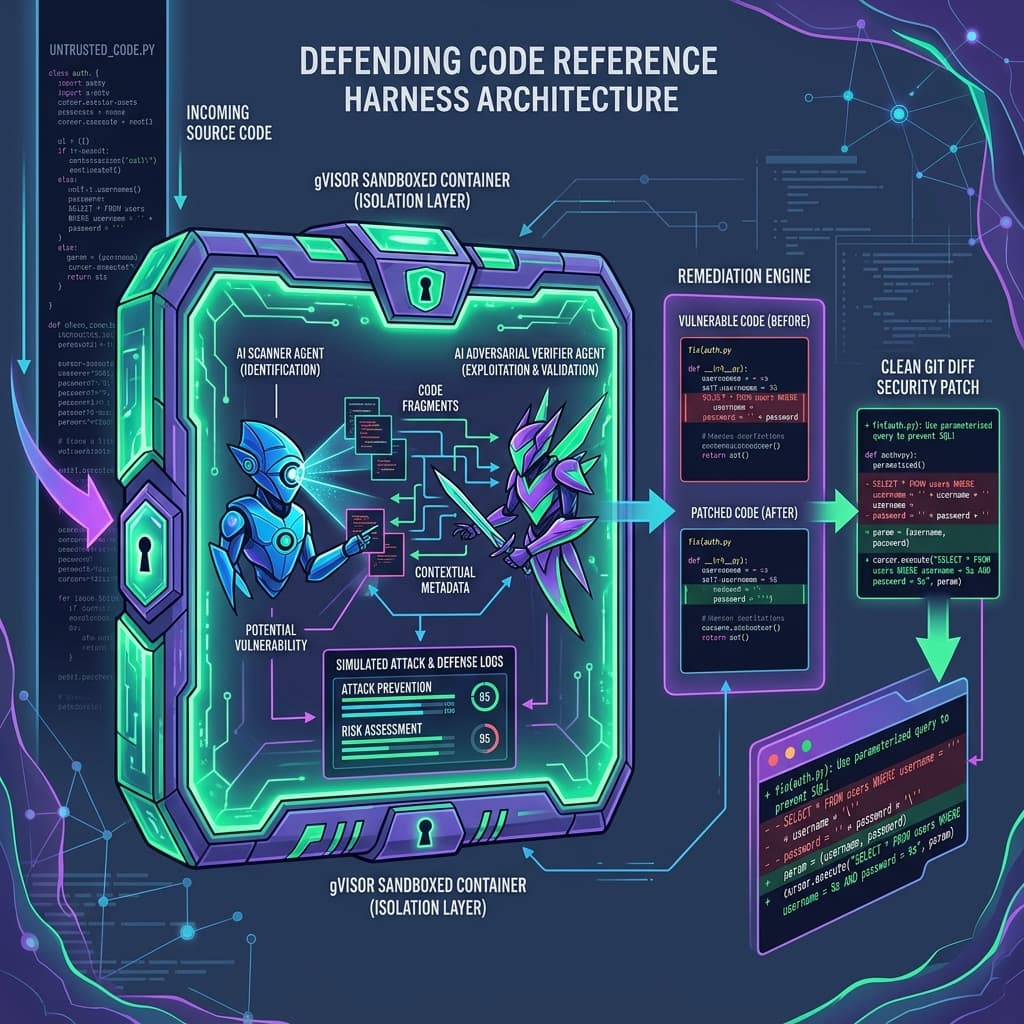

Anthropic released anthropics/defending-code-reference-harness, an open-source reference architecture engineered to solve the single hardest problem in software development: automated vulnerability discovery, verification, and patch generation without false positives or security risks.
Legacy static application security testing (SAST) scanners produce overwhelming volumes of false positives that paralyze engineering teams. Conversely, allowing unconstrained AI agents to scan and rewrite code without rigid isolation exposes enterprise infrastructure.
We evaluate how this 6-stage framework functions, how to install it step-by-step, and its strategic alignment with European NIS2 directives and the EU AI Act.
Comparison: Legacy SAST Scanners vs. Anthropic Reference Harness
| Feature | Legacy SAST Scanners (SonarQube, Snyk) | Anthropic Defending Code Reference Harness |
|---|---|---|
| False Positive Rate | Extremely high (pattern-matching alerts) | Near zero (Adversarial Verification via executable PoC) |
| Code Remediation | Generic static recommendations | Automated Git patch generation verified with unit tests |
| Execution Environment | Static plain-text scanning | Sandboxed gVisor / Docker container with hard boundaries |
| Security Lifecycle | Discovery phase only | Full 6-stage cycle: Threat Modeling, Sandbox, Scan, PoC, Triage, Patch |
| Exploitability Verification | Impossible (no code execution) | Adversarial Agent B proves exploitability before alerting engineers |
The 6 Stages of Anthropic's Security Architecture
- Threat Modeling: Defines system trust boundaries, identifying sensitive data entry points, API endpoints, and third-party libraries.
- Sandboxing: Enforces Anthropic's core architectural principle: "Security constraints must be enforced in code, not in prompts". Uses gVisor or Docker containers to isolate model invocations and restrict network/disk access.
- Discovery: Scanner Agent A analyzes source code for security flaws (SQL injection, unsafe deserialization, buffer overflows, memory leaks).
- Adversarial PoC Verification: To eliminate false positives, an independent Adversarial Agent B attempts to construct an executable Proof-of-Concept (PoC) within the sandbox. If the PoC fails to exploit the flaw, the alert is automatically discarded.
- Triage: Classifies and ranks verified vulnerabilities according to CVSS v3 severity standards.
- Patching: Drafts candidate git diff patches, runs unit test suites to prevent regression, and confirms the adversarial PoC no longer executes.
Step-by-Step Installation & Setup Tutorial
Step 1: Prerequisites and Installation
Ensure you have Python 3.10+, Docker installed and active, and an Anthropic API Key (ANTHROPIC_API_KEY):
# Clone official Anthropic repository
git clone https://github.com/anthropics/defending-code-reference-harness.git
cd defending-code-reference-harness

# Create and activate virtual environment
python -m venv .venv
source .venv/bin/activate  # On Windows: .venv\Scripts\activate

# Install dependencies
pip install -r requirements.txt
Step 2: Configure Workspace Settings (harness.yaml)
Create a central configuration file targeting your application:
version: "1.0"
target:
  directory: "./my-app"
  language: "python"
sandbox:
  type: "docker" # Options: "docker", "gvisor"
  network: "none" # Blocks outgoing internet access during testing
agent:
  model: "claude-3-7-sonnet" # Or "claude-opus-5"
  max_iterations: 15
Step 3: Run Full Security Audit Pipeline
Execute the security harness from your terminal:
python -m harness.cli run \
  --config harness.yaml \
  --output-dir ./security-reports
The CLI runs the 6-stage lifecycle. Inside ./security-reports, you will find:
verified_vulnerabilities.json: Verified flaws backed by executable PoCs.patches/:.patchfiles ready to apply viagit apply.
CI/CD Pipeline Integration (GitHub Actions)
Add this workflow to .github/workflows/security-harness.yml to block vulnerable Pull Requests automatically:
name: Security Harness Audit
on: [pull_request]

jobs:
  audit:
    runs-on: ubuntu-latest
    steps:
      - uses: actions/checkout@v4
      - name: Set up Python
        uses: actions/setup-python@v5
        with:
          python-version: '3.11'
      - name: Install Harness
        run: |
          pip install -r requirements.txt
      - name: Run Anthropic Security Audit
        env:
          ANTHROPIC_API_KEY: ${{ secrets.ANTHROPIC_API_KEY }}
        run: |
          python -m harness.cli run --target-dir . --sandbox docker
📊 Operational Impact on Code Security:
- Traditional External Audit: $5,000 to $15,000 per manual pentest ➔ Takes 2-4 weeks ➔ Static PDF reports
- Anthropic Reference Harness: Runs in minutes in CI/CD ➔ Near-zero false positives ➔ Automated Git patches
🔒 Secure Your SME Codebase and Comply with NIS2 & EU AI Act
European NIS2 directives and the EU AI Act require strict security auditing and supply-chain traceability. At IA4PYMES, we help engineering teams deploy Anthropic's reference harness and establish automated DevSecOps pipelines.
Book your 60-minute technical consultation here (100% refundable or credited against final development costs).
Architectural Best Practices
- Strict Sandboxing: Always run the harness inside gVisor containers in production to prevent adversarial PoCs from escaping to host machines.
- Integrate with Unified Gateways: Route tool connections through a centralized proxy following our Executor.sh MCP Gateway Guide.
- Audit Agent API Endpoints: Ensure strict schema validation on all tool payloads as detailed in our Gemini 3.6 Flash and 3.5 Flash Cyber Analysis.
- Streamline Design Workflows: Pair security automation with design-to-code pipelines via our Figma-Context-MCP Tutorial.