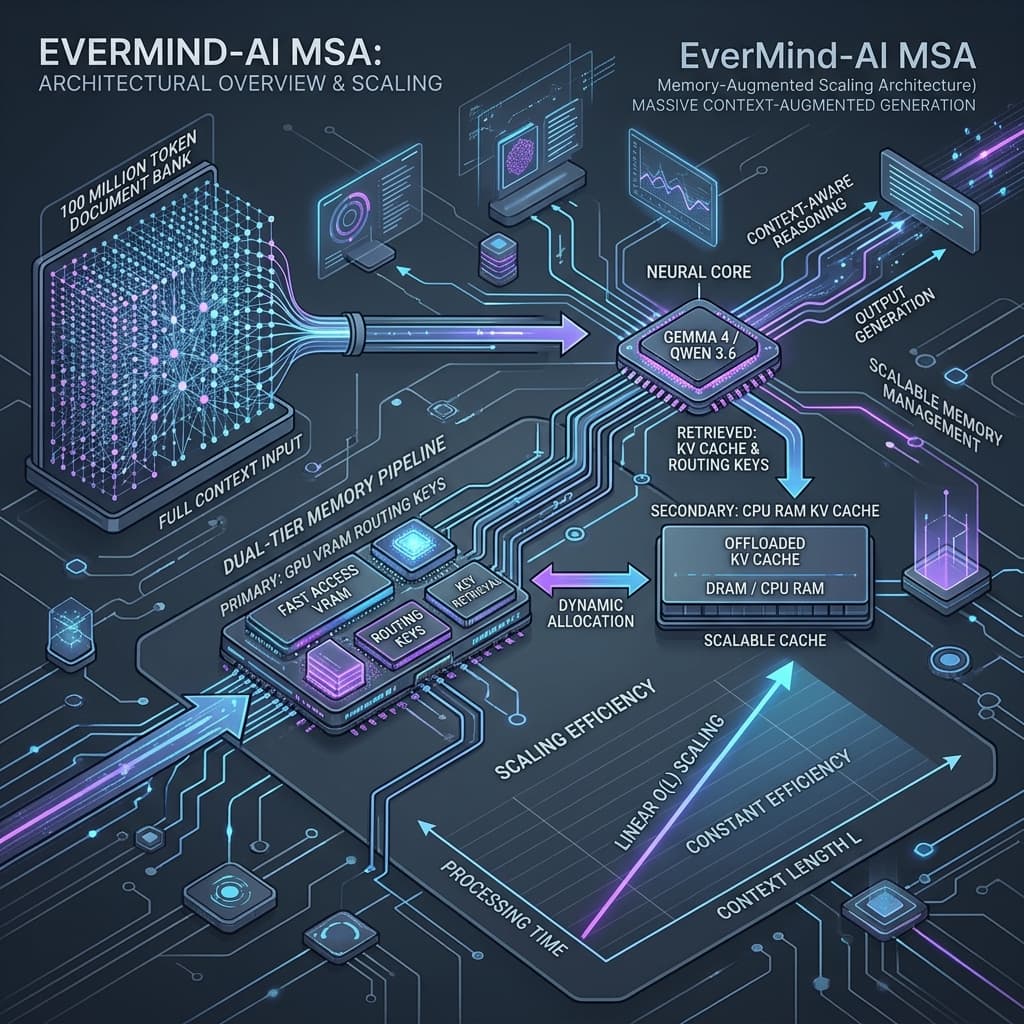

Processing massive enterprise knowledge bases (hundreds of technical PDFs, complete legal databases, or codebases exceeding 50,000 lines) using local AI models has faced two fundamental barriers: quadratic VRAM consumption ($O(L^2)$) and multi-hop reasoning degradation in traditional RAG pipelines.
EverMind-AI, in collaboration with Peking University, released Memory Sparse Attention (MSA) (https://github.com/EverMind-AI/MSA), an open-source architecture that extends the context window of small, efficient models (Gemma 4, Qwen 3.6) up to 100 Million tokens ($10^8$) on commodity hardware.
We analyze its underlying mathematics, sparse attention mechanism, and step-by-step deployment instructions for enterprise servers.
Comparison: Full Attention vs. Traditional RAG vs. EverMind-AI MSA
| Feature | Full Attention | Traditional RAG (Vector DBs) | EverMind-AI MSA |
|---|---|---|---|
| Context Extrapolation | Max 128K - 1M tokens | Indefinite (fragmented) | 100 Million true active tokens |
| Compute Complexity | Quadratic $O(L^2)$ | Linear $O(K)$ over chunks | Linear $O(L)$ over entire corpus |
| Multi-Hop Reasoning | Native and complete | Poor (chunk isolation) | Native and differentiable ($>91%$ recall) |
| VRAM Consumption | Exhausts VRAM rapidly | Low VRAM usage | Routing Keys in VRAM / KV Cache in RAM |
| Positional Extrapolation | RoPE degrades beyond training | No global positioning | Document-Level RoPE (resets per document) |
3 Core Architectural Innovations of Memory Sparse Attention
1. Hierarchical Memory Decoupling
Rather than storing the entire Key-Value (KV) cache inside GPU VRAM, MSA splits data into two tiers:
- Routing Keys: Highly compressed feature vectors stored in high-speed GPU VRAM to perform sub-millisecond retrieval routing.
- Memory Content (Full KV Cache): Offloaded to main system RAM (CPU). The system asynchronously prefetches only top-k chunks selected by the router into active GPU working memory during token generation.
2. End-to-End Differentiable Attention Routing
Unlike standard RAG, which operates as an external vector database disconnected from the model, MSA's routing mechanism is embedded directly within the Transformer's attention layers. This preserves native attention matrices required to resolve complex queries across multiple documents.
3. Document-Level RoPE (Reset-on-Document)
Rotary Position Embeddings (RoPE) fail when extrapolated far beyond training limits. MSA resolves this by resetting the positional counter to zero at the start of each new document within the bank. This allows models trained on 8K/32K contexts (such as Gemma 4 or Qwen 3.6) to navigate 100M token context banks without positional collapse.
Step-by-Step Installation & Setup Guide
Step 1: System Prerequisites & Installation
Requires a Linux environment with PyTorch 2.2+, CUDA 12.x support, and Triton:
# Clone official EverMind-AI repository
git clone https://github.com/EverMind-AI/MSA.git
cd MSA

# Create virtual environment and install in editable mode
python -m venv .venv
source .venv/bin/activate
pip install -e .
Step 2: Running Inference with Gemma 4 / Qwen 3.6
The following Python script demonstrates loading a small model and running inference over a massive corpus using CPU offloading:
import torch
from msa import MSAModelForCausalLM, MSAConfig

# Configure MSA harness parameters
msa_config = MSAConfig(
    top_k=8,                 # Active attention blocks per layer
    chunk_size=1024,         # Document chunk block size
    offload_device="cpu",    # Offload full KV cache to CPU RAM
    compressed_dim=128       # Routing Key vector size in VRAM
)

# Load small model with MSA extension
model = MSAModelForCausalLM.from_pretrained(
    "Qwen/Qwen3.6-7B-Instruct",
    msa_config=msa_config,
    torch_dtype=torch.bfloat16,
    device_map="auto"
)

# Load massive text corpus (e.g. 50 enterprise PDFs)
with open("enterprise_knowledge_bank.txt", "r", encoding="utf-8") as f:
    massive_context = f.read()

prompt = f"<context>{massive_context}</context>\n\nWhat is the projected consolidated operating margin for Q4?"

inputs = model.tokenizer(prompt, return_tensors="pt").to("cuda")
output = model.generate(**inputs, max_new_tokens=256)

print(model.tokenizer.decode(output[0], skip_special_tokens=True))
📊 Financial & Infrastructure Impact:
- Cloud Processing for 100M Tokens: $150 to $300 per query via commercial APIs ➔ Unviable for ongoing operations
- Local EverMind-AI MSA: $0 recurring cost per token ➔ Runs on 64GB RAM local servers ➔ Total data privacy
🔒 Deploy Local Models with Infinite Context in Your Enterprise
Maintaining data sovereignty while processing massive document volumes requires advanced memory architectures. At IA4PYMES, we help engineering teams deploy local AI servers running Gemma 4, Qwen 3.6, and MSA.
Book your 60-minute technical consultation here (100% refundable or credited against final development costs).
Architectural Best Practices
- RAM Sizing: Ensure host servers feature at least 64 GB to 128 GB of DDR5 RAM to accommodate full 100M token KV caches.
- Pair with Unified Gateways: Connect local agents to enterprise data tools following our Executor.sh MCP Gateway Guide.
- Audit Code Security: Implement automated security verification using our Anthropic Defending Code Reference Harness Guide.
- Validate API Endpoints: Ensure payload contract validation based on our Gemini 3.6 Flash & 3.5 Flash Cyber Analysis.