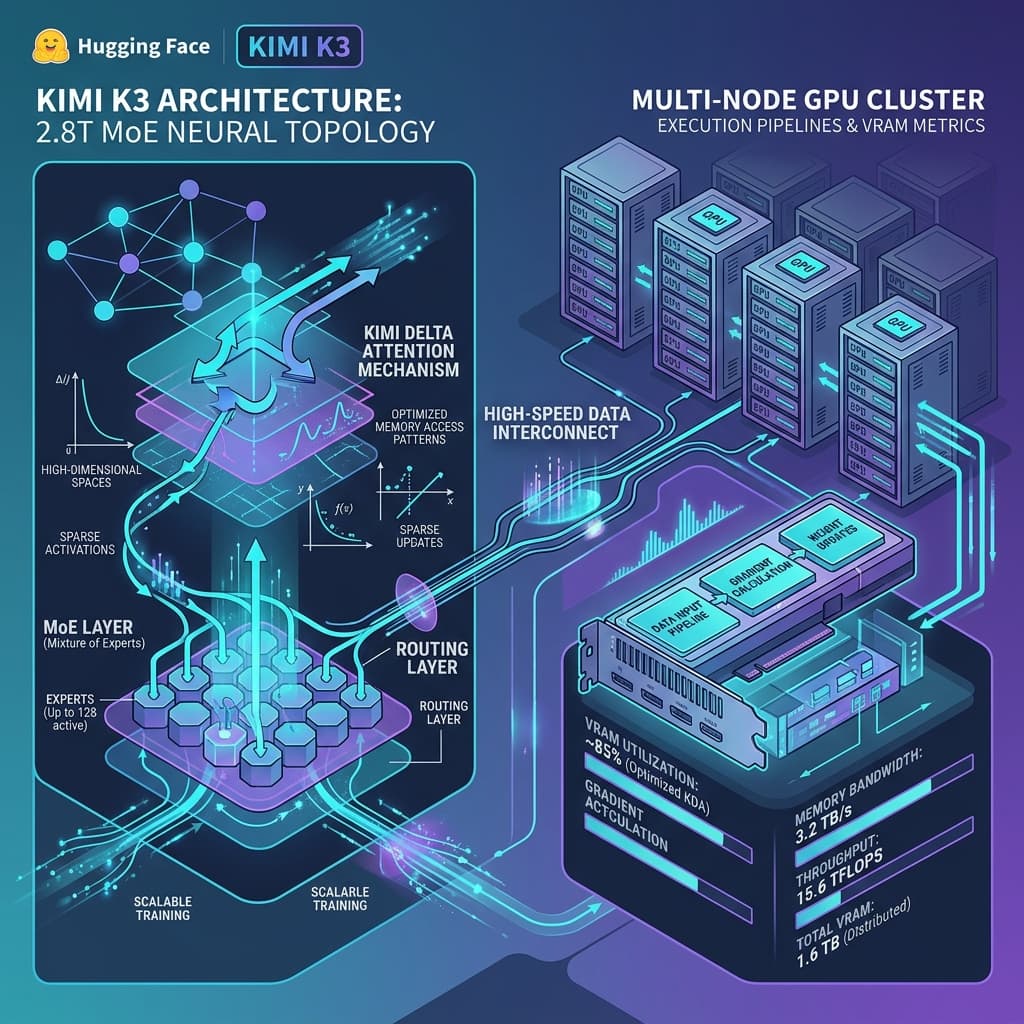

Moonshot AI has officially published the full weights of Kimi K3 on Hugging Face (moonshotai/Kimi-K3).
Featuring a 2.8 Trillion parameter architecture, Kimi K3 represents the largest open-weights model released to date, breaking the 3-trillion parameter barrier in the open-source community.
We analyze the technical commands to download and run moonshotai/Kimi-K3, detail actual GPU cluster VRAM demands, and explain how enterprise SMEs can leverage its deep reasoning without incurring unsustainable infrastructure costs.
Kimi K3 Technical Datasheet (moonshotai/Kimi-K3)
| Parameter / Feature | Technical Specification |
|---|---|
| Hugging Face Repository | moonshotai/Kimi-K3 |
| Total Parameters | 2.8 Trillion (2,800,000,000,000) |
| Active Parameters per Token | ~16 out of 896 experts (Sparse MoE Architecture) |
| Context Window | 1,000,000 tokens (1M) |
| Integrated Attention | Kimi Delta Attention (KDA) + AttnRes |
| Weight License | Open for research and self-hosting |
| Minimum VRAM (FP16/BF16) | ~5,600 GB VRAM (8x DGX Multi-Node Cluster) |
| Minimum Quantized VRAM (FP8/NVFP4) | ~1,400 GB - 1,800 GB VRAM |
Practical Download Guide from Hugging Face
For engineering teams and research labs looking to evaluate the raw model weights on private clusters, downloads are executed via huggingface-cli:
1. Weight Download via Hugging Face CLI
# Install Hugging Face tools and inference backends
pip install -U huggingface_hub vllm sglang

# Accelerated download of moonshotai/Kimi-K3
huggingface-cli download moonshotai/Kimi-K3   --local-dir ./models/Kimi-K3   --local-dir-use-symlinks False   --max-workers 16
2. Deployment Script using vLLM with Tensor Parallelism
Given its 2.8T scale, inference requires model parallelism across multiple GPUs and nodes. Below is the server initialization script using vLLM:
import os
from vllm import LLM, SamplingParams

# Multi-GPU cluster environment setup
os.environ["CUDA_VISIBLE_DEVICES"] = "0,1,2,3,4,5,6,7"

sampling_params = SamplingParams(
    temperature=0.2,
    top_p=0.95,
    max_tokens=1024
)

# Initialize Kimi K3 with Tensor Parallelism (TP=8)
llm = LLM(
    model="./models/Kimi-K3",
    tensor_parallel_size=8,
    trust_remote_code=True,
    max_model_len=65536,
    gpu_memory_utilization=0.92
)

prompt = "Analyze the following database schema and generate a lossless SQL migration script:"
outputs = llm.generate([prompt], sampling_params)

for output in outputs:
    print(output.outputs[0].text)
Hardware Reality: What Infrastructure Does Kimi K3 Demand?
It is essential to recognize that Kimi K3 is not designed for single commercial GPUs or small local servers:
- On-Disk Model Size: Raw model files exceed 5.5 Terabytes of storage space.
- VRAM Memory Demands:
- Full precision (BF16) requires over 5,600 GB of VRAM, representing a cluster of 8 inter-connected DGX B200 / H200 nodes via InfiniBand.
- Quantized FP8 or NVFP4 precision requires at least 1,400 GB of VRAM (a minimum of 16x 80GB H100/H200 GPUs).
Consequently, attempting to self-host Kimi K3 on a single on-premise SME server is technically unfeasible.
Pragmatic SME Strategy: Hybrid Inference and Data Sovereignty
To handle Kimi K3's massive scale efficiently, small and medium enterprises should adopt a two-tier hybrid deployment strategy:
1. Local Dense Models for Daily Workflows
For high-frequency tasks (email routing, invoice extraction, customer support), deploy compact open models such as Gemma 4, Qwen 3.6, or GLM-5.2 self-hosted on private 24GB-48GB GPU servers, ensuring strict compliance with the EU AI Act Countdown by August 2026.
2. Kimi K3 via Routed API for Heavy Offline Reasoning
For complex multi-repository refactoring or strategic analysis, route requests to Kimi K3 API endpoints through our Executor.sh MCP Gateway hardened against FARMA episodic memory poisoning attacks.
📊 Inference Architecture Cost Breakdown:
- Full Self-Hosted Kimi K3 Cluster: > €25,000 / month in multi-node dedicated cluster hosting.
- IA4PYMES Hybrid Architecture (Local Models + Routed Kimi K3 API): ~€450 / month in local GPU server + pay-per-use API calls. 98% reduction in infrastructure overhead.
🔒 Architect & Deploy Your Enterprise AI Infrastructure
Avoid overspending on unnecessary GPU clusters or locking into managed cloud services like OpenAI Presence. At IA4PYMES, we audit your compute requirements and deploy the optimal hybrid architecture for your business.
Book your 60-minute technical consultation here (100% refundable or credited against final development costs).
Technical Resources
- Official Hugging Face Repository: moonshotai/Kimi-K3
- Sparse Attention: Read our technical guide on EverMind-AI MSA 100M token context.