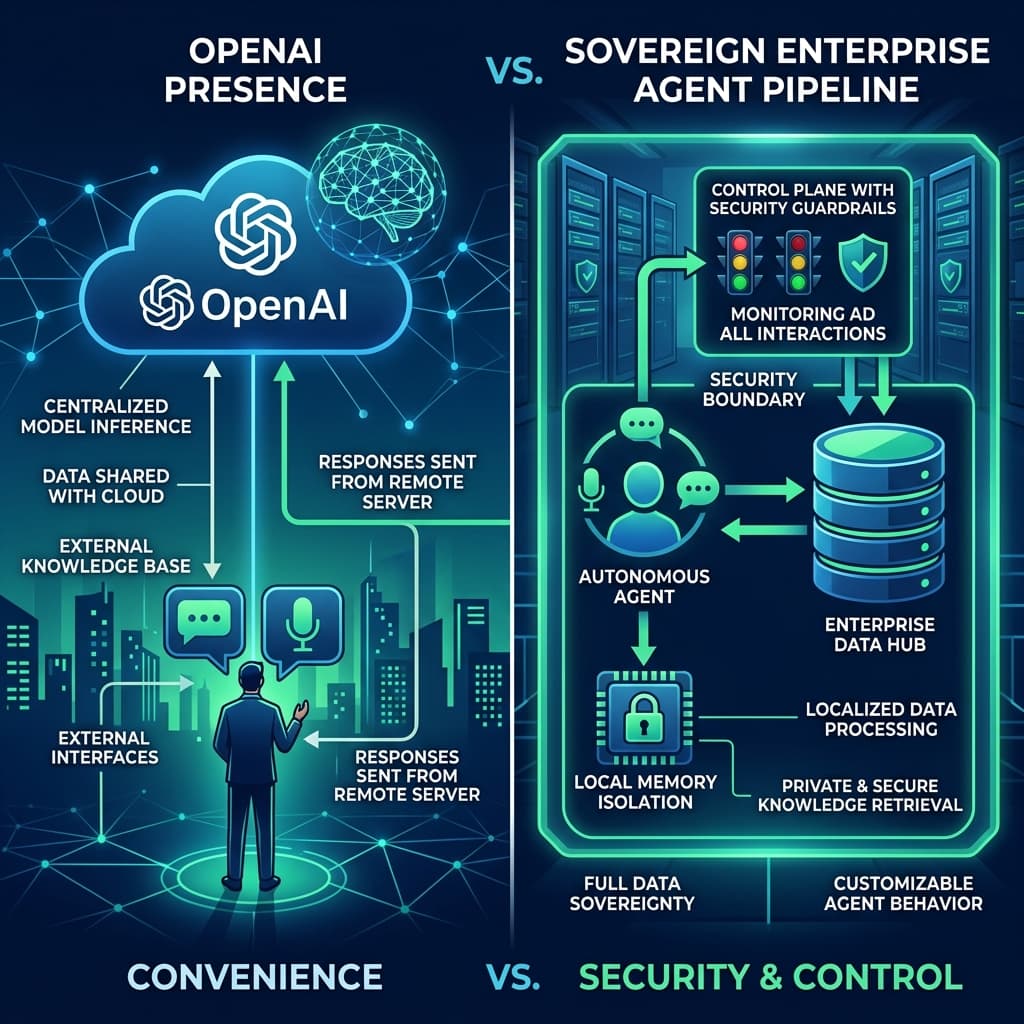

On July 22, 2026, OpenAI officially announced OpenAI Presence, a managed enterprise platform for deploying autonomous voice and chat AI agents.
Designed to automate high-value corporate workflows (inbound customer phone support, internal IT service management, and sales qualification), Presence marks OpenAI's direct entry into managed enterprise software infrastructure.
We evaluate the technical architecture of OpenAI Presence, analyze hidden costs and vendor lock-in risks for small and medium enterprises, and detail how to build an equivalent sovereign agent pipeline on private infrastructure.
Comparison: OpenAI Presence vs. Sovereign Agent Architecture
| Technical Dimension | OpenAI Presence (Managed Platform) | IA4PYMES Sovereign Architecture |
|---|---|---|
| Deployment Model | Managed SaaS platform with FDE engineers | On-premise servers / Private customer VPC |
| Data Sovereignty | OpenAI cloud telemetry & storage | 100% local sovereignty (Zero Telemetry) |
| Voice Architecture | Proprietary real-time voice API | Local Whisper STT + Kokoro TTS on private GPU |
| Reasoning Model | Closed frontier models (GPT-5.6 / Sol) | Open models (Gemma 4 / Qwen 3.6 / GLM-5.2) |
| Governance & Security | Platform-managed escalation rules | Unified MCP Gateway with HMAC-SHA256 signing |
| Cost Structure | Per-seat fee + token/minute consumption | Fixed infrastructure cost with zero per-token tax |
Core Components of OpenAI Presence
1. Pre-Production Simulation Suite
Before deploying an agent to live customer channels, Presence executes automated simulation suites. The agent interacts with synthetic customer personas to evaluate task resolution rates and verify compliance with company policy guardrails.
2. Automated Behavior Refinement via Codex
When an agent fails or escalates to a human operator, Presence analyzes the conversation trace in the background using coding models. Codex generates proposed behavior updates or configuration code that supervisors approve with a single click.
3. Managed Engineer-Led Rollout (Forward Deployed Engineers)
Unlike self-serve developer APIs, OpenAI offers Presence as a fully managed service supported by dedicated consultants and Forward Deployed Engineers (FDEs), mirroring enterprise systems integration models.
Vendor Lock-In Risks and NIS2 Compliance
For SMEs operating within the European Union, delegating voice channels and customer records to a managed external platform presents three major obstacles:
- EU AI Act Compliance (August 2026): Mandates independent auditing of reasoning logs, bias evaluation, and training data provenance.
- Unpredictable Variable Costs: Continuous phone calls and real-time conversational processing generate per-token and per-minute charges that scale quadratically with customer volume.
- Vendor Lock-In: Workflows, escalation rules, and business logic become tightly coupled to OpenAI's proprietary ecosystem.
Building a Sovereign Agent Pipeline for Your Enterprise
SMEs can implement a voice and chat agent channel with equivalent performance using open-source components deployed on private infrastructure:
Sovereign Execution Flow:
- Speech-to-Text Layer (STT): Deploy local Whisper on dedicated GPUs to transcribe incoming voice to text in under 150 ms without transmitting audio off-site.
- Reasoning & Memory Layer: Integrate open models such as Gemma 4 or Qwen 3.6 using sparse attention compression via EverMind-AI MSA to maintain deep ERP and catalog context.
- Security & Tool Integration Layer: Route corporate API calls through Executor.sh MCP Gateway with cryptographic signing against FARMA episodic memory poisoning attacks.
- Text-to-Speech Synthesis Layer (TTS): Generate spoken responses with ultra-low latency using Kokoro TTS.
# Local sovereign agent router example
from executor_mcp import AgentGateway
from memory_guard import verify_hmac_signature

gateway = AgentGateway(
    model_path="models/Qwen3.6-7B-Instruct",
    memory_backend="local_sqlite",
    security_guard="sentinel_v2"
)

def process_customer_call(audio_chunk: bytes) -> dict:
    text_prompt = local_whisper.transcribe(audio_chunk)
    response = gateway.execute_reasoning(
        prompt=text_prompt,
        max_tokens=256,
        temperature=0.2
    )
    audio_output = local_kokoro.synthesize(response.text)
    return {"audio": audio_output, "log_id": response.log_id}
📊 Estimated Financial Comparison (10,000 interactions/month):
- Managed Cloud Platform: ~€3,800 / month in licensing fees, token tolls, and voice minute metering.
- Self-Hosted Sovereign Infrastructure: ~€450 / month in fixed private GPU server costs. 88% reduction in recurring operational expenditure.
🔒 Architect & Deploy Your Sovereign Enterprise AI Pipeline
Do not lock your enterprise customer data into closed platforms. At IA4PYMES, we design, deploy, and harden autonomous voice and data agent architectures on your own private infrastructure.
Book your 60-minute technical consultation here (100% refundable or credited against final development costs).
Architectural Recommendations for Technical Teams
- Automated Code Guardrails: Run continuous verification suites using Anthropic's Defending Code Reference Harness.
- Regulatory Compliance: Review transparency and human oversight requirements under the EU AI Act Countdown for August 2026.