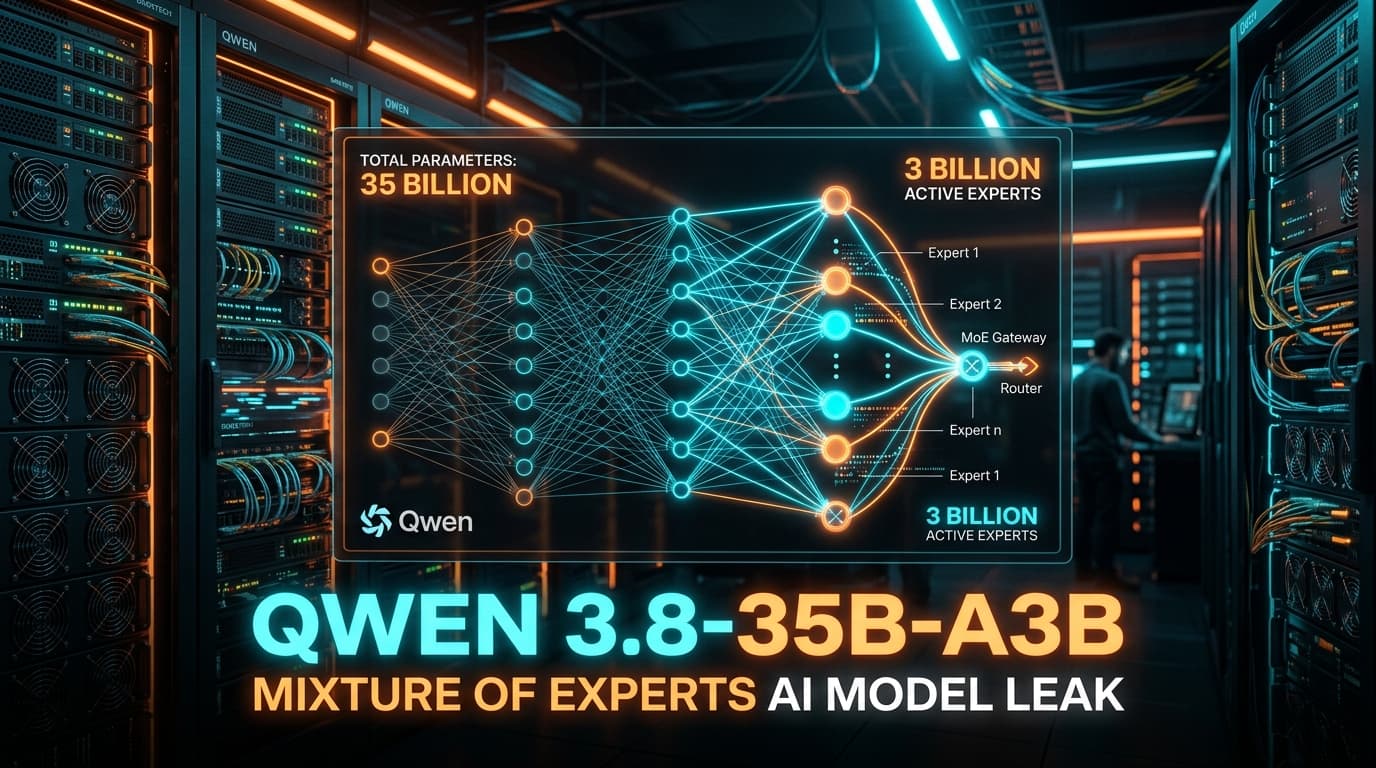

While the developer community was actively deploying the dense Qwen 3.8-27B release on Hugging Face and its recent Unsloth GGUF quantizations, a quiet commit in Alibaba's official ModelScope ms-swift repository revealed Alibaba's primary architectural leap: the registration of Qwen/Qwen3.8-35B-A3B.
Discovered in commit ab726e9d445a6520a70df2c831177d46adb1f589, the update confirms that the Qwen team is preparing to release a Mixture of Experts (MoE) model featuring 35 billion total parameters with only ~3 billion active parameters per generated token (A3B = Active 3 Billion).
For small and medium enterprises seeking AI autonomy without multi-thousand-dollar cloud GPU clusters, this architecture provides significant operational advantages over legacy dense models.
In this technical breakdown, we examine the commit evidence, the computational mechanics of MoE versus dense models, hardware memory requirements across VRAM/RAM tiers, and why 35B-A3B democratizes high-throughput local agentic deployments.
1. Technical Evidence: The ModelScope Commit
The leak originates from Alibaba's official fine-tuning and deployment framework repository (modelscope/ms-swift), where dedicated model loaders and template configurations for the Qwen 3.8 MoE family were committed:
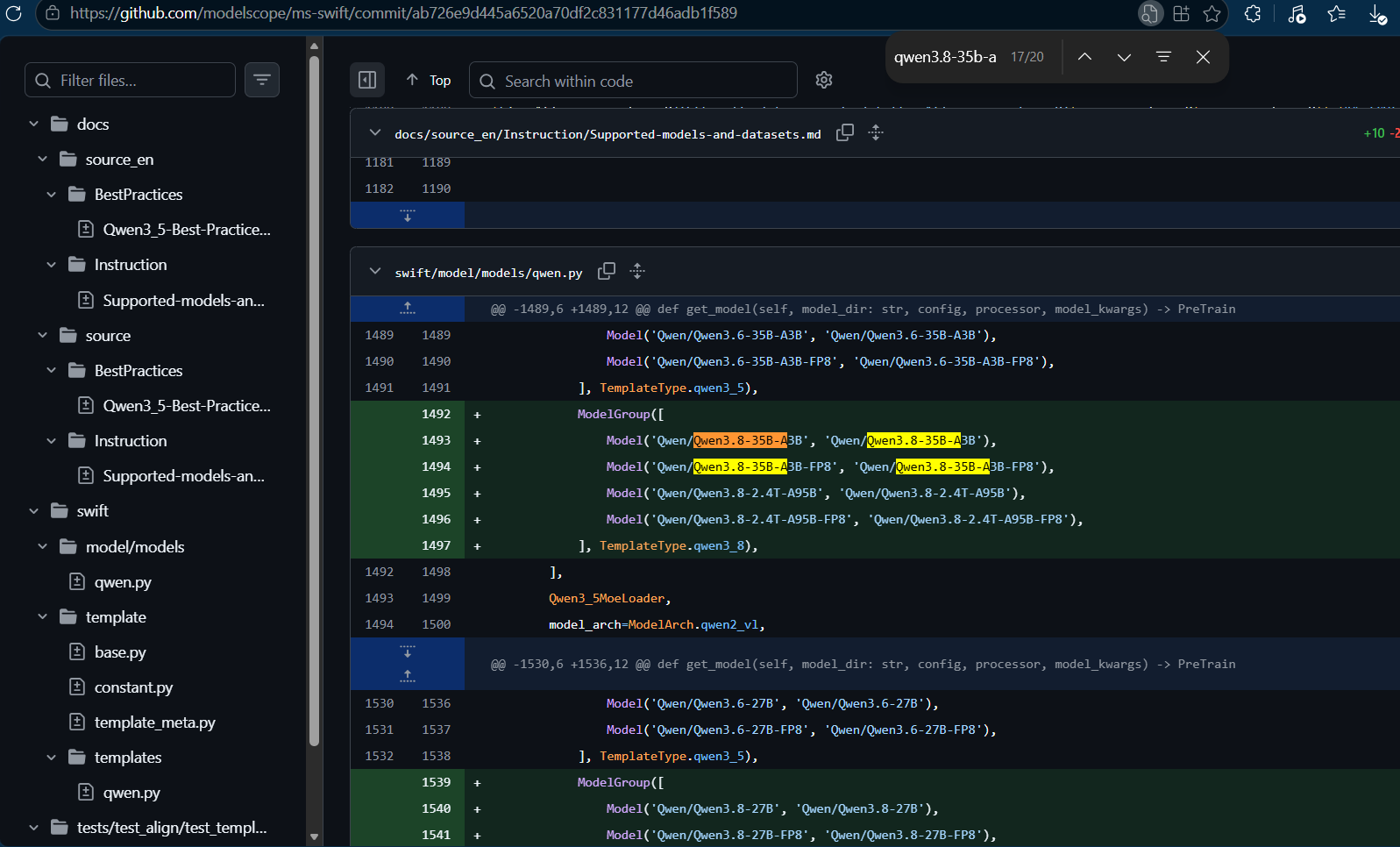
Key implementation details in swift/model/models/qwen.py:
- Addition of the model entry
Qwen/Qwen3.8-35B-A3Band its nativeFP8counterpart. - Integration with the
Qwen3_5MoeLoaderengine andTemplateType.qwen3_8. - Simultaneous inclusion of the flagship cluster model
Qwen/Qwen3.8-2.4T-A95B(2.4 trillion parameters with 95B active).
2. Dense vs. MoE: Why 35B-A3B Changes Local AI Economics
To understand the operational and financial impact, consider the mathematical distinction between dense networks and Mixture of Experts (MoE):
┌─────────────────────────────────────────────────────────────────────────┐
│                    COMPUTATIONAL ARCHITECTURE COMPARISON                │
├───────────────────────────────────┬─────────────────────────────────────┤
│ DENSE MODEL (QWEN 3.8-27B)        │ MOE MODEL (QWEN 3.8-35B-A3B)        │
├───────────────────────────────────┼─────────────────────────────────────┤
│ • 27 Billion parameters computed  │ • 35 Billion total parameters in mem│
│   for EVERY generated token       │ • Only ~3 Billion active parameters │
│ • High FLOPs computation per token│   computed per generated token      │
│ • Moderate speed (20-30 tok/sec)  │ • Computational cost of a 3B model  │
│ • Demands high memory bandwidth   │ • Ultra-high speed (60-90 tok/sec)  │
└───────────────────────────────────┴─────────────────────────────────────┘
The Expert Routing Advantage:
- 35B Knowledge Capacity: The model retains 35 billion parameters distributed across specialized sub-networks (coding, mathematical logic, JSON parsing, legal analysis).
- 3B Compute Latency: A dynamic router activates only the top 2–3 relevant experts per token. Computing a response requires only the FLOPS of a 3B model.
- Massive Throughput on Budget Hardware: While a dense 27B model saturates mid-range GPUs (NVIDIA RTX 3060/4060/4070 with 8GB–16GB VRAM), the 35B-A3B 4-bit quantized model outputs tokens at 60 to 80+ tokens per second.
3. SME Hardware & Memory Requirements
Because the compute workload per token is equivalent to a 3B model, the GPU compute capability is no longer the bottleneck—only hosting the total weights in memory:
| Format / Quantization | Total Memory (VRAM + RAM) | Estimated Generation Speed | Minimum Hardware Target |
|---|---|---|---|
| Q3_K_M (MoE) | ~14 GB | 70-90 tok/s | 12GB GPU (RTX 3060/4070) or 24GB PC RAM |
| Q4_K_M (Standard) | ~18-20 GB | 60-80 tok/s | 1x RTX 4080 (16GB) / RTX 4090 / Mac 32GB |
| Q5_K_M / Q6_K | ~23-26 GB | 50-70 tok/s | Mac Studio 36GB / Dual 16GB GPUs / 48GB RAM |
| Native FP8 | ~35 GB | 80-110 tok/s | 2x RTX 4090 (48GB VRAM) / Mac Studio 64GB |
4. High-ROI Business Use Cases for Qwen 3.8-35B-A3B
┌──────────────────────────────────────────────────────────────┐
│             SME AGENT WORKFLOW WITH QWEN 3.8-35B-A3B         │
└──────────────────────────────┬───────────────────────────────┘
                               │
               ┌───────────────┴───────────────┐
               ▼                               ▼
    [High Local Throughput]         [Zero SaaS Token Invoicing]
               │                               │
       ┌───────┴───────┐               ┌───────┴───────┐
       ▼               ▼               ▼               ▼
 [Voice Customer Care] [ERP Extraction] [Code Agents]   [Audit Compliance]
 (Sub-100ms Latency)  (SQL Queries)    (DeepSeek-Harn)  (VeriFactu GDPR)
- Real-Time Voice AI Customer Service: Speeds exceeding 70 tokens/sec allow seamless integration with conversational voice agents without awkward latency pauses.
- High-Volume Invoice & Document Extraction (VeriFactu): Extracts and cross-references tax IDs, tax rates, and line items across hundreds of receipts per minute locally.
- Autonomous Agent Loops with DeepSeek Harness and Executor.sh: In multi-step tool calling pipelines, high inference speed eliminates execution latency in terminal environments.
5. Hybrid Enterprise Strategy: Preparing Your Stack
In anticipation of the public weights drop, businesses should prepare their integration pipeline:
- Step 1 (Model Context Protocol Integration): Configure standardized local MCP gateways so the model directly interfaces with internal SQL databases and ERPs.
- Step 2 (Workload Segmentation): Route 1M-token PDF archives and complex video tasks to cloud APIs like Gemini 3.7 Flash or GLM-5.3, while shifting 100% of recurring, sensitive business logic to local Qwen 3.8-35B-A3B.
6. Next Steps for Your Business
Mixture of Experts architecture removes the compute bottlenecks of on-premise AI deployments.
Book a Sovereign AI Infrastructure Consultation with IA4PYMES → We engineer and deploy on-premise MoE AI clusters and secure agentic architectures with guaranteed ROI.
7. Frequently Asked Questions
What does "35B-A3B" mean in model naming?
It designates a model with 35 billion total parameters loaded in memory, where each token routes through a dynamic subset of expert networks equivalent to 3 billion active parameters (A3B).
Why is an MoE model significantly faster than a dense model?
A dense 27B model forces the GPU to calculate all parameters per token. In contrast, an MoE model only computes the active 3B parameters, requiring substantially fewer FLOPS and tripling generation speed.
When will the official weights for Qwen 3.8-35B-A3B be released?
Historically, once Alibaba commits model architecture definitions and template loaders to ModelScope repositories (ms-swift), public weight releases on Hugging Face follow within days or weeks.