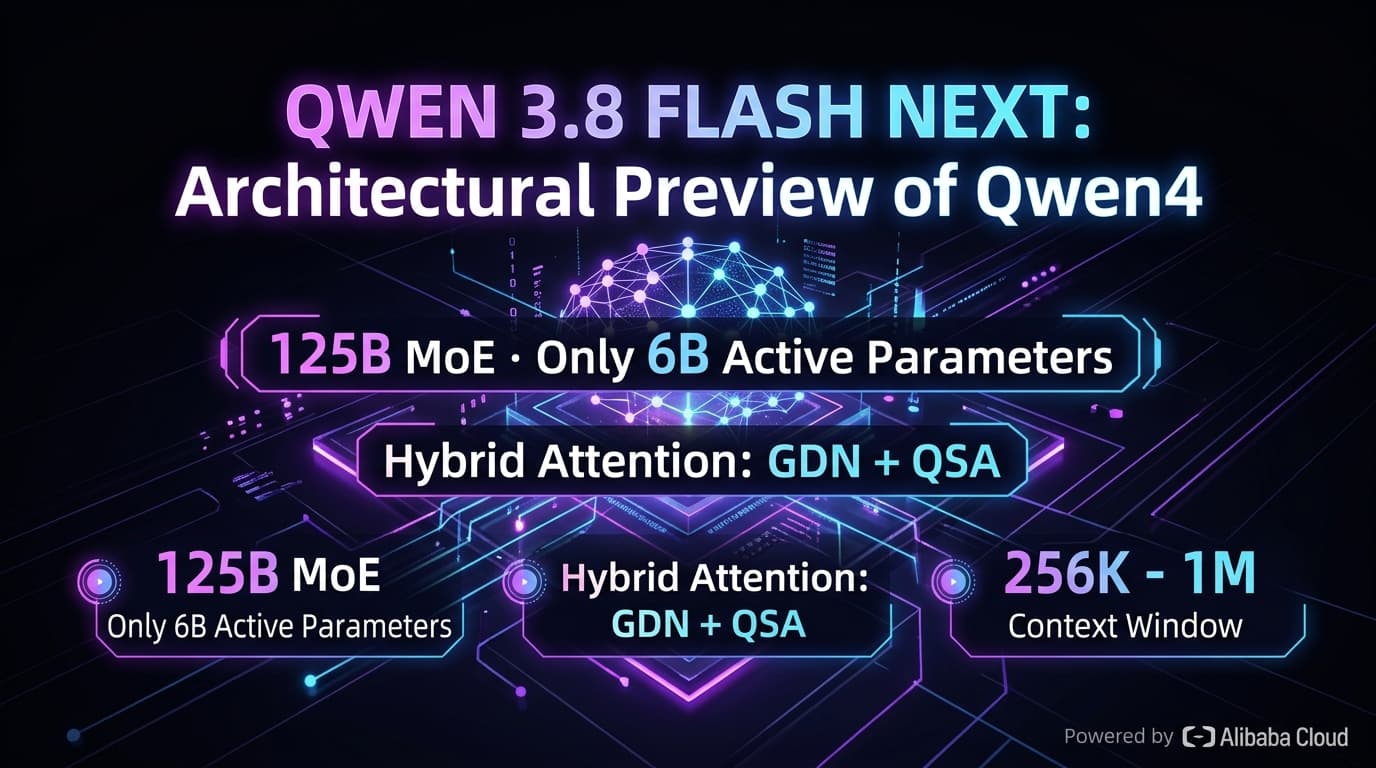

Alibaba’s AI research team has unveiled an early architectural blueprint of their upcoming model generation: Qwen 3.8 Flash Next, serving as the foundational prototype for the forthcoming Qwen4 series.
Rather than merely increasing parameter count or dataset size, Qwen 3.8 Flash Next introduces fundamental structural revisions to the transformer attention mechanism and expert routing: a 125-billion-parameter Mixture-of-Experts (MoE) that activates only 6 billion parameters per token, paired with Hybrid Attention (GDN + QSA) and a 51B parameter N-Gram Embedding Table.
The outcome is an ultra-fast, multimodal open-weight model with a native 256K context window (extensible to 1 million tokens) that executes at high token throughput with a fraction of the compute and memory footprint required by traditional dense architectures.
1. Architectural Breakdown: Four Core Innovations in Qwen 3.8 Flash Next
Alibaba has restructured the core transformer stack to break the traditional trade-off between model capability, generation speed, and compute cost:
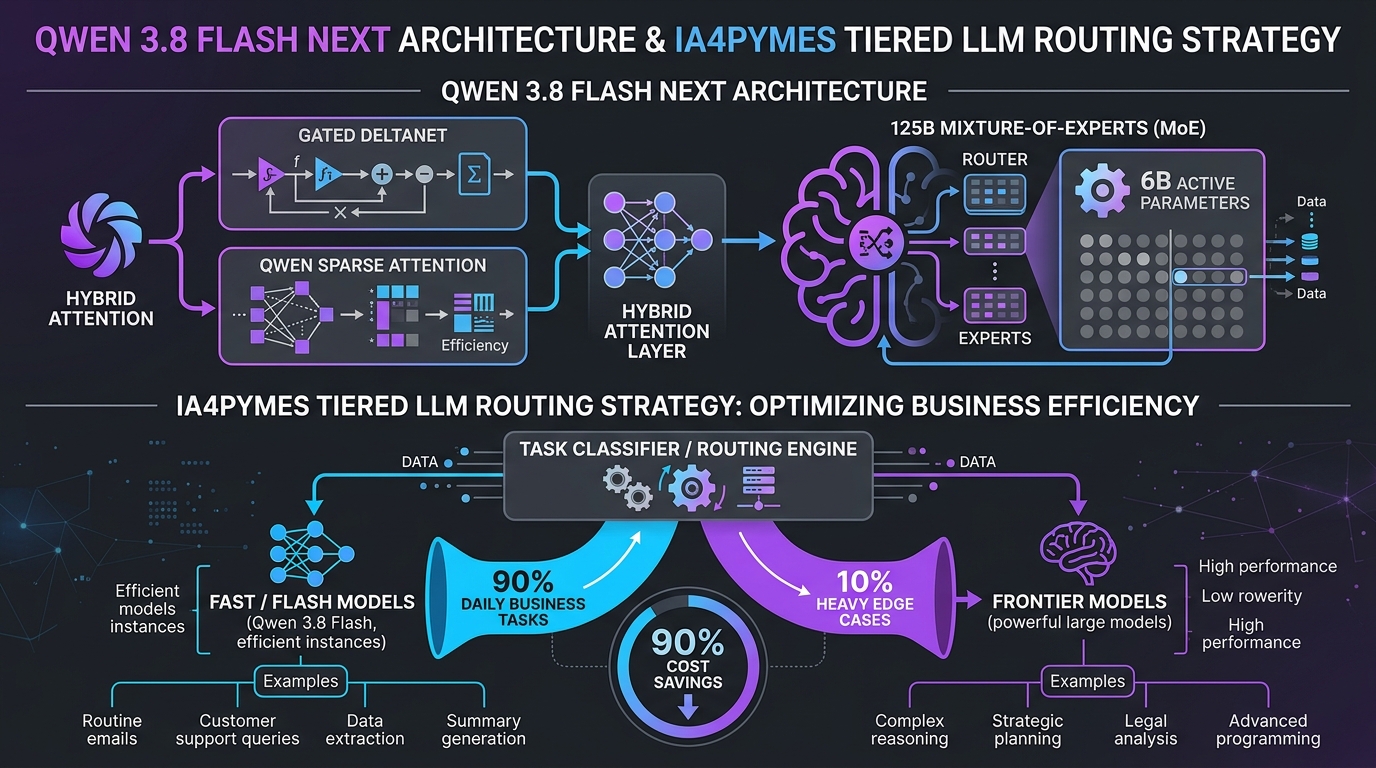
A) Ultra-Sparse MoE: 125B Total Parameters / 6B Active per Token
While the model encompasses 125 billion parameters, its dynamic routing gate routes each token through only 6 billion active parameters. During inference, GPU compute requirements mirror those of a lightweight 6B model, yet retention of knowledge and generalization benchmarks match massive frontier systems.
B) Hybrid Attention: Gated DeltaNet (GDN) + Qwen Sparse Attention (QSA)
Standard full attention scales with quadratic complexity (O(N^2)), introducing heavy latency in long-context document analysis. Flash Next introduces a dual-path hybrid attention architecture:
- Gated DeltaNet (GDN): Compresses conversation history in linear time (O(N)) via recurrent state updates and dynamic gating.
- Qwen Sparse Attention (QSA): Applies micro-block sparse attention to focus GPU compute strictly on tokens pertinent to the current query.
C) 51B Parameter N-Gram Embedding Table
The model scales model expressiveness along a compute-invariant axis: an N-gram lookup table (indexed by bigrams and trigrams) incorporating 51 billion parameters without adding FLOPs. Because these are read-only memory operations, this layer can be offloaded to NVMe SSD storage in local workstation deployments without impacting generation throughput.
D) 256K to 1,000,000 Token Context Window
The architecture natively accommodates 262,144 tokens, expandable to 1M via YaRN context extension, allowing entire codebases, multi-year financial ledgers, and video streams to be parsed in a single pass.
2. Technical Comparison: Qwen 3.8 Flash Next vs. Competing Architectures
┌─────────────────────────────────────────────────────────────────────────────┐
│                 ARCHITECTURE AND EFFICIENCY BENCHMARK (2026)                │
├───────────────────┬──────────────┬───────────────────┬──────────────────────┤
│ Model             │ Total Params │ Active per Token  │ Attention Mechanism  │
├───────────────────┼──────────────┼───────────────────┼──────────────────────┤
│ **Qwen 3.8 Flash**│ 125B MoE     │ **6B**            │ Hybrid (GDN + QSA)   │
│ **Ornith-1.5-35B**│ 35B MoE      │ 3B                │ Sparse MoE + GRPO    │
│ **Qwen 3.8-27B**  │ 27B Dense    │ 27B               │ FlashAttention-3     │
│ **DeepSeek V4-Pro**│ 284B MoE    │ 21B               │ MLA + Sparse MoE     │
└───────────────────┴──────────────┴───────────────────┴──────────────────────┘
3. Enterprise Deployment: Cloud vs. Local On-Premise Workstations
Due to sparse activation and low memory overhead, Qwen 3.8 Flash Next provides flexible deployment options for SMEs:
- Local Enterprise Hardware: Utilizing GGUF or Apple MLX quantizations, the model runs smoothly on desktop workstations such as the Apple Mac Studio with M5 Max or M5 Ultra (128GB to 512GB unified memory) at speeds exceeding 140 tokens/second.
- European Zero-Log Flat-Rate Clusters: Hostable on unmetered European GPU clusters like NaN Builders, eliminating variable pay-per-token cloud spikes.
4. TypeScript Implementation: Tiered Dynamic Model Router
To maximize efficiency in production, we deploy a dynamic router that funnels routine workloads to Qwen 3.8 Flash Next while reserving high-cost proprietary APIs exclusively for complex edge cases:
// dynamic-model-router.ts
import OpenAI from "openai";

const flashClient = new OpenAI({
  baseURL: "http://localhost:8080/v1", // Local Qwen 3.8 Flash Next instance
  apiKey: "local-enterprise-key",
});

interface ExecutionTask {
  prompt: string;
  isMissionCritical: boolean;
  contextTokensEstimate: number;
}

export async function routeAndExecuteTask(task: ExecutionTask) {
  // Tiered Routing Logic:
  // 90% of business operational tasks route to Qwen 3.8 Flash Next
  if (!task.isMissionCritical || task.contextTokensEstimate > 50000) {
    console.log("[ROUTER] Routing to Qwen 3.8 Flash Next (~$0 compute, high speed)");
    return await flashClient.chat.completions.create({
      model: "qwen-3.8-flash-next",
      messages: [{ role: "user", content: task.prompt }],
      temperature: 0.3,
    });
  }

  // Only severe regulatory risks or multi-step abstract reasoning route to heavy frontier models
  console.log("[ROUTER] Routing to Frontier Heavyweight Model");
  // Execute on frontier API per governance policy
}
5. IA4PYMES Strategic Analysis: Do Daily Business Workflows Genuinely Require Costly Frontier Models?
In the enterprise AI ecosystem, organizations often fall into "The Frontier Model Trap": the assumption that every internal workflow must run on the most expensive, compute-heavy model available (Claude Opus 4.8, GPT-5.6 Sol, or Gemini 3 Pro).
Based on our engineering deployments across dozens of SMEs, our verdict is unequivocal: No. In 90% of daily business use cases, utilizing frontier models is an unjustified operational expense.
The Reality of Daily Enterprise AI Tasks
Consider what small and medium businesses actually process day-to-day:
- Structured data extraction from invoices and receipts for VeriFactu e-invoicing.
- Customer support inquiry classification and CRM ticket routing.
- RAG document retrieval answering employee questions on product specs.
- Generating SQL queries to inspect inventory balances via MCP / Executor.sh gateways.
- Summarizing meeting transcripts and customer emails.
None of these tasks require solving mathematical proofs or authoring complex literature. They require low latency, deterministic JSON schema compliance, high uptime, and predictable unit economics.
The Balance Sheet Impact
- Processing 100,000 monthly agent tasks on frontier cloud APIs at $15 to $30 per million tokens results in $1,500 to $3,000 per month in recurring OpEx.
- Executing those exact 100,000 tasks on Qwen 3.8 Flash Next (activating only 6B parameters) via local hardware or flat-rate clusters reduces monthly costs to under $80/month, delivering outputs 3x faster with identical extraction accuracy.
The Recommended Blueprint: Tiered LLM Routing
IA4PYMES advises CTOs and business leaders to adopt a two-tier routing architecture:
- Tier 1 (90% of Traffic): Ultra-fast, highly efficient models (Qwen 3.8 Flash Next, Ornith-1.5-35B, or local Mac Studio M5). They handle extraction, classification, RAG, and routine API calls.
- Tier 2 (10% of Traffic): Heavy frontier models. Triggered conditionally only when the router identifies high legal liability, complex architecture design, or severe ambiguity.
This architectural discipline enables businesses to capture 99% of AI's operational benefits while eliminating 90% of compute overhead.
6. Strategic Takeaway
Qwen 3.8 Flash Next demonstrates that AI development has reached a mature, economically rational phase: maximizing token efficiency through hybrid attention and sparse MoE.
True enterprise value lies not in paying for the largest model, but in architecting tiered pipelines that assign the optimal model to each task.
Optimize Your Enterprise AI Architecture with IA4PYMES → We audit your business workflows, build tiered routing gateways, and deploy efficient open-source models to maximize operational margins.
7. Frequently Asked Questions
How does Qwen 3.8 Flash Next differ from Qwen 3.8-27B?
Qwen 3.8-27B is a dense model activating all 27 billion parameters on every token. Qwen 3.8 Flash Next is a 125B MoE activating only 6B parameters per token with GDN+QSA hybrid attention, providing faster generation and lower latency over long contexts.
What is the N-Gram Embedding Table?
It is a 51B parameter lookup structure indexed by word tuples that enriches language representations without adding FLOPs to GPU computation.
Is Qwen 3.8 Flash Next suitable for confidential corporate data?
Yes. As an open-weights model, it can be hosted completely on-premise or in private European cloud environments without transmitting data to external providers, ensuring full GDPR compliance.