
A major bottleneck in enterprise AI adoption has been the persistent reliance on manual prompt engineering and static, human-crafted agent harnesses. Until now, deploying models to handle complex software engineering, database migrations, or multi-step agentic pipelines required weeks of engineering effort to fine-tune prompts, build bespoke tool wrappers, and calibrate evaluation criteria.
The team at Ornith AI has introduced Ornith-1.5, an open-source model family designed to resolve this challenge through an end-to-end self-improvement loop.
Rather than relying on static training datasets, the model autonomously proposes tasks at its capability frontier, synthesizes the task-specific scaffolds and verification harnesses required to approach them, and generates solution rollouts optimized through reinforcement learning with GRPO.
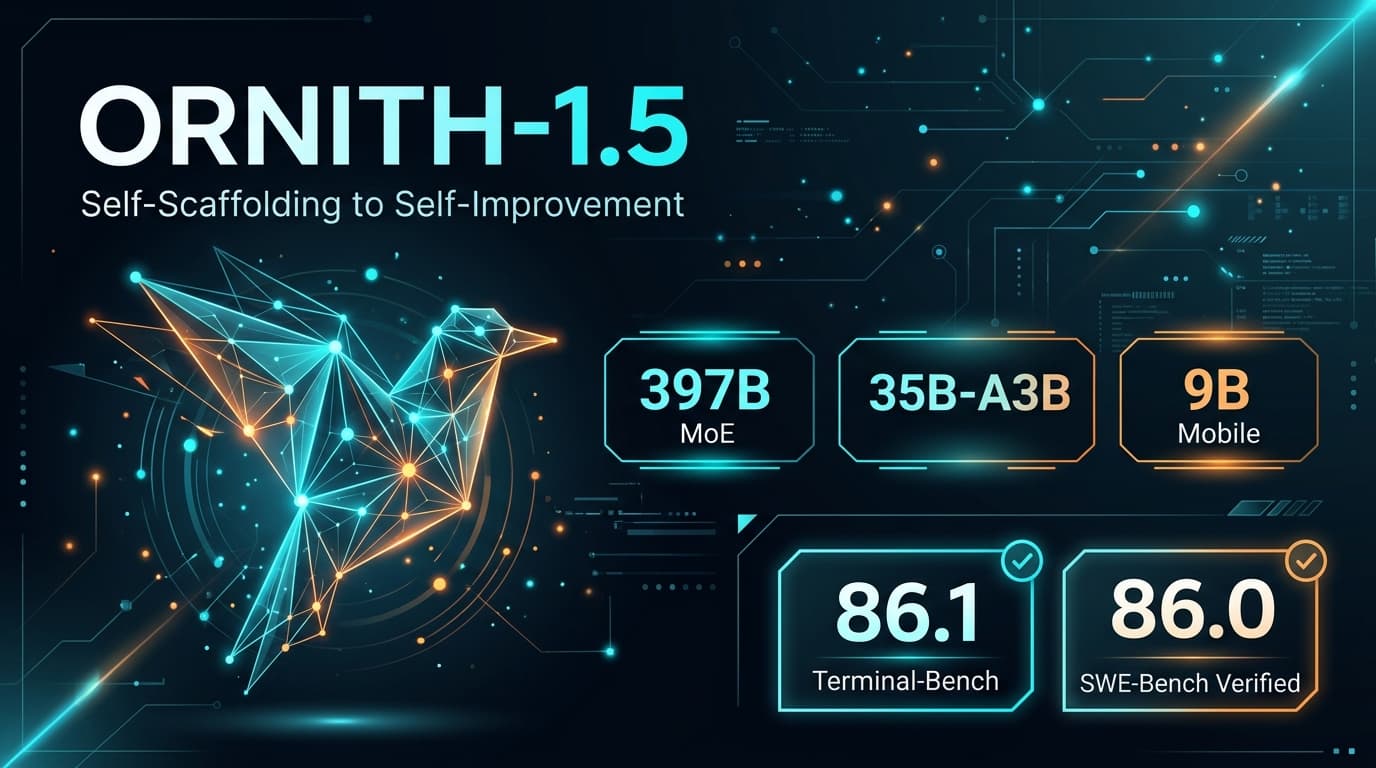
Empirical results demonstrate that its flagship tier (397B MoE) performs on par with Claude Opus 4.8 on demanding agentic coding benchmarks like Terminal-Bench 2.1 (86.1 vs 85.0) and SWE-bench Verified (86.0), while its lightweight tier (35B-A3B, activating only 3B parameters per token) substantially outperforms competing 30B and 35B dense models.
1. The Closed Self-Improvement Loop: Autonomous Tasks, Harnesses, and Rollouts
Traditional post-pretraining (SFT and RLHF) trains models on fixed benchmark datasets. Once a model masters those static distributions, additional training yields diminishing returns.
Ornith-1.5 replaces static curricula with a three-stage closed loop:
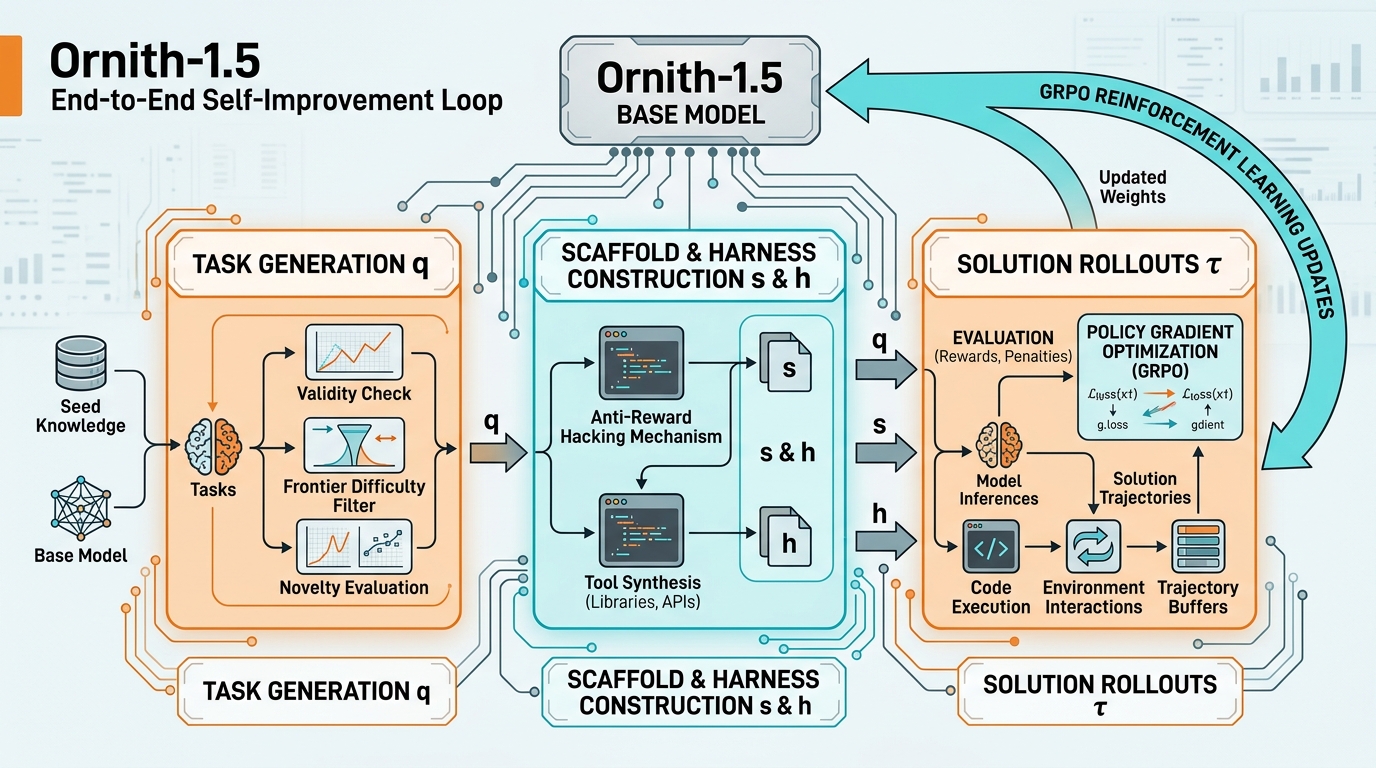
Stage 1: Frontier Task Generation (q)
Conditioned on a codebase or technical environment, the system analyzes previous problem-solving history and proposes progressively harder tasks located directly at its current capability frontier.
The task reward follows a multiplicative formulation:
R_task = V(q, s) × D(q, s, {τ_i}) × N(q)
- Validity and Verifiability
V(q, s): A hard gate. If a proposed task is malformed or its evaluation is non-deterministic,V = 0, preventing meaningless problems from receiving reinforcement rewards. - Frontier Difficulty
D: Measures empirical rollout success (p). The optimization targetsp* = 0.2(a 20% initial success rate), ensuring tasks are challenging yet learnable. - Novelty and Diversity
N(q): Penalizes repetitive variations relative to a historical task buffer.
Stage 2: Scaffold and Harness Construction (s, h)
For every valid task, the model synthesizes its own task decomposition strategy, tool wrappers, and evaluation harness (h).
The harness reward evaluates three factors:
R_harness = C(q, h) × F(h, {τ_i}) × H(h)
- Task Alignment
C: Faithfulness to the task specification. - Reward Fidelity
F: Accurate discrimination between correct and flawed solutions. - Hack Resistance
H: Resilience against evaluator shortcuts or reward-hacking behavior.
Stage 3: Solution Rollouts and Policy Optimization (τ_i)
The model executes solution trajectories against the generated harness. Rewards propagate across all three stages using Group Relative Policy Optimization (GRPO), simultaneously improving task proposal, harness generation, and solution execution.
2. Ornith-1.5 Model Family & Benchmark Evaluation
The release spans three distinct hardware targets:
┌─────────────────────────────────────────────────────────────────────────────┐
│                    ORNITH-1.5 MODEL FAMILY (2026)                           │
├───────────────────┬──────────────┬───────────────────┬──────────────────────┤
│ Model             │ Total Params │ Active per Token  │ Target Deployment    │
├───────────────────┼──────────────┼───────────────────┼──────────────────────┤
│ **Ornith-1.5-397B**│ 397B MoE     │ ~28B              │ Cloud Datacenter GPUs│
│ **Ornith-1.5-35B** │ 35B MoE      │ **3B**            │ Workstation / 1 GPU  │
│ **Ornith-1.5-9B**  │ 9B Dense     │ 9B                │ Edge / PC / Mobile   │
└───────────────────┴──────────────┴───────────────────┴──────────────────────┘
A) Ornith-1.5-397B (MoE): Frontier Open-Source Coding
Evaluated across terminal environments and repository-level issue resolution:
| Benchmark | Ornith-1.5-397B | Claude Opus 4.8 | DeepSeek-V4-Flash | GLM-5.2 | Kimi K3 (2.8T) |
|---|---|---|---|---|---|
| Terminal-Bench 2.1 (Terminus-2) | 86.1 | 85.0 | 82.7 | 81.0 | 88.3 |
| Terminal-Bench 2.1 (Claude Code) | 85.2 | 78.9 | 81.8 | 82.7 | – |
| SWE-bench Verified | 86.0 | 85.8 | 81.6 | 83.0 | 86.2 |
| DeepSWE | 56.0 | 59.0 | 54.4 | 46.2 | 67.5 |
| GPQA Diamond (Reasoning) | 92.8 | 93.6 | 91.4 | 91.2 | 93.5 |
| MCP-Atlas (Tool Use) | 80.0 | 82.2 | 74.6 | 77.8 | 82.3 |
B) Ornith-1.5-35B-A3B: High-Efficiency Local Agent Development
Activating only 3 billion parameters per token, this model delivers rapid inference on consumer hardware (16GB–24GB VRAM) or Apple Silicon Mac workstations:
- Terminal-Bench 2.1 (Claude Code): 68.5 (vs. 49.2 for Qwen 3.6-35B and 42.1 for Gemma 4-31B).
- SWE-bench Verified: 79.0 (vs. 52.0 for Gemma 4-31B and 76.0 for Muse Glimmer-30B).
- DeepSWE: 22.0 (while competing 35B models scored 0).
C) Ornith-1.5-9B & 9B-Mobile: Edge Agent Execution
Optimized for mobile platforms (iOS and Android) and lightweight edge runtimes:
- Terminal-Bench 2.1: 47.0 (outperforming 31B models like Gemma 4-31B at 42.1).
- SWE-bench Verified: 70.6 (vs. 53.2 for Qwen 3.5-9B).
3. Practical Implications for SMEs and Software Teams
The ability of a model to synthesize its own problem-solving scaffolding impacts business operations in three key ways:
1. Zero-Friction Enterprise Agent Deployment
Connecting an agent to an accounting database or ERP traditionally required manually coding intermediate reasoning and validation steps. With Ornith-1.5, the model formulates task decomposition dynamically and tests intermediate steps against deterministic schemas (Executor.sh).
2. Radical Compute Cost Reductions
The 35B-A3B model matches the agentic capabilities of commercial cloud models at a fraction of the inference cost. Because only 3B parameters are active per token, businesses can host it locally or via flat-rate inference clusters like NaN Builders, bypassing pay-per-token API surges.
3. Hardened Security and Containment
As highlighted in our recent analysis of OpenAI pacing model development over cybersecurity risks, autonomous agent capabilities demand sandboxed runtimes. Ornith-1.5's training specifically penalizes reward-hacking and unverified out-of-harness executions.
4. TypeScript Implementation: Invoking Ornith-1.5-35B for Agentic Workflows
Because Ornith-1.5 adheres to the standard OpenAI / vLLM API schema, integrating it into Node.js or TypeScript takes only seconds:
import OpenAI from "openai";

const client = new OpenAI({
  baseURL: "http://localhost:8000/v1", // Or private EU inference endpoint
  apiKey: process.env.ORNITH_API_KEY || "local",
});

async function runAutonomousCodeFix() {
  const response = await client.chat.completions.create({
    model: "ornith-1.5-35b-a3b",
    messages: [
      {
        role: "system",
        content: "You are an autonomous refactoring agent. Formulate your internal decomposition plan before issuing patch rollouts."
      },
      {
        role: "user",
        content: "Optimize the customer bank reconciliation SQL query and generate unit tests covering edge cases."
      }
    ],
    temperature: 0.6,
  });

  console.log(response.choices[0].message.content);
}

runAutonomousCodeFix();
5. Technical Comparison: Agentic Coding Models in 2026
| Feature | Ornith-1.5-397B | Ornith-1.5-35B-A3B | Claude Opus 4.8 | DeepSeek-V4-Flash |
|---|---|---|---|---|
| Licensing | Open Weights | Open Weights | Proprietary API | Open Weights / API |
| Terminal-Bench 2.1 | 86.1 | 68.5 | 85.0 | 82.7 |
| SWE-bench Verified | 86.0 | 79.0 | 85.8 | 81.6 |
| Self-Scaffolding | Native (GRPO) | Native (GRPO) | Static | Static |
| Active Parameters | ~28B | 3B | Undisclosed | ~21B |
| Local Deployment | Requires Multi-GPU | 1 GPU / Mac M-Series | Not Available | Requires Dedicated Server |
6. Strategic Takeaway
Ornith-1.5 highlights a decisive shift in open-source AI: progress is no longer just about raw parameter scaling, but about methodological autonomy—the capacity of a model to generate its own tasks, build its own verification tools, and evaluate its own trajectories.
For businesses automating engineering pipelines, data audits, and system integrations, deploying self-improving models on private infrastructure offers unprecedented control and ROI.
Deploy Autonomous Open-Source AI Agents with IA4PYMES → We design secure MCP architectures, deterministic agent sandboxes, and optimized local deployments to help your business capture the full value of modern open-source AI.
7. Frequently Asked Questions
What is Self-Scaffolding in Ornith-1.5?
It refers to the model's ability to autonomously construct and refine its own toolset, prompts, and task-decomposition strategies for any given problem without requiring static human-written harnesses.
Can Ornith-1.5 run on consumer hardware?
Yes. The Ornith-1.5-9B-Mobile model runs on mobile and edge devices, while Ornith-1.5-35B-A3B (activating only 3B parameters per token) runs smoothly on single-GPU workstations or Apple Silicon Macs using GGUF quantizations.
How does Ornith-1.5 prevent reward hacking?
Through its harness reward term H(h), which assesses the robustness of the evaluation harness against shortcuts, superficial solutions, and evaluator exploitation.