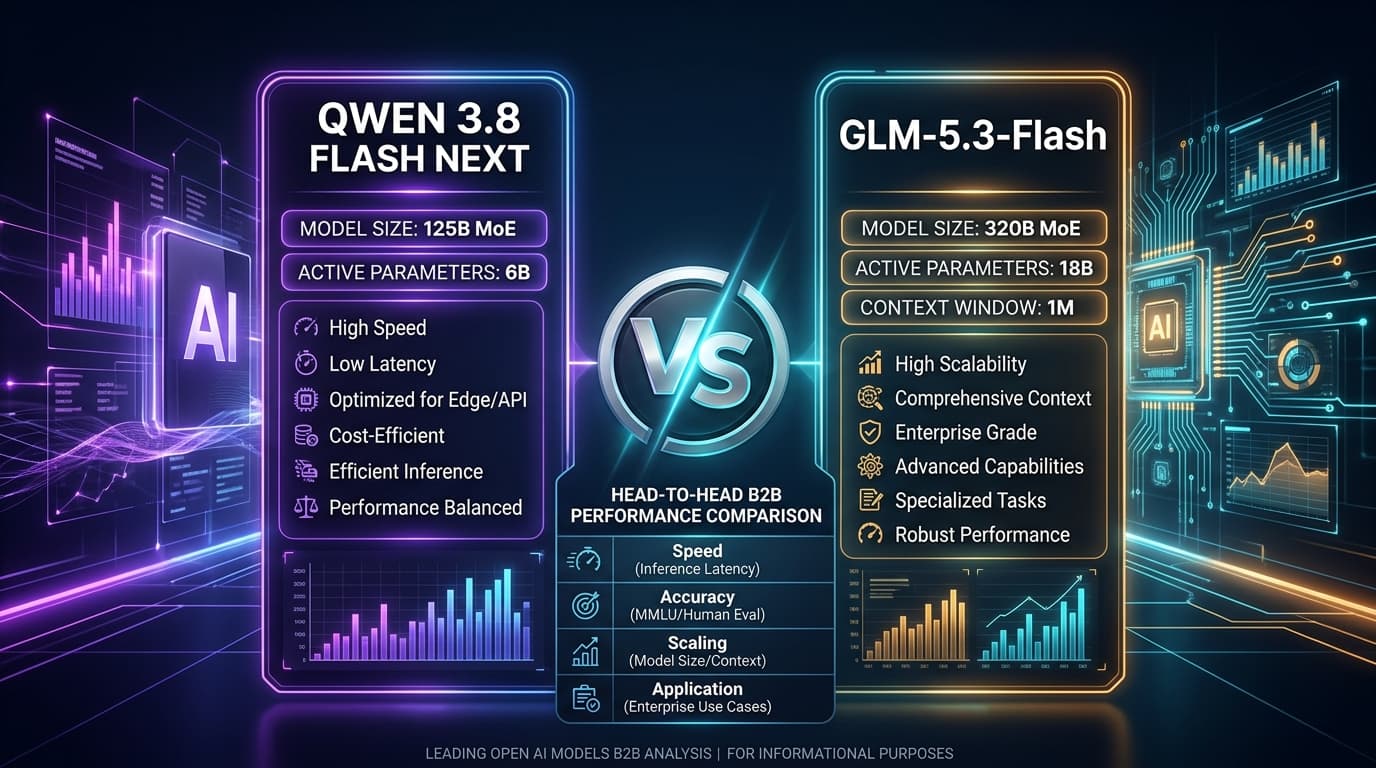

The race for high-throughput, cost-effective inference in the open-source ecosystem has accelerated with two new Mixture-of-Experts (MoE) architectures engineered to replace costly commercial APIs: Qwen3.8-Flash (Alibaba) and GLM-5.3-Flash (Zhipu AI / Z.ai, previously battle-tested anonymously under the codename ox-alpha).
Both architectures target the same fundamental enterprise objective: delivering near-frontier intelligence at extreme speeds and minimal token cost. However, their parameter allocation, active compute per token, and attention mechanisms address very different engineering requirements.
This technical comparison evaluates their architectural tradeoffs, benchmark scores across coding and reasoning, local hardware footprints, and a practical decision framework for small and medium enterprises.
1. Technical Specifications and Architectural Differences
The core distinction between the two models lies in the tradeoff between active parameter sparsity (compute per token) and reasoning depth:
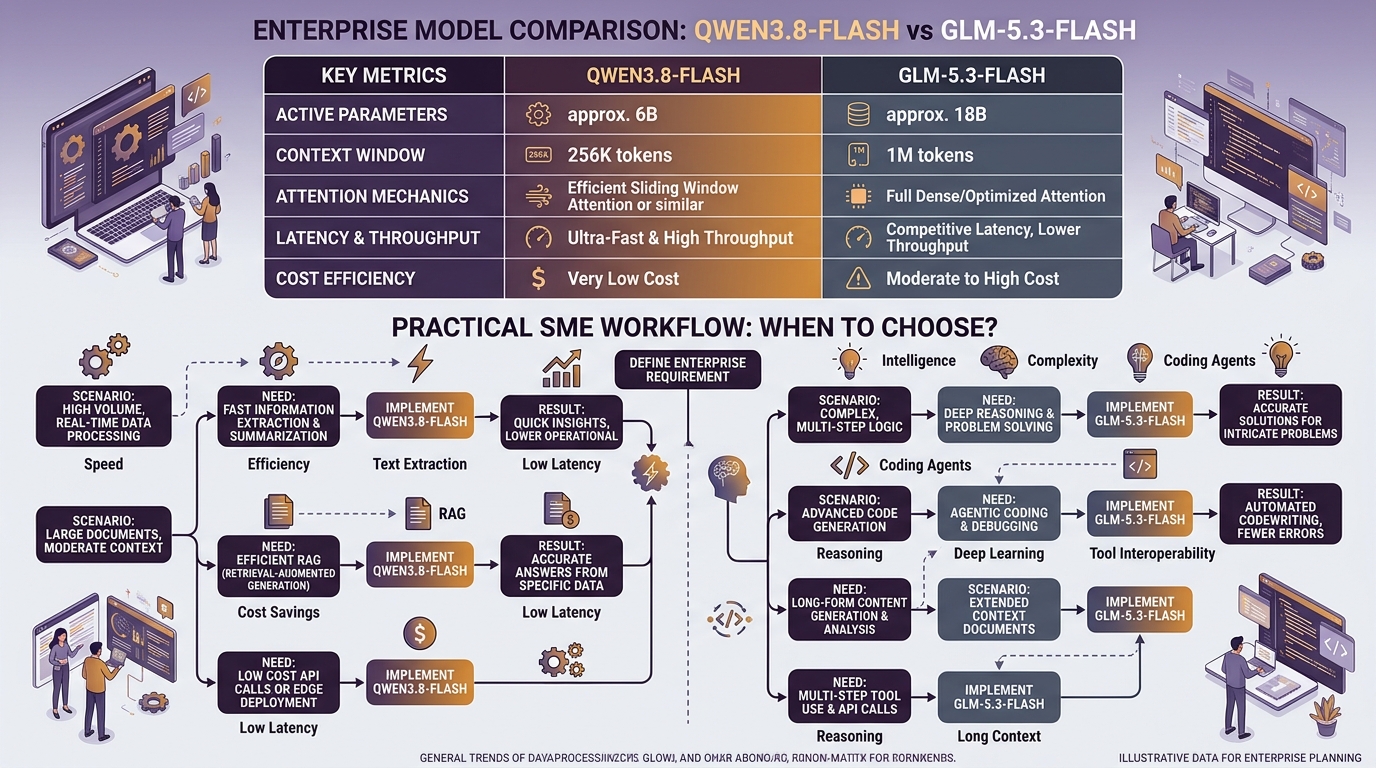
| Parameter / Feature | Qwen3.8-Flash (Alibaba) | GLM-5.3-Flash (Zhipu AI) |
|---|---|---|
| Total Parameters | 125 Billion (125B) | 320 Billion (320B) |
| Active Parameters per Token | 6 Billion (6B) | 18 Billion (18B) |
| Attention Mechanism | Hybrid: Gated DeltaNet (GDN) + QSA | Hybrid: Sparse + Linear Attention |
| Native Context Window | 256K tokens (expandable to 1M) | 1,000,000 tokens (1M) |
| Reasoning Control (Thinking) | Prompt-guided / Fixed | Tunable 3-tier budget (Low, High, Max) |
| Weights License | Open Weights / Apache 2.0 | Open Weights / MIT License |
| N-Gram Auxiliary Table | Yes (51B parameters offloadable to NVMe) | No |
| Primary Workload Target | High-speed extraction, RAG, low latency | Autonomous agent coding & refactoring |
2. Benchmark Evaluation: Coding and Reasoning
To measure real-world performance in production environments, we compare their verified scores across agentic coding and logical reasoning benchmarks:
┌─────────────────────────────────────────────────────────────────────────────┐
│                 BENCHMARKS: QWEN3.8-FLASH vs. GLM-5.3-FLASH                 │
├───────────────────────────────┬──────────────────────┬──────────────────────┤
│ Benchmark                     │ Qwen3.8-Flash (6B)   │ GLM-5.3-Flash (18B)  │
├───────────────────────────────┼──────────────────────┼──────────────────────┤
│ **SWE-bench Verified**        │ 78.4%                │ **83.2%**            │
│ **DeepSWE v1.1**              │ 24.0%                │ **48.6%**            │
│ **Terminal-Bench 2.1**        │ 69.2                 │ **76.8**             │
│ **HumanEval (Python / JS)**   │ 88.5%                │ **92.1%**            │
│ **GPQA Diamond (Reasoning)**  │ 84.2%                │ **89.6%**            │
│ **Inference Throughput**      │ **~145 tokens/sec**  │ ~75 tokens/sec       │
│ **VRAM / RAM Footprint (Q4)** │ **~42 GB**           │ ~98 GB               │
└───────────────────────────────┴──────────────────────┴──────────────────────┘
Benchmark Takeaways:
- GLM-5.3-Flash excels at multi-step agentic engineering: By activating 18B parameters and leveraging a tunable thinking budget, it resolves real GitHub issues (DeepSWE) at nearly double the success rate of Qwen3.8-Flash.
- Qwen3.8-Flash leads in throughput and hardware efficiency: By routing through just 6B active parameters, it generates tokens twice as fast, making it the ideal choice for interactive customer-facing interfaces and high-volume data ingestion pipelines.
3. Hardware Footprint and Local Deployment Options
Both models are available as open weights, allowing businesses to host them on-premise for absolute data sovereignty and GDPR compliance:
Deploying Qwen3.8-Flash
- Minimum Memory: 48GB VRAM or Unified Memory.
- Recommended Hardware: A single Nvidia RTX 6000 Ada (48GB) workstation or an Apple Mac Studio with M5 Max (128GB RAM).
- Operational Edge: Its N-gram table can be offloaded to an NVMe SSD, keeping RAM requirements compact.
Deploying GLM-5.3-Flash
- Minimum Memory: 110GB to 128GB Unified Memory or distributed VRAM.
- Recommended Hardware: A dual-GPU server (2x Nvidia A100 80GB) or an Apple Mac Studio with M5 Ultra (512GB RAM).
- Cloud Alternative: Unmetered, fixed-rate GPU inference clusters like NaN Builders.
4. Enterprise Selection Matrix: Which Model to Pick?
To avoid unnecessary compute costs or latency bottlenecks, route tasks according to this framework:
Choose Qwen3.8-Flash for:
- Document Data Extraction: Extracting structured fields from invoices for VeriFactu e-invoicing and customer receipts where speed and JSON precision are essential.
- High-Concurrency RAG Search: Internal document search systems queried by dozens of concurrent employees.
- Real-Time Voice and Chat Assistants: Workflows where response latencies below 300ms directly impact customer experience.
- Deterministic Tool Execution: Invoking structured APIs via MCP / Executor.sh gateways.
Choose GLM-5.3-Flash for:
- Autonomous Coding Agents: Repository-level refactoring, automated bug fixes, and unit test generation similar to Claude Code workflows.
- Multi-Step Logical Reasoning: Financial cross-auditing, complex contract compliance, and edge-case classification requiring deep internal deliberation.
- Massive Context Video and Long-Document Ingestion (1M Tokens): Processing full video meeting recordings or multi-thousand-page technical catalogs in a single prompt.
5. Implementation Blueprint: Hybrid Routing in TypeScript
Here is a TypeScript middleware demonstrating dynamic task routing between both models based on workload complexity:
// hybrid-model-selector.ts
import OpenAI from "openai";

const client = new OpenAI({
  baseURL: "http://localhost:8000/v1", // Local vLLM endpoint
  apiKey: process.env.LOCAL_AI_KEY || "local",
});

interface TaskPayload {
  prompt: string;
  taskType: "EXTRACTION" | "AGENTIC_CODING" | "RAG_SEARCH" | "DEEP_AUDIT";
}

export async function processEnterpriseTask(payload: TaskPayload) {
  // Intelligent model selection:
  const isHeavyTask = payload.taskType === "AGENTIC_CODING" || payload.taskType === "DEEP_AUDIT";
  const selectedModel = isHeavyTask ? "glm-5.3-flash" : "qwen-3.8-flash";

  console.log(`[ROUTER] Task: ${payload.taskType} -> Routed to: ${selectedModel}`);

  const response = await client.chat.completions.create({
    model: selectedModel,
    messages: [
      {
        role: "system",
        content: isHeavyTask
          ? "You are a senior software architect. Deliberate thoroughly before outputting the patch."
          : "You are an ultra-fast data parser. Return only the requested JSON schema."
      },
      { role: "user", content: payload.prompt }
    ],
    temperature: isHeavyTask ? 0.6 : 0.1,
  });

  return response.choices[0].message.content;
}
6. Strategic Conclusion
Qwen3.8-Flash and GLM-5.3-Flash prove that open MoE models have reached the capability thresholds necessary to replace closed commercial subscriptions across enterprise pipelines.
The most profitable architecture is not choosing one exclusively, but orchestrating both: utilizing Qwen3.8-Flash for 80% of high-speed routine operations while assigning GLM-5.3-Flash to autonomous development and complex reasoning.
Architect Your Open-Source AI Infrastructure with IA4PYMES → We audit your workflows, deploy optimized open-weight models on your private hardware, and implement intelligent routing gateways to maximize operational margins.
7. Frequently Asked Questions
Which model is more cost-effective for local on-premise hosting?
Qwen3.8-Flash is significantly more cost-effective for entry-level deployments because it activates only 6B parameters per token and requires under 48GB of RAM, fitting comfortably onto a single workstation or GPU.
What is the advantage of GLM-5.3-Flash's tunable thinking budget?
It allows developers to calibrate computational effort (Low, High, or Max) depending on whether a task requires rapid responses or deep multi-step reflection.
Can both models run concurrently on the same server?
Yes. Using modern inference engines like vLLM, SGLang, or llama.cpp, both models can be served under the same unified endpoint, allowing client applications to toggle between them via standard API requests.