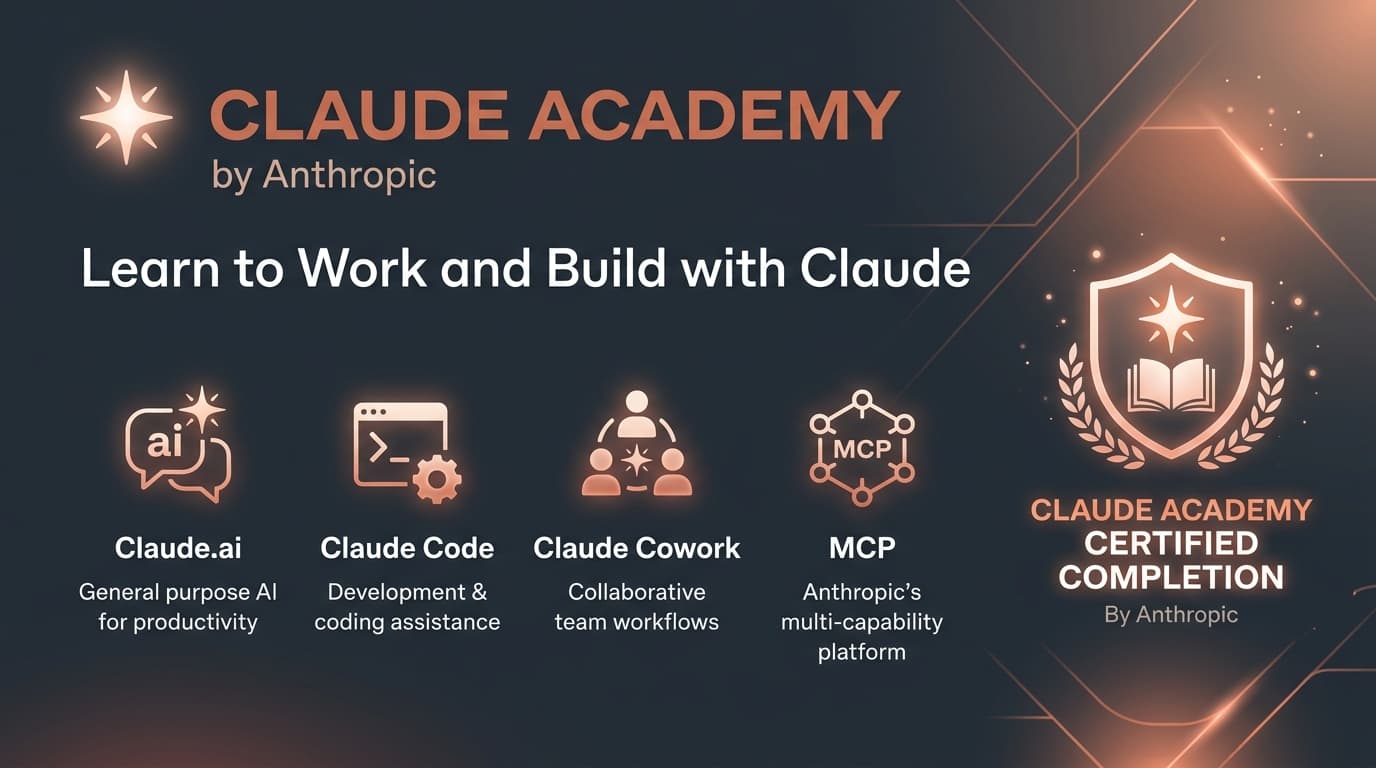

A major barrier in corporate AI adoption is not the lack of models, but the internal skills gap across business teams. Most employees use chat interfaces for basic drafting, while engineering teams spend weeks integrating bespoke APIs without mastering modern standards like the Model Context Protocol (MCP) or terminal agents like Claude Code.
To bridge this divide, Anthropic has officially introduced Claude Academy, a centralized, free learning platform featuring modular courses, real-world enterprise use cases, and official certifications for professionals, developers, and corporate teams.
The platform requires no paid subscription or enterprise account to access its curriculum. In this technical deep dive, we examine its 4 core learning tracks, the available certification paths, how to implement these patterns in production, and how SMEs can upskill their entire workforce at zero training cost.
1. What is Claude Academy and How is the Curriculum Structured?
Claude Academy consolidates Anthropic's operational and architectural knowledge into modular, role-based tracks:
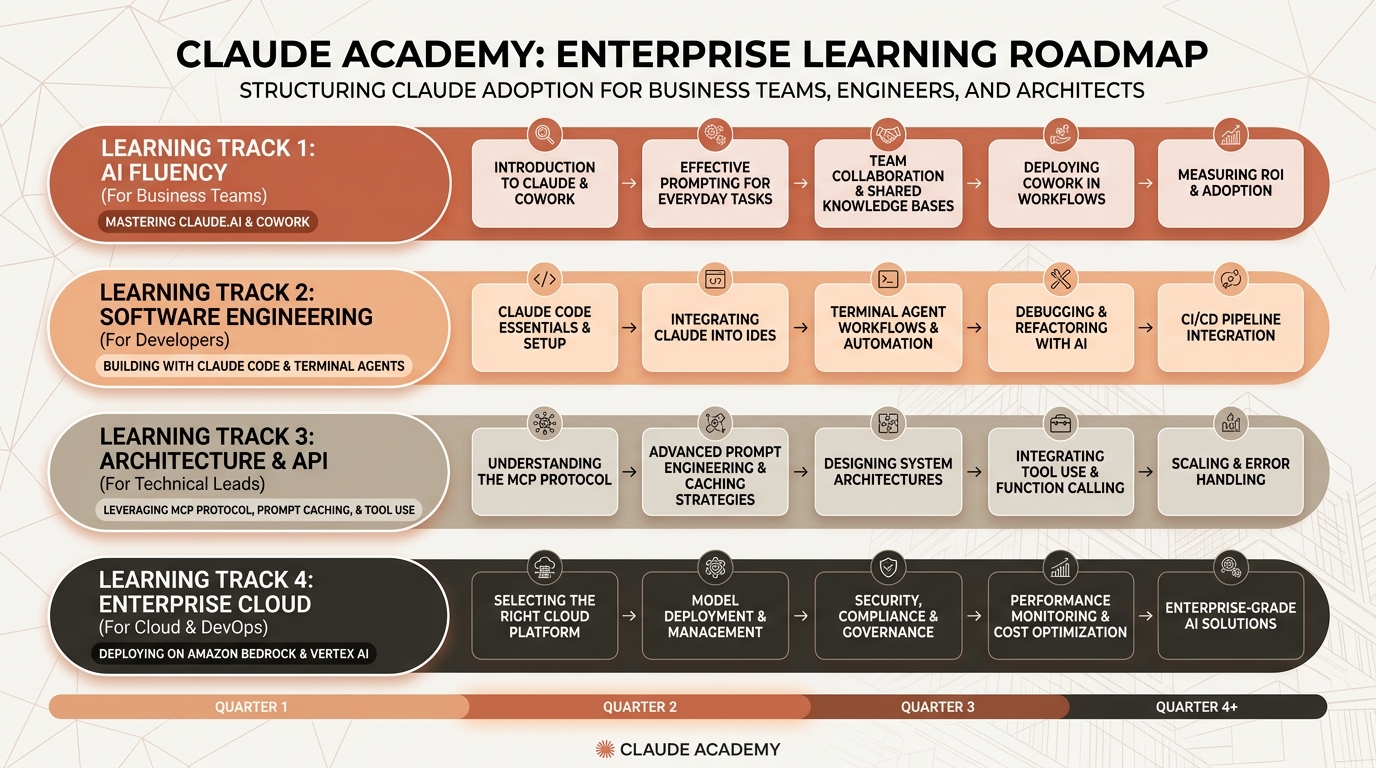
The 4 Core Learning Paths:
-
Track 1: AI Fluency & Productivity:
- Tailored for operations, finance, HR, and marketing leaders.
- Covers foundational LLM reasoning, structured prompt engineering, complex data analysis, and orchestrating workflows with Claude Cowork and Claude Tag in Slack and Microsoft Teams.
-
Track 2: Software Engineering with Claude Code:
- Designed for software engineers and technical leads.
- Covers terminal-first agent configurations, IDE extensions (Cursor, VS Code), codebase-wide refactoring, automated debugging, and CI/CD pipeline integration.
-
Track 3: System Architecture and the Claude API:
- Targeted at software architects and AI developers.
- Dives deep into tool use / function calling, cost and latency optimization with Prompt Caching (up to 90% savings on input tokens), and building custom MCP servers to connect private databases and microservices.
-
Track 4: Enterprise Cloud Deployment & Security:
- For DevOps engineers and compliance officers.
- Practical blueprints for deploying Claude natively on Amazon Bedrock and Google Cloud Vertex AI, network egress isolation, and EU AI Act compliance.
2. Complete Ecosystem Products Covered in the Academy
The curriculum spans the full Anthropic solution suite:
┌─────────────────────────────────────────────────────────────────────────────┐
│                 PRODUCT SUITE IN CLAUDE ACADEMY (2026)                      │
├───────────────────┬──────────────────────────────────┬──────────────────────┤
│ Product           │ Learning Focus                   │ Target Role          │
├───────────────────┼──────────────────────────────────┼──────────────────────┤
│ **Claude.ai**     │ Reasoning & Data Analysis        │ General Business     │
│ **Claude Cowork** │ Task Delegation & Deliverables   │ Project Teams        │
│ **Claude Code**   │ Terminal Development & Refactor  │ Software Engineers   │
│ **Claude Tag**    │ Channel-Based AI Collaboration   │ Operations / Support │
│ **Claude Platform**│ API, Console, Prompt Caching, MCP│ Cloud / AI Architects│
└───────────────────┴──────────────────────────────────┴──────────────────────┘
3. Official Certifications: Validating Team Competencies
Claude Academy provides a two-tier recognition model:
A) Free Digital Badges and Completion Certificates (Skilljar / Coursera)
Learners completing interactive modules and passing practical quizzes earn verifiable digital badges and completion certificates directly from Anthropic. This enables SMEs to verify that team members have completed data privacy, tool use, and operational training.
B) Professional Claude Certification (Pearson VUE)
For senior engineers and enterprise consultants requiring proctored credentials, Anthropic offers Pearson VUE examinations across three tracks:
- Claude Certified Practitioner: Business workflows, operational adoption, and productivity.
- Claude Certified Developer: API integrations, context optimization, and application development.
- Claude Certified Architect: Distributed MCP system design, enterprise cloud deployments (Bedrock/Vertex), and cybersecurity sandboxing.
4. Production Implementation: Optimizing API Workflows with Prompt Caching
One of the most impactful architectural practices taught in Claude Academy is Prompt Caching. When workflows repeatedly send system prompts, product documentation, or database schemas, caching that context cuts input token costs by 90% and slashes latency by 85%:
// claude-cached-api-example.ts
import Anthropic from "@anthropic-ai/sdk";

const anthropic = new Anthropic({
  apiKey: process.env.ANTHROPIC_API_KEY,
});

async function runCachedEnterpriseQuery() {
  const response = await anthropic.messages.create({
    model: "claude-3-7-sonnet-20250219",
    max_tokens: 1024,
    system: [
      {
        type: "text",
        text: "You are an enterprise financial auditor. Evaluate transactions against the company expense policy.",
      },
      {
        type: "text",
        text: "--- COMPLETE CORPORATE EXPENSE POLICY MANUAL (20,000 words) ---",
        // Enable high-speed ephemeral caching for this block:
        cache_control: { type: "ephemeral" },
      },
    ],
    messages: [
      {
        role: "user",
        content: "Audit invoice #INV-9821 and verify whether daily meal allowances exceed the corporate limit.",
      },
    ],
  });

  console.log("Cached input tokens read:", response.usage.cache_read_input_tokens);
  console.log("New cache creation tokens:", response.usage.cache_creation_input_tokens);
  console.log("Auditor output:", response.content[0]);
}

runCachedEnterpriseQuery();
5. Strategic Benefits for SMEs
For organizations with 10 to 100 employees, uncoordinated AI adoption typically leads to two severe issues:
- Redundant Subscriptions: Team members purchasing isolated SaaS accounts without unified templates or shared knowledge bases.
- Data Governance Liabilities: Uploading confidential corporate documents without clear data retention controls. As seen in our analysis of OpenAI pacing model development over cybersecurity risks, operating without structured containment introduces significant exposure.
Leveraging Claude Academy allows businesses to:
- Standardize on MCP: Connect internal databases via standardized gateways like Executor.sh rather than brittle, proprietary API scripts.
- Evaluate Hybrid Architectures: Know precisely when to use commercial Claude APIs vs. self-hosted open models like Ornith-1.5, Qwen 3.8-27B GGUF, or flat-rate clusters like NaN Builders.
- Eliminate Initial Training Costs: Upskill technical and non-technical staff using verified material developed directly by the frontier AI lab.
6. Strategic Takeaway and Action Plan
Claude Academy sets a standard for accessible, high-quality enterprise education.
We recommend a three-phase corporate rollout:
- Weeks 1–2: All non-technical staff complete the AI Fluency foundations track.
- Weeks 3–4: Software engineers configure Claude Code and complete the Prompt Caching and tool use modules.
- Month 2 onward: Technical leads audit MCP integrations and certify production cloud architectures.
Audit and Scale Your Enterprise AI Strategy with IA4PYMES → We build secure MCP gateways, sandboxed agent architectures, and hybrid cloud/local deployments to deliver measurable business ROI.
7. Frequently Asked Questions
Is Claude Academy genuinely free?
Yes. All courses, tutorials, and practical guides on academy.claude.com are 100% free to access with a standard email registration.
Do business users need coding knowledge?
No. The AI Fluency track and modules covering Claude.ai, Claude Cowork, and Claude Tag are designed specifically for operational, management, and administrative roles.
How does Claude Code differ from the standard API?
Claude Code is an interactive, terminal-first agent designed to inspect repositories, run shell commands, and edit files directly in local developer environments, whereas the API is used to programmatically embed Claude into backend services and applications.