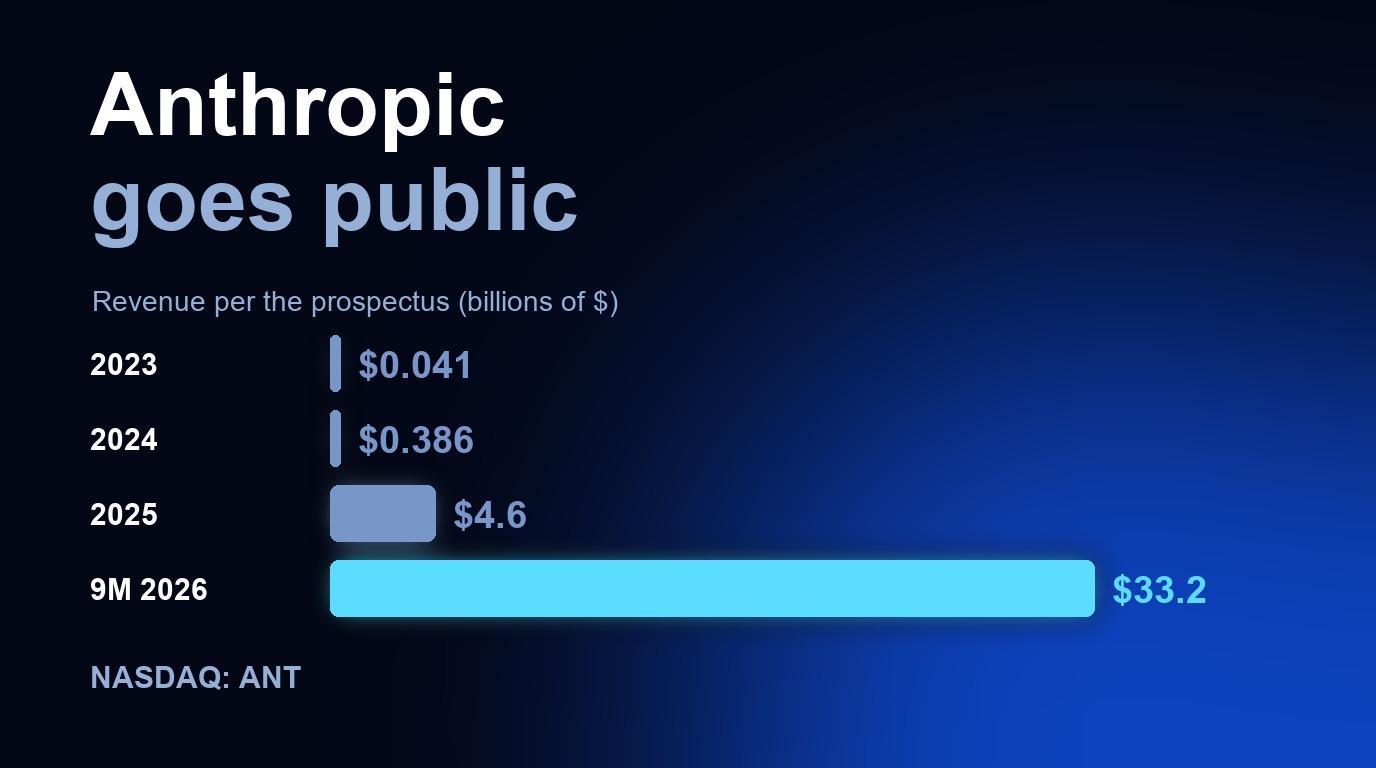

Anthropic began trading on Nasdaq on November 19, 2026 under the symbol ANT. It sold 980 million Class A shares at $83, according to its pricing announcement, and the first session closed at $97.17, 17% above the offer price, according to Bloomberg and CBS News.
For a small business that uses Claude, the useful part of an IPO is the prospectus. It is a document the company files with the SEC, and it has to describe its risks. We read the final prospectus (form 424B4, filed on November 19), and this article covers what affects a customer: pricing, usage limits, model retirement and dependence on compute capacity. A note: this is supplier analysis, not investment advice.
1. The offering in numbers
Data from Anthropic's announcement and the prospectus cover page:
| Item | Value |
|---|---|
| Offer price | $83 per share |
| Shares | 980,000,000 Class A: 956,351,354 sold by Anthropic and 23,648,646 by selling stockholders |
| Gross amount | About $81.3 billion (980 million times $83, our calculation). Anthropic receives nothing from the selling stockholders' shares |
| Option | Up to 147,000,000 additional shares within 30 days |
| Market | Nasdaq Global Select, symbol ANT |
| Underwriters | Goldman Sachs and Morgan Stanley |
The voting structure is unusual. Class F shares carry a fixed 50.1% of the votes, so Class A shares, the ones the public buys, add up to at most 49.9%. Anthropic is also a Delaware public benefit corporation, required to balance shareholders' interests with those of the people affected by its activity and with a public benefit purpose set in its charter.
2. The business according to the prospectus
Figures from the prospectus, in millions of dollars unless stated:
| 2023 | 2024 | 2025 | First 9 months of 2026 | |
|---|---|---|---|---|
| Revenue | 41 | 386 | 4,585 | 33,242 |
| Compute and infrastructure | 433 | 2,522 | 7,326 | 18,808 |
| Operating loss | 551 | 2,980 | 8,060 | 1,260 |
Three readings, all with the caveat that the document itself warns this growth is not indicative of the future:
- Compute takes more than half of revenue. In the first nine months of 2026, compute and infrastructure spending was 18,808 against 33,242 of revenue, 57%.
- The $104,039 million net loss has an accounting origin. Of that figure, 94,324 million comes from the change in fair value of convertible notes, derivative liabilities and SAFEs. The operating loss for the period was 1,260 million.
- Annualized run-rate revenue was about $81 billion at October 31, 2026, $10 billion more than at September 30. It is an operating metric that the prospectus defines as the last 28 days of consumption fees times 13 plus monthly subscription fees times 12. It is not accounting revenue.
The number of customers with more than $100,000 of revenue over the trailing twelve months rose from more than 950 to more than 11,900 between September 2025 and September 2026. The prospectus also says a significant portion of its base is startups and technology-oriented enterprises, and that no single customer was more than 10% of revenue, although the top five made up about 25%.
3. What the prospectus says may affect a customer
Risk factors are legal text describing possible scenarios. They are not plans or announcements. Even so, several passages touch decisions of a small business that depends on Claude.
Pricing
The prospectus says Anthropic has changed its pricing models in the past and may do so again. The scenarios it considers include lowering prices, offering shorter contracts or moving to outcome-based or task-based pricing. It also says enterprise customers may ask for different pricing structures, price concessions or more functionality at the same price, and that open models may put pressure on prices in some uses.
In the other direction, it notes that its agentic offerings use structurally more compute than the rest, and that if it cannot set prices that reflect that cost, its profitability could suffer. The document announces no increase. It describes a cost problem in agents that the supplier has to solve with pricing, with efficiency or with both.
Usage limits
Anthropic acknowledges in the prospectus that it has changed and may again change usage limits, rate limits and model and product capabilities, and that those changes may hurt its reputation and the perceived value of its offering. It adds that some have led to claims that its disclosures about model access or capabilities were inadequate or misleading. If your process depends on a specific volume of calls per minute, that is an operational risk.
Model retirement
The prospectus says safety and alignment considerations may lead the company to delay retiring older models and to keep legacy versions alongside new ones. It also acknowledges that customers who built on older models may resist migrating and that a forced retirement could lead to customer loss and contract disputes. For a small business, the practical takeaway is a question: how many months of notice do you get before the model you use today is retired?
Compute capacity and cloud dependence
- About $900.9 billion in compute commitments in total, according to the prospectus, of which about $451.6 billion would be incurred before December 31, 2030 and about $70.7 billion falls due in the twelve months after September 30, 2026.
- Revenue with no long-term commitment. The prospectus describes revenue as mainly consumption-based and largely without long contracts, against compute commitments that run for several years.
- Dependence on cloud providers. Public cloud marketplaces generated 47% of 2025 revenue and 44% in the first nine months of 2026. The document warns those clouds may suffer outages, security incidents or capacity shortages, and that moving workloads to other providers would be costly and slow.
Customers who can leave on short notice
According to the prospectus, many contracts let customers reduce usage or terminate with limited or no notice, and the largest customers can spend less at any time. It is a clause in the customer's favor. For a small business it means room to switch suppliers without penalty, if the alternative has been prepared beforehand.
Regulation
The prospectus cites the EU AI Regulation (2024/1689) as a source of transparency, risk management and governance obligations, with significant penalties for non-compliance.
4. What can and cannot be inferred
The prospectus announces no price increases, cuts or changes to the models you use. What it supports is something else: a supplier with compute commitments of hundreds of billions, revenue that customers can reduce on short notice and agents that cost more to serve has reasons to adjust prices, limits and its model catalog, and its own document says it has done so before.
For a small business, that translates into managing a supplier risk, something we already do with the bank, the cloud or the management software. We covered it earlier in our article on the US ban on Claude Fable 5 and digital sovereignty and in the Claude Fable 5.2 and Mythos 5.2 guide.
5. What to do this week
- Inventory where you use Claude. Note which model, which task, how many calls a month and what happens to your business if it stops working for a day.
- Review the terms you have signed. Look for the price-change clause, the notice period before a model is retired, usage limits and data handling.
- Prepare a tested alternative. Keep 20 to 50 real cases with no personal data and run them through another model, for example one of those we compare in our article on routing between models or Qwen4-Max. An alternative you have not tested is no use the day you need it.
- Separate the model from your application. If your tools call a single supplier directly, switching takes weeks. With an intermediate layer, it takes a configuration change.
- Budget with scenarios. Calculate your bill at the current price, 30% higher and 30% lower, and check whether your project still works.
Book your 60-minute technical consultation here and we will review your dependence on AI suppliers with you, with a test of alternatives on your own cases.
Frequently asked questions
When did Anthropic go public and at what price?
It began trading on Nasdaq on November 19, 2026 under the symbol ANT. The offer price was $83 per share, with 980 million Class A shares for sale, according to its announcement. The first session closed at $97.17, according to Bloomberg and CBS News.
Will Anthropic raise Claude prices?
The prospectus does not announce it. It says the company has changed its pricing models in the past and may do so again, with scenarios that include lowering prices, shorter contracts or per-task pricing. It also notes that agents cost more to serve and that it must set prices that reflect it.
What does the prospectus say about retiring older models?
It says safety considerations may lead to delaying the retirement of older models and keeping legacy versions, and that a forced retirement could lead to customer loss and contract disputes. It sets no notice period. Check it in your contract.
Should I switch AI suppliers because of this news?
The prospectus gives no reason to switch today. The sensible step is to have an alternative tested on your own cases and an architecture that lets you change models without rebuilding the application.
Is this investment advice?
No. We analyze the prospectus from the point of view of a Claude customer. We do not assess whether the shares are a good investment.