
Alibaba opened general access to Qwen4-Max on November 16, 2026. According to Alibaba Cloud's announcement, the model has 2.4 trillion parameters and activates 71 billion per token. It supports up to 1 million tokens of context and costs $1.50 per million input tokens and $4.50 per million output tokens in the Singapore region. The weights are not published: you can only use it through Alibaba's API.
This article separates what Alibaba states in its documentation from what third parties report, works out what the price means for a typical small-business bill, and covers two questions any European company should check before trying it: where the data is processed and which tasks it might suit. When a figure comes from a secondary source, we say so in the same sentence.
1. What exactly did Alibaba launch?
These facts come from Alibaba Cloud's qwen4-max documentation, its release log and the official announcement:
| Item | Value |
|---|---|
| Dates | Preview on November 11 (Token Plan only). General availability on November 16, under the ID qwen4-max |
| Parameters | 2.4 trillion total, 71 billion active per token. Alibaba says 25% fewer active parameters than Qwen3.8-Max |
| Context | 1,000,000 tokens. Maximum input of 991,808 without thinking and 983,616 with thinking |
| Maximum output | 131,072 tokens without thinking and 262,144 with thinking |
| Inputs and outputs | Text, image and video in. Text out |
| Features | Thinking, web search, function calling, structured output and context caching |
| Not supported | Batch inference and fine-tuning |
| Weights | Closed. Alibaba says smaller Qwen4 models with open weights will be released soon, with no date or sizes |
A naming note: the official name is Qwen4-Max. Press coverage also writes it as Qwen 4 Max. It is a different model from Qwen3.8-2.4T-A95B, which Alibaba released in August with open weights.
2. How much does it cost?
The Alibaba Model Studio pricing page lists a single price band, up to 1M tokens, with no tiers by context length. Prices per million tokens, from the official pricing page:
| Region | Input | Output | Cache read |
|---|---|---|---|
| Singapore (international) | $1.50 | $4.50 | $0.075 |
| Frankfurt, Beijing, Hong Kong, US (Virginia), Tokyo | $1.413 | $4.24 | $0.071 |
A cache read costs 5% of the normal input price. If you ask many questions about the same long document, that detail matters more than the base rate. Alibaba also offers 1 million free tokens for 90 days in the Singapore region.
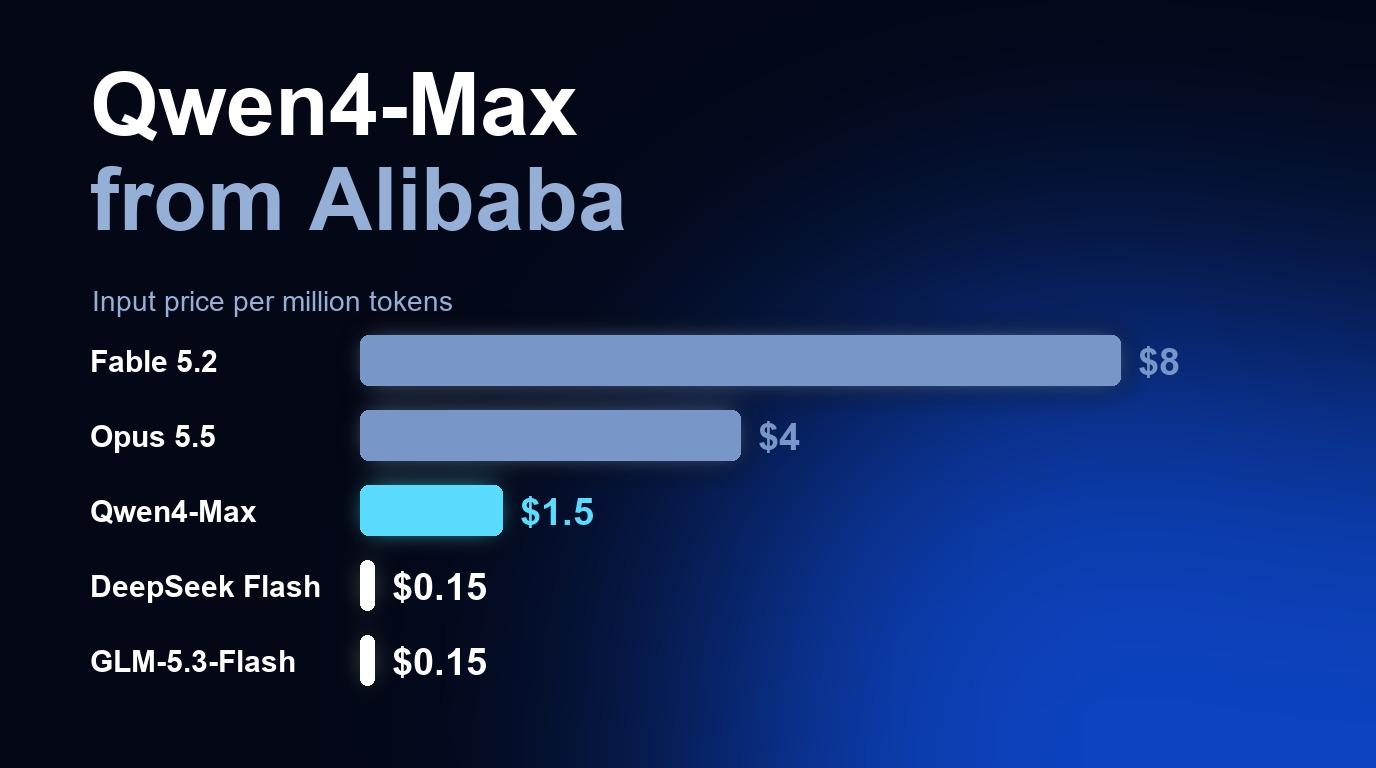
For perspective, the table compares the price with the models in our article on model routing, all at list price:
| Model | Input | Output |
|---|---|---|
| Claude Fable 5.2 | $8 | $40 |
| Claude Opus 5.5 | $4 | $20 |
| Qwen4-Max (Singapore) | $1.50 | $4.50 |
| DeepSeek Flash (off-peak) | $0.15 | $0.60 |
| GLM-5.3-Flash | $0.15 | $0.50 |
Per input token, Qwen4-Max costs about 81% less than Fable 5.2 and 63% less than Opus 5.5. It is about ten times more expensive than the Flash models. Per output token, the gap with Fable 5.2 is almost ninefold.
A bill example
We apply the same assumption as that article: 20,000 documents a month, 3,000 input tokens and 500 output tokens each, that is, 60 million input tokens and 10 million output tokens, with no caching or batching.
| Strategy | Monthly cost |
|---|---|
| Everything on Fable 5.2 | $880 |
| Everything on Opus 5.5 | $440 |
| Everything on Qwen4-Max (Singapore) | $135 |
| Everything on Qwen4-Max (Frankfurt) | $127.18 |
| Everything on DeepSeek Flash (off-peak) | $15 |
The calculation has one important limit. Alibaba documents up to 262,144 thinking tokens per answer, and we have not verified how they are billed. If you turn thinking on and the model generates thousands of tokens per task, real output will be far higher than the 500 tokens in the example. Measure the cost of a real call with thinking enabled before extrapolating.
3. What does the data say about quality?
Caution is needed here. Alibaba's announcement includes no benchmark scores and does not compare the model with Claude, GPT or Gemini. What it does claim:
- Lower cost per task. On Work360, an Alibaba proprietary benchmark covering 721 professional fields, average cost per task drops by around 60% against Qwen3.8-Max, and it uses 35% fewer tokens at high effort. The comparison is against Alibaba's own earlier model on a test that is not public.
- Code Arena position. Alibaba says it ranks sixth.
The figures against competitors come from DataCamp, which reproduces Alibaba's chart (we could not read the original image). According to DataCamp, on Terminal-Bench 4.0 Qwen4-Max scores 48.5 and Kimi K3.1 scores 67.2. It also cites two independent rankings: the Artificial Analysis Intelligence Index places it ninth with 43 points, and Vals AI places it 11th of 38. These come from a secondary source that we have not checked against the original pages.
DataCamp's numbers differ in details from what Alibaba publishes. For example, DataCamp reports a 62% cut in cost per task and Alibaba says around 60%. Where they differ, we use Alibaba's figure.
As in other launches, there is a new model with favorable figures published by its maker and few independent comparisons. For a specific task in your company, the only reliable reference is a test with your own documents.
4. What changes for a small business?
A candidate for the middle tier
With model routing, each task goes first to a cheap model and moves up to an expensive one when a validation fails. Qwen4-Max costs less than half of Opus 5.5 and ten times a Flash model. Using it as a middle tier is a reasonable hypothesis, for the tasks a Flash model cannot solve that do not justify paying Opus or Fable prices. Nobody has published an independent comparison on office tasks, which is why the test in section 6 is required.
Long documents and multimodal input
With 1 million tokens of context and image and video input, one call can hold a long contract with annexes, a technical manual or a batch of scanned invoices. A call with a full context costs $1.50 of input in Singapore. With caching, follow-up questions on the same document cost a fraction. Before sending a document like that, check the quality of the answers: a long context lets you fit a lot of text, and accuracy over it has to be measured.
What it lacks
The API does not support batch inference or fine-tuning. The first is the usual discount for overnight jobs, and the second is a way to adapt a model to your terminology. If your use case depends on either, Qwen4-Max does not cover it today.
Closed weights and smaller models on the way
You cannot download Qwen4-Max or run it on your servers. Alibaba announces smaller Qwen4 models with open weights, with no date. If your priority is running AI locally, that is the relevant news and it does not exist yet. In the meantime, there are current open options such as Qwen3.8 27B, which we cover in our article on downloading and running it locally. For what we knew before the launch, see our analysis of Qwen 4 and the Kalmia codename.
5. Privacy: where your data is processed
This is the question that matters most to a European company and the one the documentation leaves least clear.
- Frankfurt appears as a region with its own price, but Alibaba's documentation lists its deployment scope as Global. Other Alibaba models, such as qwen-plus, have a separate row with an EU scope. We found no data residency statement for qwen4-max.
- The Singapore region, which has the free quota, processes outside the EU.
- The weights are closed, so you cannot take the model to your own infrastructure to control the processing.
Before sending personal data about customers or employees, ask Alibaba Cloud in writing where it is processed, how long it is kept and which data processing agreement they offer. Until then, use only data without personal information in tests. On how to assess sending data to an AI provider, see our GDPR guide to uploading client data to a model.
6. How to test it this week
- Pick three tasks you currently run on a frontier model: the one that uses the most tokens, the simplest and the most sensitive.
- Prepare 20 to 50 real cases with no personal data. Anonymize them or use synthetic examples.
- Run them through three models: the one you use now, a Flash model and Qwen4-Max. You can use the free 1-million-token quota, with that non-personal data only.
- Score three things: whether the result is correct, how long it takes and what each task costs, with thinking on and off.
- Add automatic validations (format, amounts, required fields) before deciding when a task moves up a model.
If Qwen4-Max gets right what the Flash model gets wrong, and does it for less money than your current model, you have your middle tier. If not, the test will have cost you a few calls.
Book your 60-minute technical consultation here and we will set up the test with your own documents, including the model split and the privacy review.
Frequently asked questions
What is Qwen4-Max?
It is a multimodal language model from Alibaba, with 2.4 trillion total parameters and 71 billion active per token, supporting 1 million tokens of context and text, image and video input. Alibaba opened general API access on November 16, 2026.
How much does Qwen4-Max cost?
In the Singapore region, $1.50 per million input tokens and $4.50 per million output tokens. In Frankfurt, Beijing, Hong Kong, US (Virginia) and Tokyo, $1.413 and $4.24. Cache reads cost $0.075 and $0.071 respectively. There are no tiers by context length.
Is it open source?
No. Qwen4-Max is a closed model used only through the API. Alibaba has said it will soon release smaller Qwen4 models with open weights, with no dates or sizes.
Is data processed in Europe?
The documentation lists a Frankfurt region with its own price but with Global scope, and we found no data residency statement for this model. Before sending personal data, ask Alibaba Cloud for written confirmation of the processing location and the data processing agreement.
Is it better than Claude, GPT or Gemini?
There is not enough data to say. Alibaba's announcement does not compare the model with those competitors. According to DataCamp, a competing model scores higher on Terminal-Bench 4.0, and Artificial Analysis places it ninth on its index. Your own documents are the valid test.
What small-business tasks could it suit?
Tasks a Flash model cannot solve that do not justify a frontier model's price, such as analyzing long documents or resolving ambiguous cases. It is a hypothesis that needs your own test.