

For the vast majority of small and medium business owners and executive directors, artificial intelligence has generated immense noise: announcements about massive frontier models, futuristic claims, and software subscriptions that promise instant revenue growth but end up abandoned within weeks.
The operational reality is far more grounded. According to IBM's global enterprise AI adoption report (September 2026), 64% of companies report that their AI experiments fail to produce a measurable financial return because they are deployed haphazardly: employees pasting unstructured data into public chatbots, confidential customer records exposed, and hours wasted generating generic text.
Artificial intelligence only makes business sense for an SME if it achieves one of two concrete goals: measurably lowering operational labor costs or expanding your team's delivery capacity without needing to double headcount.
In this guide, we break down the only four business processes where standard enterprises generate true cost savings from month one, the traps to eliminate, and how to calculate financial ROI before investing a single euro.
1. The Common Pitfall: Paying Individual Chat Licenses is Not Digital Transformation
Many business leaders assume their company is modernizing because they purchase individual subscriptions to tools like ChatGPT, Claude, or Copilot for a few staff members. The typical result after three months:
- Zero integration with core business software: Staff members copy data manually from the ERP or email inbox, paste it into a chat interface, wait for an answer, and copy it back into their operational software. Time saved is negligible.
- Legal and GDPR compliance exposure: Pasting supplier invoices, customer contracts, or proprietary pricing into consumer AI tools violates data protection regulations and the European AI Act.
- Lack of quality control: Each employee prompts the AI inconsistently, with no standardized validation rules or audit trails.
Real business automation is not about having staff chat with a bot. It is about connecting artificial intelligence directly to existing repetitive workflows so tasks are completed automatically, securely, and under strict human supervision.
2. The 4 Business Processes Delivering True ROI for SMEs
Unlike massive technology conglomerates, small and medium enterprises do not need complex multi-year development programs. Over 80% of tangible financial value resides in four focused operational domains:
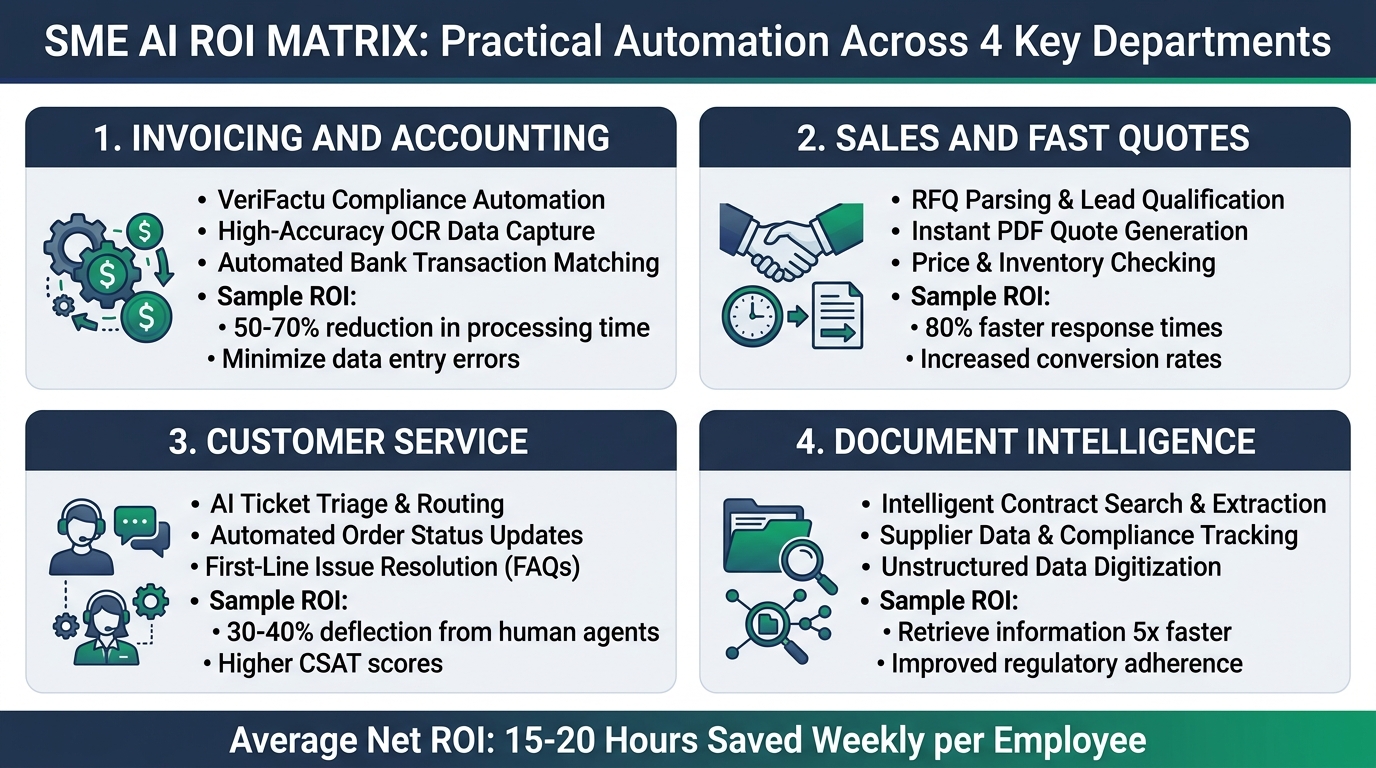
Process 1: Invoicing, Accounts Payable, and Regulatory Compliance
- The Manual Bottleneck: Receiving dozens of PDF supplier invoices and delivery slips via email, checking totals manually, entering line items into accounting software, and reconciling bank statements.
- The AI Solution: An automated pipeline that monitors your accounting inbox, extracts structured data fields (tax IDs, taxable base, VAT rates, line items, and invoice numbers), performs mathematical consistency checks, and registers the draft entry in your ERP.
- Regulatory Compliance: With mandatory electronic invoicing standards such as VeriFactu, automating invoice processing eliminates regulatory non-compliance risks while slashing processing time by over 70%.
- Typical Savings: 15–20 weekly administration hours reduced to less than 2 hours of review.
Process 2: Commercial Quotations and Fast RFQ Response
- The Manual Bottleneck: A prospective customer sends an email requesting a custom quote. Between gathering supplier prices, verifying inventory, and formatting a proposal, the response takes 24 to 48 hours—during which the buyer often contacts competing suppliers.
- The AI Solution: An automated workflow that extracts customer requirements, queries internal product catalogs and pricing tables via secure gateways like Executor.sh / MCP, and compiles a formatted PDF proposal ready for sales manager review in under 5 minutes.
- Commercial Impact: Responding to customer inquiries within 30 minutes improves deal closing rates by more than 35%.
Process 3: Customer Service and Routine Inquiries
- The Manual Bottleneck: Support personnel spend hours handling repetitive queries: shipment tracking status, business hours, technical spec sheets, or return policies.
- The AI Solution: A secure conversational agent trained exclusively on your company's official documentation, resolving routine questions across email, web, or messaging apps 24/7. When an edge case occurs, the system escalates the ticket to human staff with full conversation history.
- Typical Savings: 35% to 50% deflection of tier-1 repetitive inquiries, freeing customer support staff for high-value client relationships.
Process 4: Private Document Intelligence and Knowledge Retrieval
- The Manual Bottleneck: Staff spend 30 to 45 minutes daily searching through legacy contracts, supplier terms, technical manuals, or past project archives.
- The AI Solution: A private semantic search engine that indexes all internal company files (Word, PDF, spreadsheets) and provides exact answers with source citations in under 2 seconds.
3. Financial Analysis: Actual Monthly Savings for a 15-Person SME
To quantify return on investment, let us review the financial metrics of a typical 15-person company (5 operations/admin, 4 sales, 6 production/services):
| Operational Task | Previous Manual Process | With Process Automation | Net Monthly Savings |
|---|---|---|---|
| Invoice processing & entry | 18 hrs/week (€360/week) | 2 hrs/week (€40/week) | €1,280 / month |
| Quote drafting & price lookups | 12 hrs/week (€300/week) | 3 hrs/week (€75/week) | €900 / month |
| Document & contract retrieval | 15 hrs/week (€300/week) | 2 hrs/week (€40/week) | €1,040 / month |
| API & Infrastructure costs | €0 | ~€80 to €150 / month | -€120 / month |
| TOTAL NET MONTHLY SAVINGS | — | — | +€3,100 / month |
Beyond direct financial savings exceeding €3,000 monthly, the business speeds up commercial response times, eliminates administrative errors, and handles higher business volume without expanding administrative payroll.
4. Where Money is Wasted: 3 Practices to Eliminate
To protect your operating margins, avoid these three common missteps:
- Purchasing all-in-one software suites that go unused: Paying monthly seat licenses for complex platforms that your team abandons because they fail to match existing operating habits.
- Attempting to automate undefined processes: If an operational flow is not clearly defined on paper (who approves a discount, how delivery slips are matched), AI will simply accelerate confusion. Standardize first, then automate.
- Compromising on data privacy: When handling proprietary business records, infrastructure must ensure customer data is never used to train public models. Enterprises can deploy solutions on local workstations like the Apple Mac Studio M5 or private unmetered clusters like NaN Builders.
5. The Solution: Process Audit and Turnkey Implementation with IA4PYMES
At IA4PYMES, we do not sell generic courses or speculative tech. We help established businesses improve profitability through three structured steps:
- Operational Process Audit: We evaluate where your team spends routine hours each week and calculate the exact financial ROI of automating those bottlenecks.
- Turnkey Integration: We connect your existing software (ERP, email, databases) to secure, reliable AI models using proven engineering frameworks like gentle-pi.
- Staff Training & Support: We train your team so they master the new automated workflows smoothly from day one.
Request an Operational Process AI Audit for Your Business → We review your current workflows and deliver a concrete report outlining the top 3 processes where your business can save the most time and money this quarter.
6. Frequently Asked Questions
Do we need to replace our current ERP or accounting software?
No. AI automations integrate directly into the tools your business already uses (SAP, Navision, Holded, FacturaScripts, Excel, or email) via secure API connectors without disrupting daily operations.
How long does it take to deploy a first automation into production?
A focused business workflow (such as automatic invoice data extraction or fast quote generation) is typically scoped, implemented, tested, and fully operational in 2 to 4 weeks.
Is company and client data protected?
Yes. All IA4PYMES implementations strictly adhere to GDPR and EU AI Act regulations, utilizing dedicated private environments where sensitive commercial data is never shared with third parties or used for external model training.